




Pythagorean Theorem: Find Rectangle Diagonal Cut
What This Problem Teaches
- How diagonal cuts in rectangles create right triangles with predictable properties
- Applying the Pythagorean theorem to find missing side lengths in real-world contexts
- Recognizing that the rectangle's dimensions become the legs of a right triangle
- Converting a geometry word problem into a mathematical formula
- Understanding why diagonals are always longer than either individual dimension
Picture This
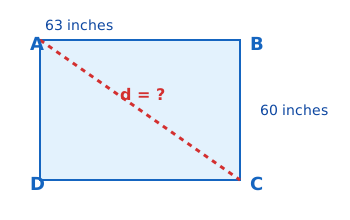
When Liz cuts diagonally from corner A to corner C, she creates two identical right triangles. Each triangle has legs of 60 inches and 63 inches, with the diagonal cut as the hypotenuse.
Solution: Method 1 — Direct Pythagorean Application
Step 1 — Identify the right triangle
The diagonal cut creates a right triangle where the rectangle's length and width become the two legs. We have legs of 60 inches and 63 inches, and we need to find the hypotenuse (the diagonal cut).
Step 2 — Set up the Pythagorean theorem
For any right triangle, a² + b² = c², where c is the hypotenuse. In our case:
d² = 60² + 63²
Step 3 — Calculate the squares
Let's compute each squared term:
63² = 63 × 63 = 3,969
Step 4 — Add the squares
Now we add the results:
Step 5 — Take the square root
To find the diagonal length, we take the square root of both sides:
Solution: Method 2 — Factor Before Computing
Step 1 — Look for common factors
Before squaring, let's see if we can factor out common terms from 60 and 63:
63 = 3 × 21
Step 2 — Factor out the common term
We can factor out 3 from both dimensions:
d² = 3²(20² + 21²)
d² = 9(400 + 441)
d² = 9(841)
Step 3 — Recognize the perfect squares
Notice that 841 = 29², so:
d = 3 × 29 = 87 inches
This method often reveals when the answer will be a clean whole number, as it did here.
Verification
Let's verify our answer by substituting back into the Pythagorean theorem:
7,569 = 3,600 + 3,969
7,569 = 7,569 ✓
Perfect! Our calculation is correct. We can also do a reasonableness check: the diagonal (87 inches) is longer than either individual dimension (60 or 63 inches), which makes geometric sense.
Does This Seem Reasonable?
Let's think about whether 87 inches makes sense for a diagonal:
- Longer than both dimensions: The diagonal (87") is longer than both the length (60") and width (63"), which it must be geometrically.
- Not too much longer: If we were finding the perimeter, we'd add: 60 + 63 = 123 inches. The diagonal being 87 inches (much less than the perimeter) makes sense.
- Clean number result: Getting exactly 87 (no decimals) suggests this problem was designed with a Pythagorean triple in mind—specifically, this is 3 times the (20, 21, 29) triple.
What Trips Students Up
Some students calculate 60 + 63 = 123 inches.
Why this is wrong: This gives the distance if you walked along the edges, not the straight diagonal cut.
Calculating 60² + 63² = 7,569 and stopping there.
Why this is wrong: This gives d², not d. You must take √7,569 = 87 to get the actual length.
Worrying about which dimension is "length" vs "width."
Why this doesn't matter: Addition is commutative: a² + b² = b² + a². The order doesn't affect the final answer.
The Pattern Behind This
For any rectangle with length l and width w, the diagonal length d is:
This formula works because cutting a rectangle corner-to-corner always creates two right triangles, where the rectangle's sides become the legs and the diagonal becomes the hypotenuse.
An interesting note: This problem uses a scaled version of the (20, 21, 29) Pythagorean triple. When you see "nice" dimensions in geometry problems, they're often chosen to produce clean answers using these special number relationships.
Where This Shows Up in Real Life
- Construction: Carpenters use the "3-4-5 rule" (or larger versions) to ensure corners are perfectly square—if the diagonal matches the Pythagorean prediction, the corner is 90 degrees.
- Screen sizes: TV and monitor sizes are measured diagonally. A "27-inch monitor" has a 27-inch diagonal, not 27-inch width or height.
- Navigation: Finding the straight-line distance between two points on a grid-based map uses the same diagonal calculation.
What If?
For a square with side length s, both legs are equal: d² = s² + s² = 2s²
(50√2)² = 2s²
(50√2)² = 50² × (√2)² = 2500 × 2 = 5000
5000 = 2s²s² = 2500s = 50 inches
Check: √(50² + 50²) = √5000 = 50√2 ✓
d² = 120² + 126²
120² = 14,400126² = 15,876
d² = 14,400 + 15,876 = 30,276d = √30,276 = 174 inches
Original diagonal was 87 inches. Doubled would be 2 × 87 = 174 inches
Yes! When you double both dimensions, the diagonal exactly doubles too. This happens because of the scaling properties of the Pythagorean theorem.
65² = 52² + w² where w is the unknown width
4225 = 2704 + w²
w² = 4225 - 2704 = 1521
w = √1521 = 39 inches
Check: √(52² + 39²) = √(2704 + 1521) = √4225 = 65 ✓
The second cut goes from a corner to the midpoint of the opposite 63-inch side. This creates a right triangle with legs of 60 inches (full length) and 31.5 inches (half the width).
d² = 60² + 31.5²
60² = 360031.5² = 992.25
d² = 3600 + 992.25 = 4592.25d = √4592.25 = 67.8 inches
67.8 inches — shorter than the full diagonal because it doesn't go all the way to the far corner.
Frequently Asked Questions
2026-06-07