




Robot Exploration: Solve for Return Times Using Cubic Equations
What This Problem Teaches
- How to solve cubic equations by factoring out common terms
- When a polynomial equals zero, each factor must equal zero
- How to identify and solve quadratic equations within cubic problems
- Physical interpretation of mathematical roots in motion problems
- Recognition that cubic polynomials can have up to three real solutions
Visualizing the Robot's Journey
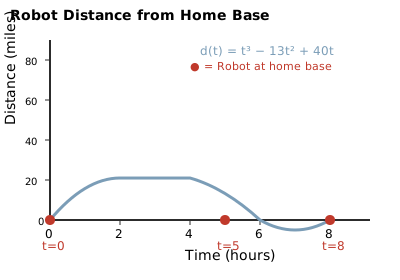
This graph shows the robot's distance from home base over time. The red dots mark when the robot is at home base (distance = 0). Notice how the robot ventures out, returns briefly at t = 5 hours, then ventures out again before returning finally at t = 8 hours.
Solution: Method 1 — Factor and Conquer
The robot returns to its home base when its distance from base equals zero. We need to solve d(t) = 0.
Step 1 — Set up the equation
We need to find all values of t where:
Step 2 — Factor out the common term
Notice that every term contains t as a factor. Factor it out:
This immediately gives us one solution: t = 0 (the robot starts at home base).
Step 3 — Solve the quadratic factor
Now we need to solve t² − 13t + 40 = 0. Let's look for factors of 40 that add to 13:
- 40 = 1 × 40, and 1 + 40 = 41 (too big)
- 40 = 2 × 20, and 2 + 20 = 22 (too big)
- 40 = 4 × 10, and 4 + 10 = 14 (close!)
- 40 = 5 × 8, and 5 + 8 = 13 ✓
So we can factor: t² − 13t + 40 = (t − 5)(t − 8)
Step 4 — Complete the factorization
Step 5 — Find all solutions
For a product to equal zero, at least one factor must be zero:
- t = 0 (robot starts at home)
- t − 5 = 0, so t = 5
- t − 8 = 0, so t = 8
Solution: Method 2 — Using the Quadratic Formula
After factoring out t, we can also solve t² − 13t + 40 = 0 using the quadratic formula as verification.
Step 1 — Apply the quadratic formula
For t² − 13t + 40 = 0, we have a = 1, b = −13, c = 40:
Step 2 — Calculate both solutions
Step 3 — Combine with the factored solution
Including the t = 0 solution from factoring out t, our complete solution set is t = 0, 5, 8.
Verification
Let's verify each solution by substituting back into the original equation:
Check t = 0:
Check t = 5:
Check t = 8:
All three solutions check out perfectly!
Watch Out For These
Some students factor out t but then ignore the solution t = 0, focusing only on the quadratic. Remember: if t is a factor, then t = 0 is automatically a solution.
When looking for factors of 40 that sum to 13, students often try combinations hastily. 40 = 8 × 5, and 8 + 5 = 13. Double-check your factor pairs!
t = 0 means the robot starts at home base, not that it "never left." The robot's journey is: start at home → explore → return at t = 5 → explore again → return at t = 8.
The Pattern Behind This
This problem illustrates a key strategy for cubic equations: always check for common factors first. When every term contains the variable, you can factor it out immediately, reducing a cubic to a quadratic.
This gives you one solution (t = 0) instantly and reduces the problem to solving a quadratic equation. The general pattern is:
- Factor out the greatest common factor
- Solve each factor equal to zero
- Collect all solutions
For motion problems specifically, t = 0 often represents the starting position or initial time, while the other solutions represent specific moments when certain conditions are met.
Real Applications
- Projectile Motion: The height of a thrown ball follows a cubic or quadratic path. Finding when height equals ground level gives you launch and landing times.
- Economics: Profit functions often involve cubic polynomials. Setting profit to zero finds break-even points for a business.
- Engineering: Structural deflection under varying loads can be modeled by cubic equations. Zero deflection points indicate optimal support locations.
What If?
For the robot to be at home base: t³ − 13t² + 40t + 12 = 0
Test t = -1: (-1)³ − 13(-1)² + 40(-1) + 12 = -1 - 13 - 40 + 12 = -42 ≠ 0
Test t = -2: (-2)³ − 13(-2)² + 40(-2) + 12 = -8 - 52 - 80 + 12 = -128 ≠ 0
Test t = -3: (-3)³ − 13(-3)² + 40(-3) + 12 = -27 - 117 - 120 + 12 = -252 ≠ 0
This cubic equation doesn't factor nicely with integer roots. Using numerical methods, we can determine this equation has no positive real solutions.
The robot never returns to home base when starting 12 miles away with this trajectory.
If the robot returns home at t = 1, 3, and 7, then d(t) = (t - 1)(t - 3)(t - 7)
(t - 1)(t - 3) = t² - 3t - t + 3 = t² - 4t + 3
(t² - 4t + 3)(t - 7)= t³ - 7t² - 4t² + 28t + 3t - 21= t³ - 11t² + 31t - 21
Check: d(1) = 1 - 11 + 31 - 21 = 0 ✓d(3) = 27 - 99 + 93 - 21 = 0 ✓d(7) = 343 - 539 + 217 - 21 = 0 ✓
d(t) = t³ - 11t² + 31t - 21
d'(t) = 3t² - 26t + 40
3t² - 26t + 40 = 0
Using the quadratic formula: t = (26 ± √(676 - 480))/6 = (26 ± √196)/6 = (26 ± 14)/6
t = (26 + 14)/6 = 40/6 = 20/3 ≈ 6.67t = (26 - 14)/6 = 12/6 = 2
d(2) = 8 - 52 + 80 = 36 milesd(20/3) = (20/3)³ - 13(20/3)² + 40(20/3) ≈ -37.04 miles (negative means past home)
Maximum distance is 36 miles at t = 2 hours
t³ - 9t² + 20t = t(t² - 9t + 20) = 0
Factor t² - 9t + 20. We need factors of 20 that add to 9:
20 = 4 × 5, and 4 + 5 = 9 ✓
So t² - 9t + 20 = (t - 4)(t - 5)
t(t - 4)(t - 5) = 0
Solutions: t = 0, t = 4, t = 5
Excluding t = 0 (starting time), the robot returns home at:
t = 4 hours and t = 5 hours
Frequently Asked Questions
Factor out the common variable first. For t³ − 13t² + 40t = 0, factor out t to get t(t² − 13t + 40) = 0. This gives you one zero immediately (t = 0) and reduces the problem to solving a quadratic equation for the remaining zeros.
When a robot returns to home base, its distance from base equals zero. In this problem, we need to find all values of t where d(t) = t³ − 13t² + 40t = 0. The solutions t = 0, t = 5, and t = 8 represent the start time and the two return times.
A cubic polynomial can have at most 3 real roots. Here, d(t) = t(t² − 13t + 40) factors completely into real linear factors: t(t − 5)(t − 8). Since we can factor it completely over the real numbers, we get exactly 3 distinct real solutions.
2026-07-28