




Rocket Projectile Motion: Height Above Launch Pad
What You Will Learn
- Finding the vertex of a parabola to determine maximum values in quadratic motion
- Interpreting the physical meaning of each term in a projectile motion equation
- Solving quadratic equations by factoring to find when objects reach ground level
- Distinguishing between mathematical and physical solutions in real-world contexts
- Connecting algebraic techniques to physics concepts like gravity and initial velocity
Visualizing the Rocket's Path
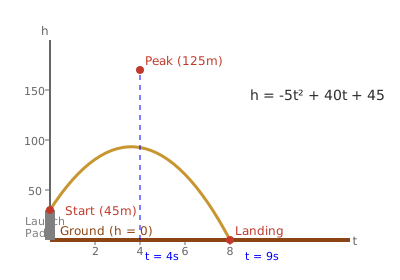
Solution: Method 1 — The Vertex Formula Approach
Since the rocket's height follows a quadratic equation, its path forms a parabola. For any parabola y = ax² + bx + c, the maximum (or minimum) occurs at the vertex. Let's use this to find both answers systematically.
Step 1 — Find when maximum height occurs
For the quadratic h(t) = -5t² + 40t + 45, we have a = -5 and b = 40. The vertex occurs at:
Step 2 — Calculate the maximum height
Substitute t = 4 back into the height equation:
h(4) = -5(16) + 160 + 45
h(4) = -80 + 160 + 45 = 125 meters
Step 3 — Find the flight time by setting height to zero
The rocket lands when its height equals zero. Set the equation equal to zero and solve:
Step 4 — Factor the equation
First, factor out -5 to simplify:
t² - 8t - 9 = 0
Now factor the quadratic expression. We need two numbers that multiply to -9 and add to -8:
Step 5 — Solve for time values
This gives us t = 9 or t = -1. Since negative time doesn't make physical sense (the rocket launches at t = 0), the flight time is 9 seconds.
Solution: Method 2 — Physics-Based Derivative Approach
We can also solve this using calculus, which connects directly to the physics of motion. The derivative of position gives velocity, and at the highest point, velocity equals zero.
Step 1 — Find the velocity function
Take the derivative of the height function:
v(t) = dh/dt = -10t + 40
Step 2 — Set velocity to zero for maximum height
At the peak, the rocket momentarily stops before falling:
10t = 40
t = 4 seconds
Step 3 — Calculate maximum height
Substitute t = 4 into the original height equation:
Step 4 — Find landing time using the quadratic formula
For -5t² + 40t + 45 = 0, using a = -5, b = 40, c = 45:
t = [-40 ± √(1600 + 900)] / (-10)
t = [-40 ± √2500] / (-10)
t = [-40 ± 50] / (-10)
This gives t = (-40 + 50)/(-10) = -1 or t = (-40 - 50)/(-10) = 9. Taking the positive solution, the flight time is 9 seconds.
Verification
Let's verify both answers by checking our work:
Checking maximum height
At t = 4 seconds:
Checking flight time
At t = 9 seconds (landing):
Physical reasonableness check
The rocket starts at 45m, goes up to 125m (gaining 80m), then falls back down. With an initial velocity of 40 m/s upward, this height gain and 9-second total flight time align with what we'd expect under Earth's gravity.
Common Pitfalls
✗ Using only the positive root for maximum height
Students sometimes solve -5t² + 40t + 45 = 125 and get confused by negative time solutions. Remember: for maximum height, use the vertex formula t = -b/(2a), not the roots of the equation.
✗ Forgetting the initial height
A common error is thinking the rocket starts at ground level and reaches only 80m high. The rocket starts at 45m and reaches an additional 80m above that, for a total of 125m above the ground.
✗ Accepting negative time solutions
When solving (t - 9)(t + 1) = 0, both t = 9 and t = -1 are mathematically correct, but only t = 9 makes physical sense. The negative solution would represent a time before launch.
✗ Confusing the coefficients
The equation h = -5t² + 40t + 45 has specific physical meaning: -5 comes from -½g where g = 10 m/s², 40 is the initial velocity, and 45 is the starting height. Mixing these up leads to wrong answers.
The Physics Behind the Math
This problem demonstrates the standard form of projectile motion under constant acceleration. The general equation is:
Where:
h₀ = 45mis the initial heightv₀ = 40 m/sis the initial velocityg = 10 m/s²is gravitational acceleration½g = 5, which explains the -5 coefficient
This gives us h(t) = 45 + 40t - 5t², which matches our equation when rearranged. Every quadratic motion problem follows this same pattern—the maximum occurs at t = v₀/g, and the object returns to its starting height at t = 2v₀/g.
t = 40/10 = 4 seconds, and if launched from ground level, it would land at t = 2(40)/10 = 8 seconds. The extra second comes from starting 45m above ground level.
Real Applications
- Aerospace engineering: Mission planners use these calculations to determine fuel requirements and trajectory windows for rocket launches
- Sports science: Analyzing the trajectory of basketballs, footballs, or javelins to optimize athletic performance
- Safety engineering: Calculating safe distances for fireworks displays and determining where debris might land
- Military ballistics: Predicting artillery shell trajectories and determining optimal firing angles for maximum range
What If? — Try These Variations
Using the vertex formula: t = -b/(2a) = -60/(2 × -5) = 60/10 = 6 seconds
h(6) = -5(36) + 60(6) + 45 = -180 + 360 + 45 = 225 meters
Set -5t² + 60t + 45 = 0, factor: -5(t² - 12t - 9) = 0
Using the quadratic formula: t = [12 ± √(144 + 36)]/2 = [12 ± √180]/2 = [12 ± 6√5]/2
Taking the positive root: t = 6 + 3√5 ≈ 12.7 seconds
Check: h(12.7) ≈ -5(161.3) + 60(12.7) + 45 ≈ -807 + 762 + 45 = 0 ✓
Answer: Maximum height is 225m at t = 6s, flight time is approximately 12.7 seconds.
Using the vertex formula: t = -40/(2 × -5) = 40/10 = 4 seconds
h(4) = -5(16) + 40(4) = -80 + 160 = 80 meters
Set -5t² + 40t = 0, factor: t(-5t + 40) = 0
t = 0 (launch) or -5t + 40 = 0, so t = 8 seconds
Check: h(8) = -5(64) + 40(8) = -320 + 320 = 0 ✓
Answer: Maximum height is 80m at t = 4s, flight time is 8 seconds.
At maximum height, the vertex formula gives: t = -v/(2 × -5) = v/10
At the vertex time, height equals 180m: h(v/10) = 180
-5(v/10)² + v(v/10) + 45 = 180
-5(v²/100) + v²/10 + 45 = 180
-v²/20 + v²/10 + 45 = 180
v²/20 + 45 = 180
v²/20 = 135
v² = 2700
v = √2700 = 30√3 ≈ 52 m/s
Check: At t = 52/10 = 5.2s, h = -5(27) + 52(5.2) + 45 = -135 + 270 + 45 = 180m ✓
Answer: The initial velocity must have been approximately 52 m/s.
We need to solve: -5t² + 40t + 45 = 105
-5t² + 40t + 45 - 105 = 0
-5t² + 40t - 60 = 0
Divide by -5: t² - 8t + 12 = 0
We need two numbers that multiply to 12 and add to -8: -6 and -2
(t - 6)(t - 2) = 0
t = 6 or t = 2
Both are positive and physically meaningful.
Check: h(2) = -5(4) + 40(2) + 45 = -20 + 80 + 45 = 105 ✓
Check: h(6) = -5(36) + 40(6) + 45 = -180 + 240 + 45 = 105 ✓
The rocket passes through 105m twice: once going up at t = 2s, once coming down at t = 6s.
Answer: The rocket is at 105m above ground at t = 2 seconds (ascending) and t = 6 seconds (descending).
Frequently Asked Questions
2026-09-03