




Finding Maximum Height in Projectile Motion
What This Problem Teaches
- Finding the vertex of a quadratic function using the formula t = -b/(2a)
- Interpreting the physical meaning of quadratic function parameters in projectile motion
- Understanding that maximum height occurs when velocity equals zero
- Connecting algebraic vertex calculations to real-world physics principles
- Recognizing the standard form of kinematic equations for vertical motion under gravity
Visualizing the Problem
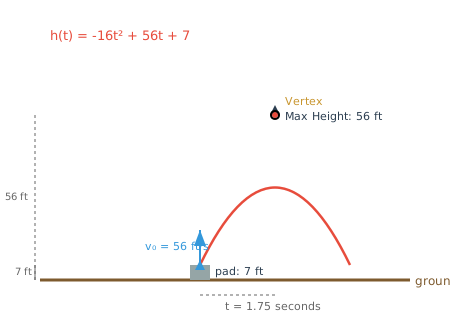
Solution: Method 1 — The Vertex Formula Approach
The height function h(t) = -16t² + 56t + 7 is a quadratic function that graphs as a downward-opening parabola. The maximum height occurs at the vertex of this parabola.
Step 1 — Identify the coefficients
In the standard form h(t) = at² + bt + c, we have:
Step 2 — Apply the vertex formula
For any quadratic function f(t) = at² + bt + c, the vertex occurs at:
Substituting our values:
Step 3 — Calculate the maximum height
Now substitute t = 1.75 back into the original height function:
The maximum height is 56 feet
Solution: Method 2 — The Calculus Approach
At the maximum height, the rocket's velocity is momentarily zero as it changes from moving upward to moving downward. We can find this point by taking the derivative and setting it equal to zero.
Step 1 — Find the velocity function
The velocity is the derivative of the height function:
Step 2 — Set velocity equal to zero
At maximum height, the velocity is zero:
Step 3 — Calculate the height at t = 1.75
Substitute back into the position function:
This confirms our answer: the maximum occurs at 1.75 seconds with a height of 56 feet.
Verification
Let's verify our answer using the derivative method. We found that the maximum occurs at t = 1.75 seconds. At this time:
Check 1 — Velocity is zero
Check 2 — Height calculation is correct
Check 3 — This is indeed a maximum (not a minimum)
Since the coefficient of t² is negative (-16), the parabola opens downward, confirming this is a maximum point.
Common Pitfalls
Using t = b/(2a) instead of t = -b/(2a). This would give t = 56/(-32) = -1.75, which is negative and doesn't make physical sense for time after launch.
Some students use a = 16 instead of a = -16, forgetting that gravity acts downward. This would suggest the parabola opens upward, which contradicts physics.
Finding t = 1.75 and incorrectly thinking this is the maximum height. The time when maximum height occurs is 1.75 seconds, but the maximum height itself is h(1.75) = 56 feet.
When calculating h(1.75), getting confused with signs: -16(3.0625) = -49, not +49. The calculation should be -49 + 98 + 7 = 56.
The Physics Behind the Math
The equation h(t) = -16t² + 56t + 7 comes directly from the kinematic equation for motion under constant acceleration:
Where:
- h₀ = 7 feet: initial height (launch pad height)
- v₀ = 56 ft/s: initial velocity (upward)
- a = -32 ft/s²: acceleration due to gravity (downward)
- ½a = ½(-32) = -16: this gives us the coefficient of t²
Why -16 and not -32? The kinematic equation uses ½at², so with gravity being -32 ft/s², we get ½(-32) = -16 as the coefficient of t². This is why projectile motion problems in feet commonly feature the -16t² term.
At the maximum height, all the initial kinetic energy has been converted to potential energy, and the velocity is momentarily zero before the rocket begins its descent.
Reality Check
Let's verify our answer makes physical sense:
Time to maximum height: 1.75 seconds
Starting with an upward velocity of 56 ft/s, gravity decelerates the rocket at 32 ft/s². Time to stop: 56 ÷ 32 = 1.75 seconds. ✓
Maximum height: 56 feet
The rocket starts 7 feet up and travels an additional 49 feet upward (the height gained from initial velocity). We can verify this using the formula for distance under constant deceleration:
Symmetry check
In projectile motion, the time to go up equals the time to come back down to the same height. Since it takes 1.75 seconds to reach maximum height, it should take another 1.75 seconds to return to the launch height of 7 feet, for a total of 3.5 seconds in the air before landing.
Four "What-If?" Problems
The vertex formula still applies: t = -b/(2a) = -56/(2×(-16)) = 1.75 seconds
Note: The time to maximum height doesn't change when we only change the starting height!
h(1.75) = -16(1.75)² + 56(1.75) + 15
h(1.75) = -49 + 98 + 15 = 64 feet
The rocket gains the same 49 feet from its initial velocity, but now starts 8 feet higher: 15 + 49 = 64 feet ✓
Maximum height: 64 feet at t = 1.75 seconds
We know the maximum occurs at t = 2.25, so: 2.25 = -v₀/(2×(-16)) = v₀/32
Solving: v₀ = 32 × 2.25 = 72 ft/s
With v₀ = 72, check if h(2.25) = 88:
h(2.25) = -16(2.25)² + 72(2.25) + 7
h(2.25) = -16(5.0625) + 162 + 7 = -81 + 162 + 7 = 88 ✓
Initial velocity: 72 ft/s
0 = -16t² + 56t + 7
Rearranging: 16t² - 56t - 7 = 0
t = [56 ± √(56² - 4(16)(-7))] / (2×16)
t = [56 ± √(3136 + 448)] / 32 = [56 ± √3584] / 32
t = [56 ± 59.87] / 32
t = (56 + 59.87)/32 ≈ 115.87/32 ≈ 3.62 seconds
The negative solution represents a time before launch, so we reject it.
The rocket hits the ground after approximately 3.62 seconds
From our original problem: t = 1.75 s, h_max = 56 feet
t = -64/(2×(-16)) = 64/32 = 2 seconds
h₂(2) = -16(2)² + 64(2) + 0
h₂(2) = -64 + 128 = 64 feet
Rocket A: 56 feet, Rocket B: 64 feet
Difference: 64 - 56 = 8 feet
Rocket B reaches a greater maximum height by 8 feet (64 ft vs 56 ft)
Frequently Asked Questions
2026-09-17