




Round-Trip Problems: Same Distance, Different Speeds
What This Problem Teaches
- How to use the distance formula (distance = speed × time) when the same distance is traveled at different speeds
- Setting up equations based on time relationships between two parts of a journey
- Recognizing that round-trip problems rely on the fact that both legs cover identical distances
- Translating word phrases like "takes 1 hour longer" into algebraic expressions
- Solving linear equations that arise from real-world motion scenarios
Picture This
Let's visualize what's happening in this round-trip journey:
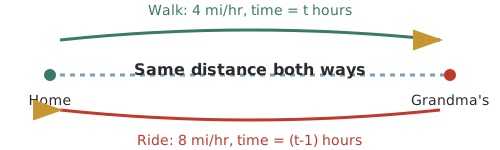
The key insight is that both legs of the journey cover exactly the same distance, but at different speeds and for different amounts of time. The walking leg takes 1 hour longer than the riding leg.
Solution: Method 1 — Time Relationship Approach
Since we're asked for the walking time, let's make that our variable and work from there.
Step 1 — Define the variable
Let t = time to walk to Grandma's house (in hours). This is what we want to find.
Step 2 — Express the riding time
We're told "walking takes 1 hour longer than riding." If walking takes t hours, then riding takes (t - 1) hours.
Step 3 — Set up the distance equation
Both legs cover the same distance. Using distance = speed × time:
4 × t = 8 × (t - 1)
Step 4 — Solve the equation
Expand the right side:
4t = 8t - 8
Collect like terms:
-4t = -8
t = 2
Therefore, it took 2 hours to walk to Grandma's house.
Solution: Method 2 — Distance as the Primary Variable
Instead of starting with time, let's work with the distance and see how the times relate.
Step 1 — Define the distance variable
Let d = distance to Grandma's house (in miles).
Step 2 — Express both times in terms of distance
Using time = distance ÷ speed:
- Walking time =
d ÷ 4hours - Riding time =
d ÷ 8hours
Step 3 — Set up the time relationship equation
Walking takes 1 hour longer than riding:
d/4 = d/8 + 1
Step 4 — Solve for the distance
Multiply everything by 8 to clear fractions:
2d = d + 8
d = 8
Step 5 — Find the walking time
Now that we know the distance is 8 miles:
Verification
Let's check our answer by substituting back into the original conditions.
• Walking time: 2 hours
• Riding time: 2 - 1 = 1 hour
• Time difference: 2 - 1 = 1 hour ✓
• Walking distance: 4 mi/hr × 2 hr = 8 miles
• Riding distance: 8 mi/hr × 1 hr = 8 miles ✓
• Both distances are equal, as required.
Our answer satisfies both conditions: the walking takes exactly 1 hour longer than the riding, and both legs cover the same 8-mile distance.
Watch Out For These
Some students think: "The average speed is (4 + 8) ÷ 2 = 6 mi/hr, so I can work with that." This is wrong because time is not evenly split between the two speeds. The slower leg takes longer, so you can't just average the rates.
Writing "riding time = walking time + 1" instead of "walking time = riding time + 1." Since walking is slower, it must take longer. Always double-check that your equation reflects the logical relationship.
Writing "8t = 4(t - 1)" instead of "4t = 8(t - 1)." Remember: distance = speed × time. The walking equation is 4 × time, not 8 × time.
The General Pattern
This problem belongs to a family called "round-trip with different rates." The general structure is:
and time₁ = time₂ + k (time difference of k)
then speed₁ × (time₂ + k) = speed₂ × time₂
Solving this general equation:
speed₁ × k = (speed₂ - speed₁) × time₂
time₂ = (speed₁ × k) ÷ (speed₂ - speed₁)
In our case: speed₁ = 4, speed₂ = 8, k = 1, so time₂ = (4 × 1) ÷ (8 - 4) = 1 hour for riding, and time₁ = 2 hours for walking.
How to Spot This Problem Type
Round-trip problems with different speeds typically include these telltale phrases:
- "same route" or "same path" — signals that both distances are equal
- "takes __ longer than" or "takes __ more time" — gives you the time relationship
- Two different speeds mentioned for the same journey
- "round trip" or "there and back" — confirms you're dealing with equal distances
Variations you might see include walking vs. biking, driving vs. flying, upstream vs. downstream, or any scenario where the same distance is covered at two different rates.
Where This Shows Up in Real Life
This type of calculation appears in several practical contexts:
- Commute planning: Walking to the bus stop vs. getting a ride back, with different time constraints for each direction.
- Delivery logistics: Trucks traveling empty (faster) vs. loaded (slower) on return trips, with fuel and time costs depending on the leg durations.
- Exercise planning: Running uphill vs. jogging back down, where the terrain creates natural speed differences but the distance remains constant.
What If?
Let t = time to walk (in hours).
Since walking takes 3 hours longer than riding: riding time = t - 3 hours.
Walking distance = Riding distance3t = 12(t - 3)
3t = 12t - 36-9t = -36t = 4
Walking: 4 hours, distance = 3 × 4 = 12 miles
Riding: 1 hour, distance = 12 × 1 = 12 miles ✓
Time difference: 4 - 1 = 3 hours ✓
Answer: 4 hours
Distance = 10 miles, speed = 5 mi/hr
Walking time = 10 ÷ 5 = 2 hours
Walking takes 1.5 hours longer than riding
Riding time = 2 - 1.5 = 0.5 hours
Speed = distance ÷ time
Riding speed = 10 ÷ 0.5 = 20 mi/hr
Walking: 2 hours at 5 mi/hr = 10 miles ✓
Riding: 0.5 hours at 20 mi/hr = 10 miles ✓
Time difference: 2 - 0.5 = 1.5 hours ✓
Answer: 20 mi/hr
Let t = walking time, so riding time = t - 2
4t = 10(t - 2)4t = 10t - 20-6t = -20t = 20/6 = 10/3 hours
Walking time: 10/3 hours
Riding time: 10/3 - 2 = 10/3 - 6/3 = 4/3 hours
Total = walking + riding = 10/3 + 4/3 = 14/3 hours
14/3 = 4⅔ hours = 4 hours 40 minutes
Walking: (10/3) × 4 = 40/3 miles
Riding: (4/3) × 10 = 40/3 miles ✓
Time difference: 10/3 - 4/3 = 6/3 = 2 hours ✓
Answer: 4⅔ hours (4 hours 40 minutes)
Let d = distance to Grandma's house
Walking time = d/3, riding time = d/9
Total time = walking + visit + riding = 6 hoursd/3 + 1 + d/9 = 6
Subtract the 1-hour visit: d/3 + d/9 = 5
Common denominator: 3d/9 + d/9 = 54d/9 = 5d = 45/4 = 11.25 miles
Walking time = distance ÷ speed = 11.25 ÷ 3 = 3.75 hours
3.75 hours = 3 hours 45 minutes
Walking: 3.75 hours
Visit: 1 hour
Riding: 11.25 ÷ 9 = 1.25 hours
Total: 3.75 + 1 + 1.25 = 6 hours ✓
Answer: 3.75 hours (3 hours 45 minutes)
Frequently Asked Questions
2026-09-02