




Roulette Probability: Understanding Independent Events
The game of roulette involves spinning a wheel with 38 slots: 18 red, 18 black, and 2 green. A ball is spun onto the wheel and will eventually land in a slot, where each slot has an equal chance of capturing the ball. You watch a roulette wheel spin 10 consecutive times and the ball lands on a red slot each time. What is the probability that the ball will land on a red slot on the next spin?
What's Really Going On Here
- Independent events — recognizing when past outcomes don't affect future probabilities
- Gambler's fallacy — understanding why "hot streaks" and "due outcomes" are statistical myths
- Basic probability calculation — applying favorable outcomes divided by total outcomes
- Critical thinking — distinguishing between psychological intuition and mathematical reality
- Real-world application — applying probability concepts to actual casino games and risk assessment
Picture This
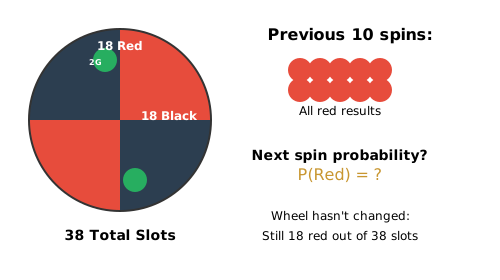
Solution: The Independence Principle
Step 1 — Identify the wheel composition
The roulette wheel has a fixed structure that doesn't change between spins:
Black slots: 18
Green slots: 2
Total slots: 38
Step 2 — Recognize that spins are independent events
This is the crucial insight: each spin is an independent event. The wheel's physical composition remains identical regardless of previous outcomes. The ball has no memory of where it landed before.
Step 3 — Apply the basic probability formula
For any single spin, the probability of landing on red equals the number of red slots divided by the total number of slots:
P(Red) = 18/38
Step 4 — Simplify the fraction
We can reduce this fraction by dividing both numerator and denominator by their greatest common divisor, which is 2:
Step 5 — Confirm independence applies
The ten consecutive red outcomes are remarkable (probability of about 1 in 1,628), but they don't alter the physical wheel. The next spin has exactly the same probability as any other single spin.
Solution: Method 2 — Conditional Probability Framework
Step 1 — Set up conditional probability notation
Let's formally express what we're looking for using conditional probability notation. We want P(Red on spin 11 | Ten consecutive reds), where the vertical bar means "given that."
Step 2 — Determine if the condition affects the outcome
For events to be independent, the condition (past results) must not influence the probability of future results. In roulette, the wheel mechanism is identical for every spin.
Step 3 — Apply the independence property
When events are independent, conditional probability equals unconditional probability:
= 18/38 = 9/19
Step 4 — Verify with the multiplication rule
If we calculated the probability of eleven consecutive reds, it would be (9/19)¹¹. The fact that ten already occurred doesn't change the probability of the eleventh—it just makes the overall sequence less likely.
Verification
Let's verify our answer by checking that it matches the fundamental definition of probability for this wheel:
• Red slots that could capture the ball: 18
• Total slots that could capture the ball: 38
• Probability = 18/38 = 9/19 ✓
Independence check: The probability is identical to what we'd calculate for the very first spin of a brand-new wheel. This confirms that past results don't matter.
Range check: Our answer of 9/19 ≈ 0.474 is reasonable—slightly less than 50% because of the two green slots that reduce the red probability.
The Gambler's Fallacy Exposed
✗ Common mistake: "After 10 reds, black is due to appear. The probability of red must be lower now."
Why it's wrong: This assumes the wheel has some mechanism to "remember" past spins and "correct" for them. Physical roulette wheels have no such mechanism.
✗ Common mistake: "Red is hot! It's more likely to continue."
Why it's wrong: This is the opposite error but equally false. Past outcomes don't create momentum for future outcomes in independent events.
✗ Common mistake: "The probability is 18/28 because we can ignore the green slots."
Why it's wrong: All 38 slots are possible outcomes. The green slots affect the probability calculation even though we're not asking about them specifically.
The gambler's fallacy is one of the most persistent cognitive biases in probability. It costs real money in casinos and affects decision-making in many other contexts where people assume that random events "balance out" in the short term.
Does This Seem Reasonable?
Let's do a sanity check on our answer of 9/19 ≈ 47.4%:
| Scenario | Probability of Red | Reasoning |
|---|---|---|
| If wheel had only red and black (36 slots) | 18/36 = 50% | Equal red and black slots |
| Actual wheel with green slots | 18/38 ≈ 47.4% | Green slots reduce red probability slightly |
| After 10 consecutive reds | 18/38 ≈ 47.4% | Wheel composition unchanged |
The answer makes perfect sense: slightly less than 50% because the green slots take up some probability space, but exactly the same as any other single spin because the wheel hasn't changed.
Historical perspective: While 10 consecutive reds is unusual (probability ≈ 1/1,628), it's not impossible. Over millions of spins in casinos worldwide, such streaks occur regularly and don't indicate anything special about the next spin.
The Broader Principle
This problem illustrates the fundamental concept of independence in probability:
Events A and B are independent if P(A | B) = P(A)
For roulette:
P(Red on next spin | Previous results) = P(Red on any spin) = 9/19
The key insight is recognizing when past outcomes can and cannot influence future probabilities:
- Independent: Coin flips, dice rolls, roulette spins, lottery drawings
- Dependent: Drawing cards without replacement, changing weather patterns, stock prices
The mathematical structure remains the same across all independent trials: the probability of any specific outcome on trial n+1 equals the probability on trial 1, regardless of what happened in trials 1 through n.
Why This Matters
Understanding independence isn't just academic—it has real consequences:
Casino gaming: Casinos profit from gamblers who fall for the gambler's fallacy, betting more heavily when they think outcomes are "due." The house edge remains constant regardless of recent results.
Medical testing: When diagnostic tests are independent, multiple tests don't influence each other's accuracy. A false positive on one test doesn't make another false positive more or less likely.
Quality control: In manufacturing, if defects occur independently, past quality doesn't predict future quality without examining the underlying process.
What If?
European wheel: 18 red, 18 black, 1 green = 37 total slots
Past spins don't change the wheel's physical structure
P(Red) = 18/37
18/37 ≈ 0.486 = 48.6%
Answer: 18/37 or approximately 48.6%
Started with 38 balls: 18 red, 18 black, 2 green
After removing 10 red balls: 28 balls remain
Red remaining: 18 - 10 = 8
Black remaining: 18 (unchanged)
Green remaining: 2 (unchanged)
Total remaining: 8 + 18 + 2 = 28
P(Red) = 8/28 = 2/7
2/7 ≈ 0.286 = 28.6%
Answer: 2/7 or approximately 28.6%
P(Black) = 18/38 = 9/19
Each spin is independent, so we multiply probabilities
P(Black then Black) = (9/19) × (9/19) = 81/361
81/361 ≈ 0.224 = 22.4%
Answer: 81/361 or approximately 22.4%
We need P(10 consecutive reds) > 0.5
This means (r/38)^10 > 0.5, where r = number of red slots
r/38 > (0.5)^(1/10)
(0.5)^(1/10) ≈ 0.9331
r > 38 × 0.9331 ≈ 35.46
Since r must be a whole number, we need at least 36 red slots
With 36 red slots: (36/38)^10 ≈ 0.513 > 0.5 ✓
Answer: At least 36 red slots
Frequently Asked Questions
2026-09-03