




System of Equations: Finding Unit Prices
What This Problem Teaches
- Setting up a system of linear equations from real-world scenarios
- Choosing between elimination and substitution methods strategically
- Translating word problems into mathematical variables and constraints
- Verifying solutions by substituting back into original contexts
- Recognizing when unit rates are the key unknowns in a mixture-type problem
Visualizing the Problem
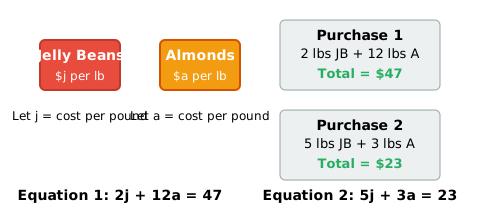
Let's organize what we know about each purchase scenario:
Solution: Method 1 — The Elimination Strategy
The most efficient approach is to use elimination, since we can easily create matching coefficients for one of the variables.
Step 1 — Define variables and set up equations
Let j = cost per pound of jelly beans (in dollars) and a = cost per pound of almonds (in dollars).
From the given information:
5j + 3a = 23 (Equation 2)
Step 2 — Choose elimination strategy
Notice that the coefficients of a are 12 and 3. Since 12 = 4 × 3, we can multiply Equation 2 by 4 to create matching coefficients for a.
Step 3 — Multiply to create matching coefficients
Multiply Equation 2 by 4:
20j + 12a = 92 (Equation 3)
Step 4 — Subtract to eliminate variable a
Subtract Equation 1 from Equation 3:
20j + 12a - 2j - 12a = 45
18j = 45
j = 45/18 = 2.5
Step 5 — Solve for the other variable
Substitute j = 2.5 into Equation 1:
5 + 12a = 47
12a = 42
a = 42/12 = 3.5
Solution: Method 2 — The Substitution Approach
Alternatively, we can solve one equation for a variable and substitute into the other.
Step 1 — Solve Equation 2 for j
From 5j + 3a = 23:
j = (23 - 3a)/5
Step 2 — Substitute into Equation 1
Replace j in 2j + 12a = 47:
(46 - 6a)/5 + 12a = 47
Step 3 — Clear the fraction
Multiply everything by 5:
46 + 54a = 235
54a = 189
a = 189/54 = 3.5
Step 4 — Find j by substitution
Substitute a = 3.5 back:
Verification
Let's check our answer by substituting back into both original purchase scenarios:
Check Purchase 1
2 pounds jelly beans + 12 pounds almonds:
Check Purchase 2
5 pounds jelly beans + 3 pounds almonds:
Both calculations match the given totals, confirming our solution is correct.
Watch Out For These
Setting j = almonds and a = jelly beans, then forgetting which is which when writing the final answer. Always define your variables clearly at the start and double-check your conclusion.
Getting the wrong multiple when scaling equations. If you multiply
5j + 3a = 23 by 4, you get 20j + 12a = 92, not 20j + 12a = 23. The right side must be multiplied too.
Finding that
j = 2.5 and stopping there. The problem asks for both unit prices, so you must also find the value of a.
Stating the answer as "jelly beans cost 2.5" without specifying dollars per pound. Always include units in context problems.
The Pattern Behind This
This is a classic unit rate system, where unknown rates (prices per unit) are the variables. The general structure is:
a₂x + b₂y = c₂
where x and y are unit rates, the coefficients a and b are quantities purchased, and c values are total costs.
The key insight is recognizing when elimination will be cleaner than substitution. Look for coefficients that are multiples of each other—here, 12 and 3 for the almond coefficients made elimination the natural choice.
This same mathematical structure appears in:
- Ticket sales problems (adult vs. child ticket prices)
- Mixture problems (cost per ounce of different ingredients)
- Production problems (cost per hour for different types of labor)
Real Applications
Beyond grocery store scenarios, this type of calculation is essential in:
Business cost analysis: Determining unit costs for raw materials when you only have data from mixed purchases with different suppliers.
Restaurant management: Calculating ingredient costs per pound when your invoices show mixed orders (like "5 lbs flour + 2 lbs sugar = $18").
Manufacturing: Finding hourly rates for different skill levels when payroll data combines multiple worker types on the same projects.
What If?
Let j = cost per pound of jelly beans, a = cost per pound of almonds.
2j + 12a = 23 (Equation 1)
5j + 3a = 47 (Equation 2)
Multiply Equation 2 by 4: 20j + 12a = 188
(20j + 12a) - (2j + 12a) = 188 - 23
18j = 165
j = 165/18 = 9.17 (approximately)
Substitute into Equation 1: 2(9.17) + 12a = 23
18.34 + 12a = 23
a = 4.66/12 = 0.39 (approximately)
Check: 2(9.17) + 12(0.39) = 18.34 + 4.66 = 23 ✓
Answer: Jelly beans $9.17/lb, almonds $0.39/lb
Let j = jelly beans, a = almonds, c = cashews (all $/lb):
2j + 12a + c = 50 (Equation 1)
5j + 3a + c = 26 (Equation 2)
j + a + c = 9 (Equation 3)
Subtract Equation 2 from Equation 1:
(2j + 12a + c) - (5j + 3a + c) = 50 - 26
-3j + 9a = 24
-j + 3a = 8 (Equation 4)
Subtract Equation 3 from Equation 2:
(5j + 3a + c) - (j + a + c) = 26 - 9
4j + 2a = 17 (Equation 5)
From Equation 4: j = 3a - 8
Substitute into Equation 5: 4(3a - 8) + 2a = 17
12a - 32 + 2a = 17
14a = 49, so a = 3.5
Then j = 3(3.5) - 8 = 2.5
From Equation 3: c = 9 - j - a = 9 - 2.5 - 3.5 = 3
Answer: Jelly beans $2.50/lb, almonds $3.50/lb, cashews $3.00/lb
Let j = pounds of jelly beans, a = pounds of almonds
Budget constraint: 2.50j + 3.50a = 30
Ratio constraint: a = 2j (twice as many almonds)
Replace a with 2j in the budget equation:
2.50j + 3.50(2j) = 30
2.50j + 7j = 30
9.5j = 30
j = 30/9.5 = 60/19 ≈ 3.16 pounds
a = 2j = 2(60/19) = 120/19 ≈ 6.32 pounds
Check: 2.50(60/19) + 3.50(120/19) = 150/19 + 420/19 = 570/19 = 30 ✓
Answer: 3.16 lbs jelly beans, 6.32 lbs almonds
Let j = pounds of jelly beans, a = pounds of almonds
Total cost: 2.50j + 3.50a = 37
Quantity relationship: a = j + 4 (4 more almonds)
Replace a in the cost equation:
2.50j + 3.50(j + 4) = 37
2.50j + 3.50j + 14 = 37
6j = 23
j = 23/6 ≈ 3.83 pounds of jelly beans
a = j + 4 = 23/6 + 4 = 47/6 ≈ 7.83 pounds of almonds
Check: 2.50(23/6) + 3.50(47/6) = 57.5/6 + 164.5/6 = 222/6 = 37 ✓
Answer: 3.83 lbs jelly beans, 7.83 lbs almonds
Frequently Asked Questions
2026-10-16