




Table Seating: Solving a System of Equations
What This Looks Like
What You Will Learn
- How to translate a word problem into a system of linear equations
- Identifying count constraints versus value constraints in real-world scenarios
- Using the elimination method to solve systems efficiently
- Verifying solutions by substituting back into original equations
- Recognizing when a problem has exactly one solution and why
Solution: Method 1 — The Elimination Approach
Step 1 — Define variables and identify constraints
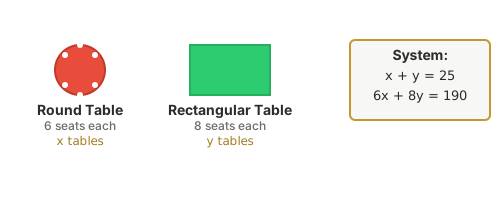
Let x = number of round tables and y = number of rectangular tables. We have two pieces of information to work with: the total number of tables (25) and the total number of seats (190).
Step 2 — Write the system of equations
The first constraint is about counting tables: x + y = 25
The second constraint is about counting seats: round tables contribute 6 seats each, rectangular tables contribute 8 seats each, for a total of 190 seats: 6x + 8y = 190
x + y = 25
6x + 8y = 190
Step 3 — Use elimination to remove one variable
To eliminate x, multiply the first equation by -6:
-6x - 6y = -150
Step 4 — Add the equations to eliminate x
Now add this modified equation to the second original equation:
6x + 8y = 190
________________
0x + 2y = 40
2y = 40
y = 20
Step 5 — Find the remaining variable
Substitute y = 20 back into the first equation:
x = 5
Solution: Method 2 — Substitution Strategy
Step 1 — Solve the simpler equation for one variable
From the first equation x + y = 25, we can express x in terms of y:
Step 2 — Substitute into the second equation
Replace x in the second equation:
150 - 6y + 8y = 190
150 + 2y = 190
2y = 40
y = 20
Step 3 — Find the first variable
Use y = 20 to find x:
Verification
Let's check our solution by substituting x = 5 and y = 20 back into both original equations:
Second equation: 6x + 8y = 6(5) + 8(20) = 30 + 160 = 190 ✓
Both equations are satisfied, confirming our solution is correct.
Does This Seem Reasonable?
Let's think about whether 5 round tables and 20 rectangular tables makes sense. The rectangular tables have more seats (8 vs 6), so if we want to maximize seating with a fixed number of tables, we'd expect more rectangular tables than round ones. Indeed, we found 20 rectangular tables versus only 5 round tables.
As a boundary check: if all 25 tables were round, we'd have 25 × 6 = 150 seats (too few). If all were rectangular, we'd have 25 × 8 = 200 seats (too many). Our answer of 190 seats falls between these extremes, which makes sense.
Common Pitfalls
6x + 8y = 25 and x + y = 190This reverses which equation represents counting tables versus counting seats. Always match the equation structure to what you're counting: simple addition for counting objects, weighted addition for counting values or capacities.
To eliminate
x, you need the coefficients of x to be opposites. Since the coefficients are 1 and 6, multiply the first equation by -6, not the second equation by -1.
Always substitute your answer back into both original equations. If either equation isn't satisfied, you made an error somewhere.
The Pattern Behind This
This is a classic "mixture" or "constraint satisfaction" problem. The general pattern is:
Value equation: (value₁)x + (value₂)y = total value
This pattern appears in many contexts: coin problems (pennies and dimes), ticket sales (adult and child tickets), and resource allocation (workers with different productivity rates). The mathematical structure is always the same: two unknowns, two linear constraints, yielding exactly one solution at their intersection point.
Real Applications
Event Planning: Restaurants and venues use this calculation to optimize table arrangements for different party sizes and revenue targets.
Manufacturing: Production managers solve similar systems when allocating resources between different product lines with varying capacity requirements.
Transportation: Airlines and buses mix vehicle types (small and large capacity) to meet passenger demand while minimizing fleet size.
What If?
The system becomes: x + y = 25 and 6x + 8y = 180
Multiply first equation by -6: -6x - 6y = -150
-6x - 6y + 6x + 8y = -150 + 180, so 2y = 30 and y = 15
x + 15 = 25, so x = 10
Check: 10 + 15 = 25 ✓ and 6(10) + 8(15) = 60 + 120 = 180 ✓
Answer: 10 round tables and 15 rectangular tables
With 8 round tables and 24 total tables: 8 + y = 24, so y = 16
Check: 6(8) + 8(16) = 48 + 128 = 176 ✓
Answer: 16 rectangular tables
Let r = round tables, q = square tables, t = rectangular tables. Given: r = 2q
Tables: r + q + t = 30
Seats: 6r + 4q + 8t = 200
2q + q + t = 30 → 3q + t = 30 → t = 30 - 3q
6(2q) + 4q + 8(30 - 3q) = 20012q + 4q + 240 - 24q = 200-8q = -40 → q = 5
r = 2(5) = 10 and t = 30 - 3(5) = 15
Tables: 10 + 5 + 15 = 30 ✓
Seats: 6(10) + 4(5) + 8(15) = 60 + 20 + 120 = 200 ✓
Answer: 10 round, 5 square, 15 rectangular tables
Constraints: x ≥ 8, y ≥ 12, and x + y = 25
From x + y = 25 and y ≥ 12: x ≤ 13
From x ≥ 8: the range is 8 ≤ x ≤ 13
Total seats = 6x + 8y = 6x + 8(25 - x) = 6x + 200 - 8x = 200 - 2x
Since seats = 200 - 2x, seats decrease as x increases.
Maximum seats: x = 8 → 200 - 2(8) = 184 seats
Minimum seats: x = 13 → 200 - 2(13) = 174 seats
Max: 8 round + 17 rectangular = 25 tables, 48 + 136 = 184 seats ✓
Min: 13 round + 12 rectangular = 25 tables, 78 + 96 = 174 seats ✓
Answer: Minimum 174 seats, Maximum 184 seats
Frequently Asked Questions
2026-08-25