



Three-Solution Mixture: Acid Concentration
What This Problem Teaches
- Setting up systems of equations with three unknowns and a constraint relationship
- Converting percentage concentrations to pure ingredient amounts
- Using substitution to reduce complex systems to simpler forms
- Interpreting constraint language ("2 times as much") in mathematical terms
- Verifying solutions by checking both volume and concentration requirements
Picture This
Solution: Method 1 — The Three-Variable Setup
Step 1 — Define variables with the constraint
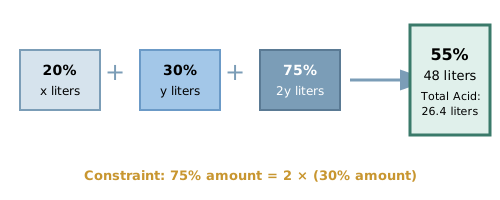
Let x = liters of 20% solution and y = liters of 30% solution. Since we use 2 times as much 75% solution as 30% solution, we'll use 2y liters of 75% solution.
Step 2 — Set up the volume equation
The total volume must equal 48 liters:
x + 3y = 48
Step 3 — Calculate the required acid content
A 55% acid solution of 48 liters contains:
Step 4 — Set up the acid content equation
The pure acid from each solution must sum to 26.4 liters:
0.20x + 0.30y + 1.50y = 26.4
0.20x + 1.80y = 26.4
Step 5 — Solve using substitution
From the volume equation: x = 48 - 3y
Substitute into the acid equation:
9.6 - 0.60y + 1.80y = 26.4
9.6 + 1.20y = 26.4
1.20y = 16.8
y = 14
Step 6 — Find the remaining amounts
Now we can find x and the amount of 75% solution:
Amount of 75% solution = 2y = 2(14) = 28
Solution: Method 2 — Systematic Table Approach
Step 1 — Organize the information in a table
Let's use the constraint to express all amounts in terms of one variable. Let y = liters of 30% solution.
| Solution Type | Concentration | Volume (L) | Pure Acid (L) |
|---|---|---|---|
| 20% acid | 0.20 | x | 0.20x |
| 30% acid | 0.30 | y | 0.30y |
| 75% acid | 0.75 | 2y | 1.50y |
| Final mixture | 0.55 | 48 | 26.4 |
Step 2 — Express total volume in terms of y
From the volume constraint: x + y + 2y = 48, so x = 48 - 3y
Step 3 — Write the acid balance equation
Total pure acid equals sum of acid from each component:
0.20(48 - 3y) + 1.80y = 26.4
9.6 - 0.60y + 1.80y = 26.4
9.6 + 1.20y = 26.4
y = 14
Step 4 — Calculate all amounts
75% solution: 2y = 28 liters
20% solution: x = 48 - 3(14) = 6 liters
Verification
Check the volume requirement
Check the constraint relationship
30% amount = 14 liters
28 = 2 × 14 ✓
Check the final concentration
Calculate the total pure acid:
From 30%: 0.30 × 14 = 4.2 liters
From 75%: 0.75 × 28 = 21.0 liters
Total acid: 1.2 + 4.2 + 21.0 = 26.4 liters
Final concentration: 26.4 ÷ 48 = 0.55 = 55% ✓
Watch Out For These
✗ Misinterpreting the constraint
Writing "30% amount = 2 × 75% amount" instead of "75% amount = 2 × 30% amount." The problem states we use 2 times as much of the 75% solution, not that the 30% is twice the 75%. This reversal leads to completely wrong equations.
✗ Using concentrations instead of volumes in constraint
Setting up 0.75 = 2 × 0.30 instead of recognizing that the "2 times as much" refers to the volume amounts, not the concentration percentages. The constraint is about liquid quantities, not acid percentages.
✗ Forgetting to calculate pure acid content
Setting up the equation as 0.20x + 0.30y + 0.75(2y) = 48 instead of = 26.4. The number 48 is the total volume, but the acid equation needs the pure acid content (55% of 48 = 26.4 liters).
✗ Losing track of the 2y factor
Writing the acid equation as 0.20x + 0.30y + 0.75y instead of 0.20x + 0.30y + 0.75(2y). Since we use 2y liters of 75% solution, the acid contribution is 0.75 × 2y = 1.50y, not just 0.75y.
The General Formula
For three-component mixture problems with one constraint relationship, the structure is:
Content equation: c₁x + c₂y + c₃(constraint factor)y = target content
Where: c₁, c₂, c₃ are the concentrations of each component
In our case, the constraint factor was 2, target content was 0.55 × 48 = 26.4, and concentrations were 0.20, 0.30, and 0.75. The key insight is expressing one variable in terms of another using the constraint, reducing the system from three unknowns to two equations with two unknowns.
How to Spot This Problem Type
- "Mix all three" — signals a three-component system, not the simpler two-component mixture
- "2 times as much of X as Y" — indicates a constraint relationship that reduces the variables
- "Obtain [amount] liters of [concentration]%" — gives you both volume and content targets
- Multiple percentage concentrations listed — distinguishes from simple dilution problems
- "How many liters of each" — confirms you need to find all component amounts
What If?
Let y = liters of 30% solution. Then 75% solution = 2y liters, and 20% solution = 48 - 3y liters.
For 50% concentration: 0.50 × 48 = 24 liters of pure acid needed.
0.20(48 - 3y) + 0.30y + 0.75(2y) = 249.6 - 0.60y + 0.30y + 1.50y = 249.6 + 1.20y = 24y = 12
30% solution: y = 12 liters
75% solution: 2y = 24 liters
20% solution: 48 - 3(12) = 12 liters
Volume: 12 + 12 + 24 = 48 ✓
Acid: 0.20(12) + 0.30(12) + 0.75(24) = 2.4 + 3.6 + 18 = 24 ✓
Concentration: 24 ÷ 48 = 50% ✓
Answer: 12 liters of 20%, 12 liters of 30%, 24 liters of 75%
Let z = liters of 75% solution. Then 30% solution = 2z liters (twice as much 30% as 75%).
x + 2z + z = 48, so x = 48 - 3z
0.20x + 0.30(2z) + 0.75z = 26.40.20(48 - 3z) + 0.60z + 0.75z = 26.49.6 - 0.60z + 1.35z = 26.49.6 + 0.75z = 26.4z = 22.4
75% solution: z = 22.4 liters
30% solution: 2z = 44.8 liters
20% solution: 48 - 3(22.4) = -19.2 liters
We get a negative amount for the 20% solution, which is impossible. This constraint combination cannot produce a 55% solution with these concentrations.
Answer: No solution exists. The constraint makes the problem impossible.
Minimize: Cost = 2x + 5y + 12z
Subject to: x + y + z = 48 and 0.20x + 0.30y + 0.75z = 26.4
From constraints: x = 48 - y - z0.20(48 - y - z) + 0.30y + 0.75z = 26.49.6 - 0.20y - 0.20z + 0.30y + 0.75z = 26.40.10y + 0.55z = 16.8y = 168 - 5.5z
Cost = 2(48 - (168 - 5.5z) - z) + 5(168 - 5.5z) + 12z= 2(-120 + 4.5z) + 5(168 - 5.5z) + 12z= -240 + 9z + 840 - 27.5z + 12z= 600 - 6.5z
Since coefficient of z is negative, cost decreases as z increases. Maximum feasible z occurs when y = 0:168 - 5.5z = 0, so z = 30.55 litersx = 48 - 0 - 30.55 = 17.45 liters
Use 17.45 L of 20%, 0 L of 30%, 30.55 L of 75%
Minimum cost = 2(17.45) + 5(0) + 12(30.55) = $401.50
75% solution contributes: 0.75 × 16 = 12 liters of pure acid
Remaining volume needed: 48 - 16 = 32 liters
Remaining acid needed: 26.4 - 12 = 14.4 liters
Let x = liters of 20% solution, y = liters of 30% solution
Volume: x + y = 32
Acid: 0.20x + 0.30y = 14.4
From volume equation: x = 32 - y0.20(32 - y) + 0.30y = 14.46.4 - 0.20y + 0.30y = 14.40.10y = 8y = 80
y = 80 liters, but we only have 32 liters of volume left. This is impossible.
The 16 liters of 75% solution provides too much acid (12 L), requiring the remaining 32 L to have concentration 14.4/32 = 45%. But mixing 20% and 30% solutions cannot exceed 30% concentration.
Answer: No solution exists. 16 L of 75% provides too much acid.
Frequently Asked Questions
2026-08-06