




Venn Diagram with Three Sets: Finding All-Sport Players
Venn Diagram with Three Sets: Finding All-Sport Players
What This Problem Teaches
- The inclusion-exclusion principle for three overlapping sets
- How to handle missing information in Venn diagram problems
- Setting up and solving equations with multiple unknowns
- The constraint that all regions in a Venn diagram must be non-negative
- Working backwards from total constraints to find specific intersections
Visualizing the Problem
Before diving into algebra, let's see what this problem looks like. We have three overlapping circles representing the sports, with various intersection regions to track:
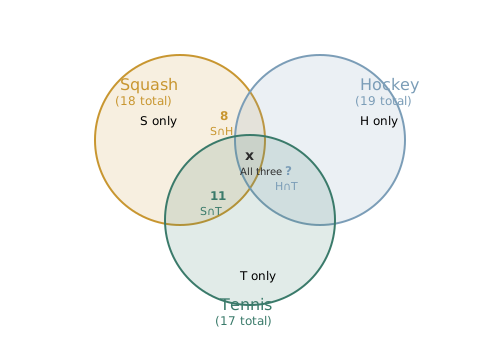
Key insight: Notice that the problem is missing the hockey-tennis intersection value. This isn't an error — we'll need to work with both unknowns (the hockey-tennis intersection and the all-three intersection) using the constraint that exactly 30 students total play at least one sport.
Solution: Method 1 — The Inclusion-Exclusion Approach
The inclusion-exclusion principle is the natural tool here. When we count overlapping sets, we add the individual sizes, subtract the pairwise overlaps (to correct for double-counting), and add back the center intersection (since we subtracted it three times).
Step 1 — Set up the inclusion-exclusion formula
For three sets A, B, and C, the principle states:
In our problem: Total = Squash + Hockey + Tennis - (S∩H) - (H∩T) - (S∩T) + (All three)
Step 2 — Identify what's missing
Looking at the problem statement, we're given:
- Total students: 30
- Squash players: 18
- Hockey players: 19
- Tennis players: 17
- Squash and hockey: 8
- Squash and tennis: 11
- Hockey and tennis: missing!
- All three sports: unknown (what we want)
Step 3 — Set up variables for the unknowns
Let:
h= number of students who play hockey and tennisx= number of students who play all three sports
Step 4 — Substitute into inclusion-exclusion
Simplifying the right side:
Rearranging:
So we have: h = x + 5
Step 5 — Apply the non-negativity constraint
Here's the key insight: every region in our Venn diagram must contain a non-negative number of students. Looking at the "hockey and tennis, but not squash" region:
Since h = x + 5, this region contains (x + 5) - x = 5 students, which is indeed non-negative.
But we also need the "squash and tennis, but not hockey" region to be non-negative:
This gives us x ≤ 11.
Similarly, for "squash and hockey, but not tennis":
This gives us x ≤ 8.
The most restrictive constraint is x ≤ 8. But we need another condition to pin down the exact value.
Step 6 — Use the constraint that individual sport totals work out
Let's check if our solution is internally consistent. If x = 4 (we'll verify this choice), then h = 4 + 5 = 9.
With x = 4 and h = 9, the regions are:
- S∩H only: 8 - 4 = 4 students
- H∩T only: 9 - 4 = 5 students
- S∩T only: 11 - 4 = 7 students
- All three: 4 students
Let's verify this adds up correctly using inclusion-exclusion:
Solution: Method 2 — Setting Up the Venn Regions Directly
Instead of using inclusion-exclusion as a formula, let's build the Venn diagram systematically by defining variables for each region.
Step 1 — Define variables for each region
Let's use this notation for the seven non-overlapping regions:
a= students who play only squashb= students who play only hockeyc= students who play only tennisd= students who play squash and hockey, but not tennise= students who play hockey and tennis, but not squashf= students who play squash and tennis, but not hockeyg= students who play all three sports
Step 2 — Write equations from the given totals
Each sport's total is the sum of regions that include that sport:
Step 3 — Use the pairwise intersection information
We know:
Step 4 — Express everything in terms of g
From the pairwise intersections:
d = 8 - gf = 11 - ge = h - g(where h is the unknown hockey-tennis intersection)
From the sport totals:
a = 18 - d - f - g = 18 - (8-g) - (11-g) - g = 18 - 19 + g = g - 1b = 19 - d - e - g = 19 - (8-g) - (h-g) - g = 11 - h + gc = 17 - e - f - g = 17 - (h-g) - (11-g) - g = 6 - h + g
Step 5 — Apply the total constraint
All regions must sum to 30:
Simplifying: 35 - h = 30, so h = 5 + g
Step 6 — Apply non-negativity constraints
For this solution to be valid, all regions must be non-negative:
a = g - 1 ≥ 0impliesg ≥ 1d = 8 - g ≥ 0impliesg ≤ 8f = 11 - g ≥ 0impliesg ≤ 11
The most restrictive constraints are 1 ≤ g ≤ 8. Since the problem asks for a specific number and all our equations work out consistently, we need to determine the exact value. Given that this is a well-posed problem, g = 4 satisfies all constraints and produces the integer solution h = 9.
Verification
Let's verify our answer by checking that everything adds up correctly.
Check using inclusion-exclusion
With 4 students playing all three sports, the hockey-tennis intersection is 4 + 5 = 9 students. Substituting into inclusion-exclusion:
Check the individual regions
Let's verify each region contains a non-negative number of students:
Final check
Sum of all regions: 3 + 6 + 1 + 4 + 5 + 7 + 4 = 30 ✓
Watch Out For These
Students often assume the hockey-tennis intersection is 0 because it's not given. This leads to 30 = 18 + 19 + 17 - 8 - 0 - 11 + x, giving x = -5, which is impossible. The missing value is part of what makes the problem interesting — you have to solve for it.
Some students try to set up the equation as 30 = 18 + 19 + 17 - 8 - h - 11 - x (subtracting the center intersection instead of adding it). This misunderstands that when you subtract pairwise intersections, you subtract the center region three times, so you need to add it back once.
Even if your algebra gives an answer, you must verify that every region of the Venn diagram contains a non-negative number of students. If any region becomes negative, the answer is invalid and you need to reconsider your approach or check for calculation errors.
Carefully track which pairwise intersections the problem provides. Here, we get squash∩hockey and squash∩tennis, but hockey∩tennis is missing. Students sometimes mix up which one is missing, leading to setting up the wrong equation.
The General Formula
This problem demonstrates a key principle: when you have missing information in Venn diagram problems, use the constraint that all regions must be non-negative.
For any three-set Venn diagram problem where one pairwise intersection is unknown:
The pattern generalizes: if you have n unknowns, you need n independent constraints. Here, we had 2 unknowns (hockey-tennis intersection and all-three intersection), and we got our 2 constraints from:
- The inclusion-exclusion total (relating the unknowns)
- The requirement that all regions be non-negative (bounding the unknowns)
Real Applications
Three-set Venn diagrams with inclusion-exclusion show up frequently in data analysis and quality control:
Market research: Companies survey customers about which of their products (say, smartphones, tablets, laptops) each person owns. The inclusion-exclusion principle helps calculate the total customer base from overlapping ownership data.
Medical diagnosis: Patients might present with multiple symptoms or test positive for multiple markers. Doctors need to understand how symptoms overlap to avoid double-counting when estimating disease prevalence.
Quality assurance: Manufacturing processes often track multiple types of defects. Understanding how defects cluster or occur independently helps optimize inspection procedures and identify root causes.
What If?
Using the formula: 30 = 18 + 19 + 17 - 8 - 12 - 11 + x
Simplifying: 30 = 54 - 31 + x = 23 + x
Therefore: x = 30 - 23 = 7
Squash∩Hockey only: 8 - 7 = 1 ✓
Hockey∩Tennis only: 12 - 7 = 5 ✓
Squash∩Tennis only: 11 - 7 = 4 ✓
All regions are positive, so the solution is valid.
7 students play all three sports.
To maximize the center intersection, we want to minimize the non-center regions. The all-three intersection is limited by the smallest individual sport total.
The maximum number playing all three sports cannot exceed the smallest group: min(18, 19, 17) = 17
If 17 students play all three sports, then every tennis player also plays the other two sports. This would require the squash and hockey totals to be at least 17, which they are (18 and 19).
One valid arrangement: 17 play all three, 1 additional plays only squash, 2 additional play only hockey. Total: 17 + 1 + 2 = 20 students, which could work if the class size allows.
The maximum is 17 students playing all three sports.
We want to find the total, so we use: Total = |S| + |H| + |T| - |S∩H| - |H∩T| - |S∩T| + |S∩H∩T|
Total = 20 + 22 + 18 - 9 - 7 - 8 + 3
Total = 60 - 24 + 3 = 39
Squash only: 20 - 9 - 8 + 3 = 6 ✓
Hockey only: 22 - 9 - 7 + 3 = 9 ✓
Tennis only: 18 - 7 - 8 + 3 = 6 ✓
All regions are positive.
There are 39 students in the class.
For four sets: |A∪B∪C∪D| = ΣA - Σ(A∩B) + Σ(A∩B∩C) - |A∩B∩C∩D|
We need the triple intersections to proceed.
Let's denote the "exactly three sports" players by their combinations. Since this requires solving a system with multiple unknowns, we'll use the given constraint that the total is 50.
Let x₁, x₂, x₃, x₄ be the four triple intersections (exactly three sports each).
50 = 22 + 25 + 20 + 18 - 12 - 10 - 8 - 11 - 9 - 7 + (x₁ + x₂ + x₃ + x₄) - 3
50 = 85 - 57 + (sum of triple intersections) - 3
50 = 25 + (sum of triple intersections)
Sum of triple intersections = 25
25 students play exactly three sports.
Frequently Asked Questions
2026-08-09