




Two Jobs System of Equations: Find Hours Worked
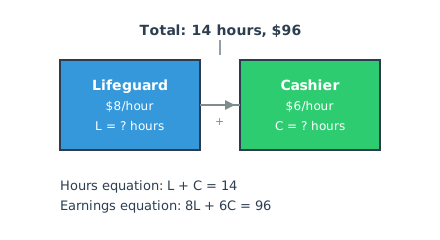
You worked 14 hours last week and earned a total of $96 before taxes. Your job as a lifeguard pays $8 per hour, and your job as a cashier pays $6 per hour. How many hours did you work at each job?
- Setup:
L + C = 14(hours) and8L + 6C = 96(dollars) - Answer:
L = 6lifeguard hours,C = 8cashier hours - One-line check:
6 + 8 = 14and8·6 + 6·8 = 48 + 48 = 96✓
If your numbers match, the sections on pitfalls, the general pattern, and the four What-If problems are where this page adds the most.
What You Will Learn
- Two quantities, two equations. One equation counts hours and the other counts dollars. Recognizing that the same two unknowns appear in two different "currencies" is the heart of every system-of-equations word problem.
- Substitution and elimination, side by side on one problem, so you can feel when each is the natural choice.
- A no-algebra shortcut (assume everything is the lower rate, then correct) that explains why the algebra works.
- How to reality-check a total before solving: any total pay must lie between "all hours at the low rate" and "all hours at the high rate."
- How a system looks as a picture: two lines crossing at exactly one point, and what that point means in the story.
Solution: Method 1 — The Substitution Approach
The problem gives us two separate facts about the same week: how many hours we worked, and how much we earned. Each fact becomes one equation. Once we have both, substitution lets us fold one fact into the other so only one unknown is left.
Step 1 — Name the unknowns
We are asked for hours at two jobs, so we need two variables. Choosing letters that remind you of the jobs is a small habit that prevents mix-ups later.
Step 2 — Translate the hours into an equation
The two jobs together took up 14 hours. Nothing else is happening, so the hours simply add:
Step 3 — Translate the money into an equation
Money earned at a job is rate × hours. The lifeguard job contributes 8L dollars and the cashier job contributes 6C dollars, and together they total $96:
Notice that the first equation is measured in hours and the second in dollars. The coefficients 8 and 6 are what convert hours into dollars. This is why you cannot just reuse "1 and 1" in both equations.
Step 4 — Solve one equation for one variable
The hours equation is the easiest to rearrange because both coefficients are 1. Solving for L:
In words: whatever hours weren't spent as a cashier were spent as a lifeguard.
Step 5 — Substitute into the other equation
Replace L in the money equation with (14 − C). The parentheses matter, because the 8 multiplies the whole expression:
Step 6 — Back-substitute to find the other unknown
Put C = 8 into the simple equation L = 14 − C:
So the week included 6 hours of lifeguarding and 8 hours of cashiering.
Solution: Method 2 — Elimination (Adding Equations to Cancel a Variable)
Substitution rewrites one equation inside another. Elimination does something different: it combines the two equations so that one variable disappears. It shines when both equations are already in the form ax + by = c, as ours are.
Step 1 — Line up the equations
Step 2 — Make one pair of coefficients match
The C terms are 1C and 6C. Multiply the entire hours equation by 6 and the C coefficients will match:
There is a nice interpretation here: 6L + 6C = 84 says "if every hour had paid $6, you would have earned $84."
Step 3 — Subtract to eliminate C
The leftover 2L = 12 says that the $12 extra beyond the $84 baseline came from lifeguard hours, each of which pays $2 more than a cashier hour. We'll lean on that idea again in Method 3.
Step 4 — Find the other variable
From L + C = 14: C = 14 − 6 = 8.
Choosing between the two methods. Because the coefficients in the hours equation are both 1, substitution was just as quick. Elimination wins when neither equation can be solved for a variable without fractions (for example 3x + 5y = 19 and 4x − 5y = 2). A good habit: glance at both equations, and if one variable has coefficient 1 or −1 anywhere, substitution is usually painless; otherwise reach for elimination.
Solution: Method 3 — The "Start at the Low Rate and Correct" Shortcut
You can solve this problem without writing a single variable. It takes a guess that is easy to compute, measures how wrong it is in dollars, and then uses the $2 pay gap to correct it.
Step 1 — Make a guess that respects the hours
Suppose all 14 hours were at the cashier job. That guess automatically satisfies "14 hours," so only the money can be off:
Step 2 — Measure the error in dollars
The real total is $96, so the guess is short by 96 − 84 = $12.
Step 3 — Find what one correction is worth
If you move one hour from cashier to lifeguard, the total hours stay at 14, but the pay goes up by 8 − 6 = $2. Every swap closes $2 of the gap.
Step 4 — Count the swaps
Six hours moved to lifeguarding means 6 lifeguard hours and 14 − 6 = 8 cashier hours. The table shows the same story as a staircase:
| Lifeguard hours | Cashier hours | Total pay | Compare with $96 |
|---|---|---|---|
| 0 | 14 | $84 | $12 short |
| 2 | 12 | $88 | $8 short |
| 4 | 10 | $92 | $4 short |
| 6 | 8 | $96 | Exactly right ✓ |
| 8 | 6 | $100 | $4 over |
Each row adds two lifeguard hours and removes two cashier hours, so the pay climbs by $4 per row. The table makes clear why there can be only one correct split: the pay increases steadily, and it passes through $96 only once.
Solution: Method 4 — Seeing the System as Two Crossing Lines
Each equation describes every possible way a week could have gone. Graph each one and the answer is the single week that satisfies both facts: the crossing point.
Step 1 — Put both equations in slope-intercept form
Let the horizontal axis be lifeguard hours L and the vertical axis be cashier hours C.
Step 2 — Plot the lines and read the intersection
The hours line crosses the axes at (0, 14) and (14, 0). The money line crosses at (0, 16) and (12, 0). Here is what that looks like:
Step 3 — Interpret the crossing point
The lines meet at (6, 8): 6 lifeguard hours and 8 cashier hours. Every other point on the blue line gets the hours right but the pay wrong; every other point on the gold line gets the pay right but the hours wrong. Because the lines have different slopes (−1 and −4/3), they cross exactly once, which is the geometric reason this system has a single answer.
A graph read by eye is only as accurate as your drawing, so treat this method as a way to understand and confirm the answer, then rely on algebra for exactness.
The Answer
Lifeguard: 6 hours | Cashier: 8 hours
That is 6 × $8 = $48 from lifeguarding plus 8 × $6 = $48 from cashiering, for a total of $96 over 14 hours.
Verification
With a system, "check your answer" means checking it in both original equations. An answer that satisfies only one is just a point on one of the lines.
Hours equation:L + C = 6 + 8 = 14 ✓
Money equation:8L + 6C = 8(6) + 6(8) = 48 + 48 = 96 ✓
As an independent check, all four methods above landed on the same pair of numbers, and Method 3's staircase table shows $96 appearing in exactly one row. We also confirm that the answer makes sense in the story: both hour counts are positive, and they are whole numbers of hours, which is what we'd expect from the situation.
Sanity Check: Could You Have Predicted the Rough Answer?
Before doing any algebra, you can tell roughly where the answer must lie. If all 14 hours were at the lower rate, you'd earn $84. If all were at the higher rate, you'd earn $112. Your actual $96 sits between them:
| Scenario | Total pay |
|---|---|
| All 14 hours as cashier | $84 |
| Your actual week | $96 |
| Half and half (7 and 7) | $98 |
| All 14 hours as lifeguard | $112 |
The $96 total is below the 7-and-7 split ($98), so you must have spent more time at the lower-paying job. That matches 8 cashier hours against 6 lifeguard hours. Another way to say it: your average pay was 96 ÷ 14 ≈ $6.86 per hour, which is closer to $6 than to $8.
This range test also catches impossible problems. A total of $120 in 14 hours would be impossible with these rates, since even all-lifeguard only reaches $112.
Three Mistakes That Are Easy to Make
Substituting back into the same equation. You solved the hours equation for L, so plugging that expression back into the hours equation just gives 14 = 14, which is true but useless. The substitution must go into the other equation, the one you didn't use to solve.
Multiplying only the first term. The 8 multiplies both pieces inside the parentheses: 8·14 = 112 and 8·C. Forgetting this is the most common slip in this exact problem, and it makes the "pay" equation lose $98 of the lifeguard wages.
Treating the two jobs as equally weighted. The average of $8 and $6 is $7 only if the hours are split evenly, and the hours are exactly what we don't know. Splitting 7 and 7 would pay $98, not $96. Here the 14 hours are known, but the balance between jobs is the unknown. The lower total pay is the signal that the split is lopsided toward the $6 job.
A habit worth building: label each equation with its unit. If you ever write something like 8L + 6C = 14 or L + C = 96, the units give it away immediately: you've mixed dollars with hours.
If You See These Words...
This problem belongs to a large family. Watch for these structural clues:
- A total count AND a total value. "14 hours" and "$96." Whenever a problem gives you how many items and what they're worth altogether, you have two equations waiting.
- Two categories with different unit values. Hourly rates here; but also coin values, ticket prices, or per-pound costs.
- "How many of each?" is the signature question.
The same skeleton appears in disguise:
If you can solve one, you can solve all of them. Only the nouns change.
The General Formula
Method 3 hides a formula. Suppose you worked H total hours, earned T dollars in total, and the two pay rates are a (higher) and b (lower). Then the shortcut becomes:
Here: (96 − 6·14) ÷ (8 − 6) = (96 − 84) ÷ 2 = 6. The numerator is the dollar gap above the all-low-rate baseline, and the denominator is the pay difference per swapped hour.
Limits of the formula. It requires the two rates to be different (a ≠ b), or you'd be dividing by zero. It also only makes sense when b·H ≤ T ≤ a·H. Outside that range the "hours" come out negative or larger than H, which is the algebra's way of saying the situation is impossible.
The deeper idea: this is a weighted average problem. The average pay, 96/14, is a blend of $6 and $8, and the weights are the hours at each job.
A Problem Older Than Algebra Notation
The same structure appears in the classic "chickens and rabbits in a cage" puzzle from the Chinese text Sunzi Suanjing (roughly 4th–5th century): given the total number of heads and the total number of legs, find how many of each animal there are. The traditional solution assumes every animal is a chicken, then corrects for the extra legs, which is exactly Method 3. Problems that combine "how many?" with "how much in total?" have stayed in textbooks for well over a thousand years because they teach how to turn a story into two linked facts.
Where This Shows Up in Real Life
- Payroll and scheduling: Managers estimate labor budgets by mixing staff at different pay grades across a fixed number of shifts.
- Event ticketing: Given total attendance and total revenue, organizers can work out how many adult and student tickets sold.
- Pharmacy and chemistry: Blending two solutions of different strengths to hit a target concentration is the same weighted-average idea, with strengths in place of pay rates.
When the Answer Isn't Neat
Real paychecks rarely land on perfect whole numbers. Suppose the total had been $97 instead of $96, with everything else the same. The method does not change at all:
Half-hours are perfectly reasonable for time worked, so 6.5 and 7.5 hours is a fine answer. When an answer is a fraction or decimal, that's not a sign that you made an error; it is just a different set of numbers flowing through the same machinery. The test of correctness is always the same: put it back into both equations (8·6.5 + 6·7.5 = 52 + 45 = 97 ✓).
Where This Leads
Add a third job and you need a third equation: three unknowns require three independent facts. Such systems are solved by extending elimination step by step, and in later courses by matrices. The geometry grows too: instead of two lines crossing at a point, three planes meet at a point. Be careful, though: a third job does not automatically give a third independent equation, as Problem 4 below hints.
Extend Your Thinking
Try each problem on paper first, then click Solve This! to compare your work. They get harder as you go.
Everything is the same (14 total hours, lifeguard at $8 per hour, cashier at $6 per hour), but now you earned exactly $100. How many hours did you work at each job?
With L lifeguard hours and C cashier hours: L + C = 14 and 8L + 6C = 100.
All 14 hours as cashier would pay 14 × 6 = 84 dollars, so the gap is 100 − 84 = 16 dollars.
Each hour moved to lifeguarding adds 8 − 6 = 2 dollars, so 16 ÷ 2 = 8 lifeguard hours.
C = 14 − 8 = 6. 8 hours as lifeguard and 6 hours as cashier.
8 + 6 = 14 ✓ and 8(8) + 6(6) = 64 + 36 = 100 ✓. Notice the split flipped from the original (6/8 became 8/6) because the pay crossed the $98 halfway mark.
Same 14 hours and the same $96 total, but the lifeguard job now pays $9 per hour (the cashier job stays at $6). How many hours did you work at each job? Why does the number of lifeguard hours go down even though the job pays more?
L + C = 14 and 9L + 6C = 96.
Multiply the first equation by 6: 6L + 6C = 84. Subtract from the second: 9L − 6L = 96 − 84, so 3L = 12.
L = 4, and C = 14 − 4 = 10.
Each lifeguard hour now pays $3 more than a cashier hour (instead of $2), so fewer lifeguard hours are needed to cover the same $12 gap above the $84 baseline: 12 ÷ 3 = 4. 4 hours as lifeguard and 10 hours as cashier.
4 + 10 = 14 ✓ and 9(4) + 6(10) = 36 + 60 = 96 ✓.
In another week, you earned $88 total (lifeguard $8 per hour, cashier $6 per hour). This time you aren't told the total hours. Instead you know that you worked 3 more hours as a cashier than as a lifeguard. How many hours did you work at each job?
"3 more cashier hours than lifeguard hours" gives C = L + 3. The money equation is 8L + 6C = 88.
Since C is already isolated, substitute directly: 8L + 6(L + 3) = 88.
8L + 6L + 18 = 88, so 14L = 70 and L = 5.
C = 5 + 3 = 8. 5 hours as lifeguard and 8 hours as cashier (13 hours in all).
The cashier hours exceed the lifeguard hours by 8 − 5 = 3 ✓ and the pay is 8(5) + 6(8) = 40 + 48 = 88 ✓. This shows that the "second fact" doesn't have to be a total; any relationship between the unknowns works.
You also tutor at $12 per hour. One week you worked 16 hours in total across lifeguarding ($8), cashiering ($6), and tutoring ($12), and earned $130. You worked 3 more hours as a cashier than as a tutor. How many hours did you work at each job?
Let L, C, T be the hours as lifeguard, cashier, and tutor. The facts: L + C + T = 16, 8L + 6C + 12T = 130, and C = T + 3.
Substitute C = T + 3 into the hours equation: L + (T + 3) + T = 16, so L = 13 − 2T.
8(13 − 2T) + 6(T + 3) + 12T = 130. Expanding: 104 − 16T + 6T + 18 + 12T = 130.
Combine: 122 + 2T = 130, so 2T = 8 and T = 4.
C = 4 + 3 = 7 and L = 13 − 2(4) = 5. 5 hours lifeguarding, 7 hours cashiering, 4 hours tutoring.
Hours: 5 + 7 + 4 = 16 ✓. Pay: 8(5) + 6(7) + 12(4) = 40 + 42 + 48 = 130 ✓. Clue: 7 = 4 + 3 ✓. Be careful when inventing a third clue yourself: some clues (such as "cashier hours are twice tutoring hours" with these particular numbers) turn out not to add any new information, leaving the system unsolvable.
Frequently Asked Questions
Let one variable stand for the hours at each job, then write two equations: one for total hours and one for total earnings. Solve the system by substitution or elimination. In this example, L + C = 14 and 8L + 6C = 96. Rewriting the first as L = 14 − C and substituting gives 8(14 − C) + 6C = 96, which simplifies to 112 − 2C = 96, so C = 8 hours as a cashier and L = 6 hours as a lifeguard.
Use substitution when one equation already has a variable with coefficient 1 (or is easy to solve for), such as L + C = 14. Use elimination when both equations are in standard form and you can multiply one of them to make a pair of coefficients match. In this example either works: multiplying L + C = 14 by 6 gives 6L + 6C = 84, and subtracting that from 8L + 6C = 96 leaves 2L = 12, so L = 6.
The total pay must fall between "all hours at the lower rate" and "all hours at the higher rate." In this example, 14 hours at $6 is $84 and 14 hours at $8 is $112, so a total of $96 is possible. Because $96 is closer to $84 than to $112, more hours must have been worked at the lower-paying job, which matches the answer of 8 cashier hours and 6 lifeguard hours.
2026-09-15