




Two Trains Traveling Toward Each Other: When Do They Meet?
Picture This
Let's visualize what's happening. Two trains start simultaneously from opposite stations and head directly toward each other:
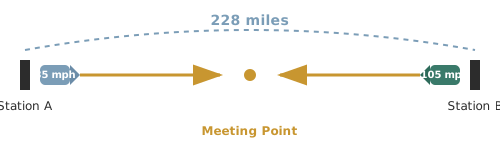
What You Will Learn
- How to recognize when objects are closing distance versus maintaining it
- The combined rate concept: when to add speeds and when to subtract them
- Converting decimal hours into hours and minutes for real-world interpretation
- Why meeting point problems are fundamentally about rate addition
- How to verify your answer using individual distances
Solution: Method 1 — The Combined Rate Approach
When two objects move toward each other, they work together to eliminate the distance between them. Each train reduces the gap by its own speed every hour.
Step 1 — Find the combined speed
Since both trains are closing the gap simultaneously, we add their speeds:
Step 2 — Apply the distance formula
Use the basic relationship: time = distance ÷ speed. The "distance" is the total gap to close, and the "speed" is how fast they're closing it together:
Time = 228 miles ÷ 190 mph = 1.2 hours
Step 3 — Convert to hours and minutes
Convert the decimal to a more practical format:
0.2 hours × 60 minutes/hour = 12 minutes
Final answer: 1 hour and 12 minutes
Solution: Method 2 — The Distance-Sum Approach
Let's think about this differently. At the moment they meet, the distances traveled by both trains must add up to the original separation.
Step 1 — Set up the equation
Let t = time until meeting (in hours). Each train travels for exactly t hours:
85t + 105t = 228
Step 2 — Solve for time
Combine like terms and solve:
t = 228 ÷ 190 = 1.2 hours
Step 3 — Interpret the result
This confirms our first method: 1.2 hours = 1 hour and 12 minutes.
Verification
Let's verify by checking that both trains' individual distances add up to 228 miles:
Train B distance: 105 mph × 1.2 hours = 126 miles
Total: 102 + 126 = 228 miles ✓
Perfect! The distances add up exactly to the original separation, confirming our answer is correct.
Common Pitfalls
✗ Using individual speeds instead of combined speed
Calculating 228 ÷ 85 = 2.68 hours or 228 ÷ 105 = 2.17 hours. This gives you how long it would take each train to travel the entire distance alone, not when they meet.
✗ Subtracting speeds instead of adding them
Computing 105 - 85 = 20 mph and then 228 ÷ 20 = 11.4 hours. Speed subtraction is for chase problems where one object is trying to catch another moving in the same direction.
✗ Forgetting to convert decimal hours
Leaving the answer as 1.2 hours without recognizing that 0.2 hours = 12 minutes. Always convert to the most practical time format.
How to Spot This Problem Type
Look for these key phrases that signal a meeting problem:
- "Travel toward each other" or "head toward one another"
- "Start at the same time from opposite points"
- "How long until they meet?" or "When will they pass each other?"
- Two starting locations with a distance between them
- Two different speeds moving in opposite directions
The crucial distinction: objects moving toward each other (add speeds) versus objects moving in the same direction (subtract speeds for relative motion).
The Pattern Behind This
All meeting problems follow the same structure:
This formula works because:
- Each object contributes its full speed to closing the gap
- The combined effect is the sum of individual rates
- Time is the same for both objects (they meet simultaneously)
This pattern appears in physics (relative velocity), network theory (convergence rates), and economics (market equilibrium problems).
Real Applications
- Air traffic control: Calculating when aircraft on converging flight paths will reach the same airspace
- Emergency response: Determining when ambulances from two hospitals will meet at an optimal patient transfer point
- Military logistics: Coordinating the rendezvous time for supply convoys approaching from different bases
- Delivery optimization: Planning when delivery trucks should leave warehouses to meet at distribution centers
What If?
Combined speed = 70 mph + 80 mph = 150 mph
Time = 300 miles ÷ 150 mph = 2 hours
Train A: 70 × 2 = 140 miles
Train B: 80 × 2 = 160 miles
Total: 140 + 160 = 300 miles ✓
Answer: 2 hours exactly
In 0.5 hours: 105 × 0.5 = 52.5 miles
Remaining distance: 228 - 52.5 = 175.5 miles
Once both trains are moving: 85 + 105 = 190 mph
Time = 175.5 ÷ 190 = 0.924 hours ≈ 55.4 minutes
Fast train total: 105 × (0.5 + 0.924) = 149.5 miles
Slow train: 85 × 0.924 = 78.5 miles
Total: 149.5 + 78.5 = 228 miles ✓
Answer: About 55 minutes after the slower train starts
Combined speed = 228 miles ÷ 1.5 hours = 152 mph
Unknown speed = 152 - 85 = 67 mph
Train A: 85 × 1.5 = 127.5 miles
Train B: 67 × 1.5 = 100.5 miles
Total: 127.5 + 100.5 = 228 miles ✓
Answer: The other train travels at 67 mph
Let t = meeting time. For A and B to meet at the same point:
Distance from west + Distance from east = 280 miles60t + 80t = 280
140t = 280t = 2 hours
A and B meet at: 60 × 2 = 120 miles from west
This is 140 - 120 = 20 miles from the midpoint
C needs to travel: √(210² + 20²) = √44,500 ≈ 211 miles
C's travel time: 211 ÷ 70 ≈ 3.01 hours
Since this doesn't equal 2 hours, they don't all meet simultaneously at this rate.
Answer: The trains cannot all meet at the same point with these speeds and positions
Frequently Asked Questions
2026-10-16