




Two-Train Overtaking Problem: Solve for Speed
What This Problem Teaches
- Setting up equations when objects start at different times but travel the same distance
- Converting time differences into hours for distance calculations
- Understanding that "overtaking" means both objects have traveled identical distances from the starting point
- Recognizing how speed differences compensate for time disadvantages in catching up scenarios
- Building confidence with multi-step distance-rate-time problems involving relative motion
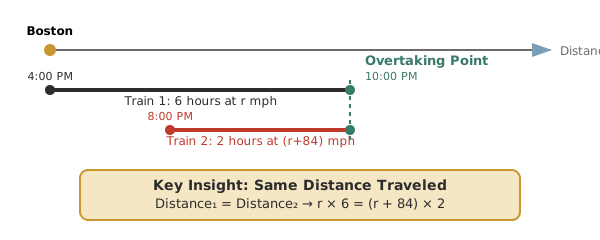
Visualizing the Problem
Solution: Method 1 — Equal Distance at Meeting Point
Step 1 — Set up the variable
Let r = speed of the first train (mph). Then the speed of the second train = r + 84 mph.
Step 2 — Calculate travel times until overtaking
Both trains are overtaken at 10:00 PM, so we need to find how long each train travels:
- First train: leaves at 4:00 PM, overtaken at 10:00 PM → travels for 6 hours
- Second train: leaves at 8:00 PM, overtaken at 10:00 PM → travels for 2 hours
Step 3 — Set up the distance equation
When the second train overtakes the first, they have traveled the same total distance from Boston. Using Distance = Speed × Time:
Distance of first train = Distance of second trainr × 6 = (r + 84) × 2Step 4 — Solve for r
Expand and solve the equation:
6r = 2(r + 84)6r = 2r + 1686r - 2r = 1684r = 168r = 42Step 5 — Find both speeds
- First train speed:
r = 42mph - Second train speed:
r + 84 = 42 + 84 = 126mph
Solution: Method 2 — Relative Speed and Gap Closing
Step 1 — Calculate the head start distance
The first train gets a 4-hour head start (4:00 PM to 8:00 PM). In this time, it travels 4r miles ahead of the second train.
Step 2 — Find the relative speed
The second train moves (r + 84) - r = 84 mph faster than the first. This is how quickly it closes the gap.
Step 3 — Set up the catch-up equation
The second train needs 2 hours to close a 4r mile gap at a relative speed of 84 mph:
Time × Relative Speed = Head Start Distance2 × 84 = 4r168 = 4rr = 42This gives us the same result: first train at 42 mph, second train at 126 mph.
Verification
Let's check that both trains travel the same distance by 10:00 PM:
| Train | Speed | Travel Time | Distance |
|---|---|---|---|
| First Train | 42 mph | 6 hours | 42 × 6 = 252 miles |
| Second Train | 126 mph | 2 hours | 126 × 2 = 252 miles |
✓ Both trains travel exactly 252 miles from Boston when they meet at 10:00 PM.
Common Pitfalls
Setting up r × 6 = (r + 84) × 6 — this assumes both trains travel for the same amount of time, ignoring the 4-hour delay of the second train.
Thinking both trains travel for 10 hours because they meet at 10:00 PM. You must calculate from each train's individual start time to the meeting time.
Trying to solve r + (r + 84) = 168 as if the speeds should sum to some total. The speeds relate through the equal distance condition, not by simple addition.
Does This Seem Reasonable?
Let's check if our answer makes sense in the real world:
- Speed range: 42 mph is reasonable for a local train, while 126 mph falls within high-speed rail territory
- Time advantage: The second train gets only 2 hours vs. 6 hours for the first — a 3:1 disadvantage. The speed advantage is 126:42 = 3:1, which exactly compensates
- Distance check: 252 miles in 6 hours is a sensible journey length for intercity rail
The mathematical relationship makes physical sense: when one train has triple the time, the other needs triple the speed to cover the same ground.
Recognizing This Problem in the Wild
Look for these key phrases that signal an overtaking problem:
- "leaves at different times" + "same direction" + "overtakes" or "catches up"
- "faster by [amount]" combined with a time delay
- Two speeds given as a difference rather than individual values
- A specific time when the faster object catches the slower one
Problem structure: Any scenario where a delayed but faster entity catches up to an earlier but slower one — whether trains, cars, runners, or even business growth rates.
The Underlying Pattern
All overtaking problems follow this general structure:
(Speed₁) × (Time₁) = (Speed₂) × (Time₂)Where Time₁ and Time₂ are measured from each object's start time to the meeting point.
The key insight is that equal distance ≠ equal time. The object that starts later must have proportionally higher speed to compensate for less time.
Special case: If the speed difference and time difference are given, you can often solve using relative motion — the faster object closes the gap at a rate equal to the speed difference.
What If?
Let r = speed of first train. Second train speed = r + 60 mph.
First train: 3:00 PM to 11:00 PM = 8 hours
Second train: 7:00 PM to 11:00 PM = 4 hours
8r = 4(r + 60)
8r = 4r + 2404r = 240r = 60
First train: 60 mph, Second train: 120 mph
First train travels from 2:00 PM to 8:00 PM = 6 hours
Distance = 45 × 6 = 270 miles
Second train needs 270 ÷ 135 = 2 hours to travel 270 miles
If it arrives at 8:00 PM after 2 hours of travel, it left at 6:00 PM
The second train left at 6:00 PM
Let t = hours after 4:00 PM when Train C overtakes Train B
Train B travels for 2 hours before Train C starts: 70 × 2 = 140 miles
When they meet: Distance of C = Distance of B100t = 140 + 70t
100t - 70t = 14030t = 140t = 4.67 hours
Train C overtakes Train B at 8:40 PM (4:00 PM + 4 hours 40 minutes)
1:00-4:00 PM: travels 50 × 3 = 150 miles
4:00-4:30 PM: stopped
After 4:30 PM: continues at 50 mph
Let t = hours after 5:00 PM when they meet
Train A position: 150 + 50(t - 0.5) = 150 + 50t - 25 = 125 + 50t
Train B position: 80t
80t = 125 + 50t30t = 125t = 4.17 hours = 4 hours 10 minutes
Time: 5:00 PM + 4:10 = 9:10 PM
Distance: 80 × 4.17 = 333 miles from Boston
Train B overtakes Train A at 9:10 PM, 333 miles from Boston
Frequently Asked Questions
2026-08-23