




Uniform Acceleration: Calculate Distance Covered
What This Problem Teaches
- How to apply kinematic equations for uniformly accelerated motion
- Understanding the relationship between velocity, acceleration, time, and distance
- Recognizing when an object starts "from rest" (initial velocity = 0)
- Converting between different kinematic formulations to verify answers
- Interpreting motion graphs and connecting area under curves to physical quantities
Visualizing the Motion
Let's see what this uniform acceleration looks like graphically:
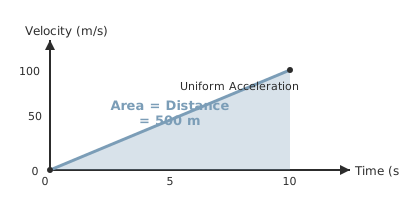
The velocity increases linearly with time, forming a straight line from the origin. The distance traveled equals the area under this velocity-time graph, which is a right triangle.
Solution: Method 1 — The Kinematic Equation Approach
Step 1 — Identify the given values
Let's organize what we know:
- Initial velocity:
u = 0 m/s(starts from rest) - Final velocity:
v = 100 m/s - Time taken:
t = 10 s - Distance covered:
s = ?(what we need to find)
Step 2 — Find the acceleration
Using the equation v = u + at:
a = (100 - 0) / 10
a = 10 m/s²
Step 3 — Apply the kinematic equation for distance
Now we use the equation s = ut + ½at²:
s = (0)(10) + ½(10)(10)²
s = 0 + ½(10)(100)
s = ½(1000)
s = 500 m
Step 4 — Interpret the result
The body covers a distance of 500 meters during its 10-second acceleration phase.
Solution: Method 2 — Area Under the Velocity-Time Graph
For uniformly accelerated motion, the velocity-time graph is a straight line. The distance traveled equals the area under this line.
Step 1 — Recognize the geometric shape
The velocity increases linearly from 0 to 100 m/s over 10 seconds, forming a right triangle on the velocity-time graph.
Step 2 — Calculate the area of the triangle
For a triangle, Area = ½ × base × height:
Distance = ½ × time × final velocity
Distance = ½ × 10 s × 100 m/s
Distance = ½ × 1000 m
Distance = 500 m
Step 3 — Connect to physics
This geometric approach reinforces that the area under any velocity-time curve gives the displacement. For uniform acceleration starting from rest, it's always a triangular area.
Verification
Let's check our answer using the average velocity method:
For uniform acceleration from rest, the average velocity = (initial + final) / 2
Average velocity = (0 + 100) / 2 = 50 m/s
Distance = average velocity × time = 50 × 10 = 500 m ✓
We can also verify by checking if our calculated acceleration gives the correct final velocity:
Both checks confirm our answer of 500 meters is correct.
Watch Out For These
✗ Using the wrong kinematic equation:
Some students try v² = u² + 2as first, but this requires knowing the acceleration beforehand. While it works, it's an extra step when you can use s = ut + ½at² directly after finding acceleration.
✗ Forgetting that "from rest" means u = 0:
The phrase "from rest" is physics shorthand for initial velocity equals zero. Missing this makes the entire calculation incorrect.
✗ Unit confusion:
Make sure all units are consistent. Velocity in m/s, time in seconds, and acceleration in m/s² will give distance in meters. Don't mix km/h with seconds.
✗ Using final velocity instead of average velocity:
Distance ≠ final velocity × time. For uniform acceleration, you need average velocity × time. The final velocity approach only works for constant velocity motion.
The Pattern Behind This
This problem demonstrates the fundamental kinematic equations that govern uniformly accelerated motion:
v = u + at (velocity-time)
s = ut + ½at² (displacement-time)
v² = u² + 2as (velocity-displacement)
s = (u + v)t / 2 (average velocity)
When starting from rest (u = 0), these simplify to:
s = ½at²
v² = 2as
s = vt / 2
The beauty of these equations is their interconnectedness. Given any two quantities (acceleration, initial velocity, final velocity, time, displacement), you can always find the other three. This problem type appears throughout physics, from falling objects to accelerating vehicles.
How to Spot This Problem Type
- "Uniformly accelerated" or "constant acceleration" - signals kinematic equations
- "From rest" - means initial velocity u = 0
- "Final velocity" and "time taken" - classic kinematic problem setup
- "Calculate distance" or "find displacement" - you'll need a kinematic equation relating distance to other variables
- Any problem giving three kinematic variables (velocity, acceleration, time, distance) and asking for the fourth
Real Applications
- Vehicle safety testing: Calculating stopping distances for cars accelerating to highway speeds, crucial for setting speed limits and designing safe following distances.
- Elevator design: Engineers use these calculations to determine how long elevators take to reach different floors and ensure passenger comfort during acceleration phases.
- Rocket launch analysis: NASA uses kinematic equations to track rocket acceleration phases and calculate fuel requirements for achieving specific velocities.
- Sports biomechanics: Analyzing sprinter acceleration out of starting blocks or calculating the distance covered during a cyclist's acceleration phase.
What Comes After This
Once you're comfortable with uniform acceleration problems, physics pushes into more complex territory:
- Variable acceleration: Where acceleration itself changes over time, requiring calculus-based approaches like
a = dv/dtandv = ds/dt. - Two-dimensional motion: Projectile motion where you analyze horizontal and vertical components separately, each with different acceleration values.
- Circular motion: Objects moving in circles experience centripetal acceleration pointing toward the center, leading to concepts like angular velocity.
Here's a taste of the next level: A ball is thrown upward at 30 m/s from a 50-meter tower. Find the maximum height reached and the total time until it hits the ground. This requires understanding that gravity provides constant downward acceleration, creating a more complex kinematic scenario.
What If?
Initial velocity u = 0 m/s (from rest), distance s = 400 m, time t = 8 s, final velocity v = ?
Using s = ut + ½at²: 400 = 0 + ½a(8)², so a = 400/(½ × 64) = 12.5 m/s²
Using v = u + at: v = 0 + 12.5 × 8 = 100 m/s
Check with average velocity: s = (u + v)t/2 = (0 + 100) × 8/2 = 400 m ✓
Answer: 100 m/s
Initial velocity u = 15 m/s, final velocity v = 85 m/s, time t = 10 s, distance s = ?
Using v = u + at: 85 = 15 + a(10), so a = 70/10 = 7 m/s²
Using s = ut + ½at²: s = 15(10) + ½(7)(10)² = 150 + 350 = 500 m
Average velocity = (15 + 85)/2 = 50 m/s. Distance = 50 × 10 = 500 m ✓
Answer: 500 m
Initial velocity u = 0 m/s (from rest), acceleration a = 15 m/s², distance s = 1200 m, time t = ?
Using s = ut + ½at² with u = 0: 1200 = 0 + ½(15)t²
1200 = 7.5t², so t² = 1200/7.5 = 160, therefore t = √160 = 4√10 ≈ 12.65 s
Check: s = ½ × 15 × (12.65)² ≈ ½ × 15 × 160 = 1200 m ✓
Answer: 4√10 seconds ≈ 12.65 seconds
Phase 1: u = 0, a = 2 m/s², t₁ = 10 s
Distance: s₁ = ½at₁² = ½(2)(10)² = 100 m
Final velocity: v = 0 + 2(10) = 20 m/s
Phase 2: constant velocity v = 20 m/s, t₂ = 15 s
Distance: s₂ = vt₂ = 20 × 15 = 300 m
Total distance = s₁ + s₂ = 100 + 300 = 400 m
Phase 1 check: Average velocity = (0 + 20)/2 = 10 m/s, so 10 × 10 = 100 m ✓
Phase 2 check: Constant velocity motion, so 20 × 15 = 300 m ✓
Answer: 400 m total
Frequently Asked Questions
2026-09-10