




Solve Upstream-Downstream Rate Problems With River Current
What This Problem Teaches
- How to handle opposing and assisting forces in motion problems
- Setting up equations when the same distance is covered at different effective speeds
- Converting time units to maintain consistency in rate calculations
- Recognizing that upstream speed = still water speed - current, downstream speed = still water speed + current
- Using the fundamental relationship: distance = rate × time when distance is constant but rates vary
Let's Draw What's Happening
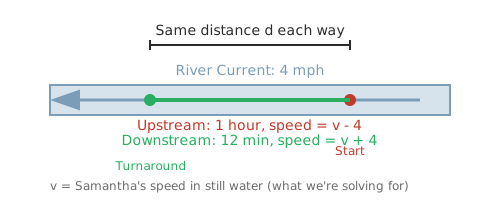
Solution: Method 1 — The Equal Distance Approach
Step 1 — Define variables and effective speeds
Let v = Samantha's swimming speed in still water (mph)
The river current is 4 mph, so:
- Upstream effective speed =
v - 4mph (current opposes her) - Downstream effective speed =
v + 4mph (current assists her)
Step 2 — Convert time units
Since the river speed is in mph, convert 12 minutes to hours:
Step 3 — Set up the equal distance equation
Using distance = rate × time for both trips, and knowing the distances are equal:
(v - 4) × 1 = (v + 4) × 0.2
Step 4 — Solve for v
Expand the right side:
Subtract 0.2v from both sides:
Add 4 to both sides:
Divide by 0.8:
Solution: Method 2 — The Ratio Approach
Step 1 — Recognize the time ratio
Notice that downstream takes 12 minutes while upstream takes 60 minutes. This is a ratio of 1:5.
Step 2 — Connect time ratio to speed ratio
Since distance is constant, speeds are inversely proportional to times. If downstream is 5 times faster than upstream:
Step 3 — Solve the equation
Expand and simplify:
24 = 4v
v = 6
Verification
Let's check that both trips cover the same distance when Samantha's still water speed is 6 mph:
Upstream trip:
- Effective speed = 6 - 4 = 2 mph
- Time = 1 hour
- Distance = 2 × 1 = 2 miles
Downstream trip:
- Effective speed = 6 + 4 = 10 mph
- Time = 0.2 hours
- Distance = 10 × 0.2 = 2 miles
✓ Both distances equal 2 miles, confirming our answer.
Common Pitfalls
Setting up the equation as (v - 4) × 1 = (v + 4) × 12 leads to v = -5.6, which is negative and meaningless. Always keep time units consistent with the rate units.
Writing upstream speed as v + 4 and downstream as v - 4 reverses the physics. Upstream means fighting the current (subtract), downstream means current helps (add).
Students often want to find the actual distance traveled, but it's not needed. The key insight is that both distances are equal, so we can set up the equation without knowing the specific distance value.
The Pattern Behind This
This is a classic current problem with the general setup:
Upstream speed = v - c
Downstream speed = v + c
For equal distances:
(v - c) × t₁ = (v + c) × t₂
The beauty of this formula is that it works for any situation where the same distance is covered in different times due to a helping or hindering force - whether it's swimming in a current, flying with or against wind, or walking on a moving walkway.
Notice how dramatically the current affects travel times. Even though Samantha's still water speed (6 mph) is only 1.5 times the current speed (4 mph), the downstream trip is 5 times faster than upstream. This non-linear effect makes current problems particularly interesting.
Real Applications
- Aviation: Pilots constantly calculate flight times with and against jet streams, using identical mathematics to optimize fuel consumption and arrival times.
- Marine navigation: Ship captains use this approach when planning routes with or against ocean currents, especially crucial for fuel efficiency on long voyages.
- Athletics: Track coaches consider wind assistance when comparing sprint times - a tailwind helps runners just like a current helps swimmers.
Four "What-If?" Problems
Let c = current speed (mph). Convert times: 45 min = 0.75 hours, 15 min = 0.25 hours
Upstream distance = Downstream distance
(8 - c) × 0.75 = (8 + c) × 0.25
6 - 0.75c = 2 + 0.25c
4 = c
Upstream: (8-4) × 0.75 = 3 miles
Downstream: (8+4) × 0.25 = 3 miles ✓
Answer: The river current is 4 mph.
Upstream speed = 5 - 3 = 2 mph
Downstream speed = 5 + 3 = 8 mph
24 minutes = 24/60 = 0.4 hours
8 minutes = 8/60 ≈ 0.133 hours
Distance = rate × time = 2 mph × 0.4 hours = 0.8 miles
Distance = 8 mph × 0.133 hours ≈ 0.8 miles ✓
Answer: Marcus swam 0.8 miles each way.
Let v = Ana's speed in still water
40 min = 2/3 hours, 10 min = 1/6 hours
(v - 6) × (2/3) = (v + 6) × (1/6)
(2/3)v - 4 = (1/6)v + 1
(1/2)v = 5
v = 10
Upstream: (10-6) × (2/3) = 8/3 miles
Downstream: (10+6) × (1/6) = 8/3 miles ✓
Answer: Ana can swim 10 mph in still water.
Upstream speed = 7 - 3 = 4 mph
Time upstream = 2 miles ÷ 4 mph = 0.5 hours
Downstream speed = 7 + 3 = 10 mph
Time downstream = 2 miles ÷ 10 mph = 0.2 hours
Total distance = 2 + 2 = 4 miles
Total time = 0.5 + 0.2 = 0.7 hours
Average speed = 4 ÷ 0.7 ≈ 5.71 mph
The average speed (5.71 mph) is less than the still water speed (7 mph) because the current hurts more on the slow upstream leg than it helps on the fast downstream leg.
Answer: Carlos's average speed is approximately 5.71 mph.
Frequently Asked Questions
2026-09-02