




Work Rate Problem: Staggered Printer Operation
What This Problem Teaches
- Setting up work rate equations when machines operate in different phases
- Converting time-to-complete into fraction-per-minute rates
- Breaking complex scenarios into manageable calculation steps
- Solving fractional equations where the unknown appears in denominators
- Verifying solutions by checking that work phases sum to exactly one complete job
Visualizing the Work Timeline
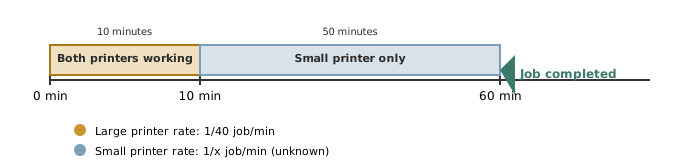
Solution: Method 1 — The Work Rate Equation
Step 1 — Define the work rates
Let x = time (in minutes) for the smaller printer to complete the job alone.
Small printer rate = 1/x jobs per minute
Combined rate = 1/40 + 1/x jobs per minute
Step 2 — Calculate work done in Phase 1 (both printers working)
Both printers work together for 10 minutes:
Work in Phase 1 = (1/40 + 1/x) × 10 = 10/40 + 10/x = 1/4 + 10/x
Step 3 — Calculate work done in Phase 2 (small printer only)
After the large printer breaks, the small printer works alone for 50 minutes:
Step 4 — Set up the equation for total work
The sum of work from both phases must equal exactly 1 complete job:
(1/4 + 10/x) + 50/x = 1
1/4 + 10/x + 50/x = 1
1/4 + 60/x = 1
Step 5 — Solve for x
Isolate the term containing x:
60/x = 3/4
x = 60 × 4/3 = 240/3 = 80
Solution: Method 2 — Work Units Approach
Step 1 — Define one complete job as 40 work units
Since the large printer completes the job in 40 minutes, let's say the complete job equals 40 work units. This means:
Small printer rate = 40 units ÷ x minutes = 40/x units per minute
Step 2 — Calculate units completed in each phase
Phase 1 (both working for 10 minutes):
Phase 2 (small printer alone for 50 minutes):
Step 3 — Set up the equation
Total units must equal 40 (one complete job):
10 + 400/x + 2000/x = 40
10 + 2400/x = 40
2400/x = 30
x = 2400/30 = 80
Verification
Let's check that our answer produces exactly one complete job:
With x = 80 minutes for the small printer:
Small printer rate = 1/80 jobs per minute
Combined rate = 1/40 + 1/80 = 2/80 + 1/80 = 3/80 jobs per minute
Phase 1 (both working for 10 minutes):
Phase 2 (small printer alone for 50 minutes):
Total work:
The verification confirms our answer is correct.
Common Pitfalls
✗ Mistake 1: Adding the times instead of the rates
Why this fails: You can't add completion times directly. Work rates (fractions per minute) are what combine when machines work together, not their individual completion times.
✗ Mistake 2: Forgetting that "50 more minutes" is additional time
Why this fails: The 50 minutes is how long the small printer needs after both worked together for 10 minutes. It's not the small printer's solo time for the entire job.
✗ Mistake 3: Setting up the work equation incorrectly
Why this fails: This only accounts for the large printer working for 10 minutes, ignoring that the small printer was also working during those first 10 minutes. The correct Phase 1 work is (1/40 + 1/x) × 10.
The Pattern Behind This
This problem follows the general pattern for two-phase work problems:
The key insight is recognizing when a problem has multiple phases with different working conditions. Any time you see "after X minutes, something changes," you're likely dealing with a multi-phase scenario.
For this specific type where one machine breaks down:
Where:
- A = time for machine 1 alone
- B = time for machine 2 alone (unknown)
- t₁ = time both machines work together
- t₂ = time machine 2 works alone after machine 1 breaks
Real Applications
This exact scenario appears in several real-world contexts:
Manufacturing: When a production line has multiple machines and one breaks down mid-shift, requiring calculation of individual machine capacities for maintenance planning.
Network Systems: When servers work in parallel to handle data processing, and one server goes offline partway through a large job batch.
Construction Projects: When multiple crews work together initially, but one crew is reassigned to another project, and you need to determine individual crew productivity rates.
What If?
Large printer rate = 1/30 jobs per minute. Small printer rate = 1/x jobs per minute.
Both work for 10 minutes: (1/30 + 1/x) × 10 = 10/30 + 10/x = 1/3 + 10/x
Small printer alone for 40 minutes: (1/x) × 40 = 40/x
1/3 + 10/x + 40/x = 1, so 1/3 + 50/x = 1
50/x = 2/3, so x = 50 × 3/2 = 75
75 minutes for the small printer working alone.
Phase 1: (1/40 + 1/x) × 15 = 15/40 + 15/x = 3/8 + 15/x
Small printer alone for 45 minutes: 45/x
3/8 + 15/x + 45/x = 1, so 3/8 + 60/x = 1
60/x = 5/8, so x = 60 × 8/5 = 96
96 minutes for the small printer working alone.
All work for 8 minutes: (1/40 + 1/60 + 1/x) × 8 = 8/40 + 8/60 + 8/x = 1/5 + 2/15 + 8/x
Medium and small for 5 minutes: (1/60 + 1/x) × 5 = 5/60 + 5/x = 1/12 + 5/x
Small alone for 35 minutes: 35/x
1/5 + 2/15 + 8/x + 1/12 + 5/x + 35/x = 1. Combine constants: 1/5 + 2/15 + 1/12 = 12/60 + 8/60 + 5/60 = 25/60 = 5/12
5/12 + 48/x = 1, so 48/x = 7/12, thus x = 48 × 12/7 = 576/7 ≈ 82.3
82.3 minutes (or exactly 576/7 minutes) for the small printer alone.
Both printers work together for t minutes, then small printer works alone for 30 minutes.
Large rate = 1/40, small rate = 1/80, combined rate = 1/40 + 1/80 = 3/80
Phase 1 + Phase 2 = 1 job: (3/80)t + (1/80)(30) = 1
3t/80 + 30/80 = 1, so 3t + 30 = 80, thus 3t = 50, and t = 50/3 ≈ 16.67
Both printers worked together for 16⅔ minutes (or exactly 50/3 minutes).
Frequently Asked Questions
2026-09-04