




Combined Work Rate: When Does Dad Join?
What This Problem Teaches
- Converting between work time and work rate (the key insight that rates add, times don't)
- Setting up equations where individual contributions combine to create a known total
- Working with fractions that represent "portion of job completed per hour"
- Recognizing that faster workers do proportionally more of the work
- Understanding why averaging times gives completely wrong answers in work problems
Solution: Method 1 — The Work Rate Addition
The essential insight is that work rates add when people work together, but work times don't. We need to think in terms of "cars per hour" rather than "hours per car."
Step 1 — Convert times to work rates
Levi alone takes 2.5 hours, so his rate is 1/2.5 = 2/5 cars per hour. When they work together, they complete 1 car in 1 hour, so their combined rate is 1/1 = 1 car per hour.
Step 2 — Set up the rate equation
When working together, individual rates add up to the combined rate:
2/5 + Dad's rate = 1
Step 3 — Solve for Dad's rate
Dad's rate = 1 - 2/5 = 5/5 - 2/5 = 3/5 cars per hour
Step 4 — Convert Dad's rate back to time
If Dad completes 3/5 of a car per hour, then to complete 1 whole car takes 1 ÷ (3/5) = 1 × (5/3) = 5/3 hours.
5/3 hours = 5/3 × 60 = 100 minutes = 1 hour and 40 minutes
Solution: Method 2 — The Fraction Visualization
Let's visualize what happens during that 1 hour when they work together:
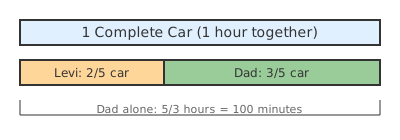
Step 1 — Find Levi's contribution in 1 hour
In 1 hour, Levi completes 1 ÷ 2.5 = 2/5 of the car.
Step 2 — Find Dad's contribution
Since the whole car gets done in 1 hour, Dad must complete the remaining fraction: 1 - 2/5 = 3/5 of the car.
Step 3 — Scale up to find Dad's solo time
If Dad does 3/5 of the car in 1 hour, then to do the full car (5/5), he needs (5/5) ÷ (3/5) = 5/3 hours.
Verification
Let's check: Levi's rate is 2/5 cars/hour, Dad's rate is 3/5 cars/hour. Together: 2/5 + 3/5 = 5/5 = 1 car per hour. ✓
This means they finish 1 car in exactly 1 hour when working together, which matches the problem statement.
Double-check Dad's time: At 3/5 cars per hour, for 1 full car: 1 ÷ (3/5) = 5/3 = 1.67 hours = 100 minutes. ✓
Watch Out For These
Thinking: "Together they take 1 hour, Levi takes 2.5 hours, so Dad takes 2×1 - 2.5 = -0.5 hours." This gives a negative time, which is impossible. The error is assuming each person does half the work—actually, the faster worker does more.
Writing something like 2.5 + Dad's time = 1. Times don't add—this would mean Dad takes -1.5 hours. You must work with rates (jobs per hour), not times (hours per job).
Finding Dad's rate as 3/5 cars per hour and stopping there. The question asks for time, so you need the reciprocal: 1 ÷ (3/5) = 5/3 hours.
The General Pattern
For any two-person work problem:
Where: A = time for person 1 alone
B = time for person 2 alone
T = time working together
Given any two of these values, you can solve for the third. In our problem: 1/2.5 + 1/B = 1/1, so 1/B = 1 - 1/2.5 = 3/5, giving B = 5/3 hours.
Key insight: The person who works faster (smaller time) contributes a larger fraction of the combined work. This is why averaging times fails—it assumes equal contribution regardless of speed.
How to Spot This Problem Type
- "Working together" or "working simultaneously" — signals that rates combine
- "Alone" vs. "together" time comparisons — you'll need the work rate formula
- Two different completion times given — typically one person alone and both together
- Asked to find the other person's solo time — requires solving the rate equation
These problems appear in algebra, SAT/ACT prep, and real-world contexts like manufacturing, project management, and resource allocation.
What If?
Levi's rate: 1/2.5 = 2/5 cars/hour. Together rate: 1/1.5 = 2/3 cars/hour.
Dad's rate = 2/3 - 2/5 = 10/15 - 6/15 = 4/15 cars/hour
Dad's time = 1 ÷ (4/15) = 15/4 = 3.75 hours = 3 hours 45 minutes
Check: 2/5 + 4/15 = 6/15 + 4/15 = 10/15 = 2/3 ✓
Levi: 1/2.5 = 2/5 cars/hour. Mia: 1/3 cars/hour. Together: 1/0.75 = 4/3 cars/hour.
2/5 + 1/3 + Dad's rate = 4/3
Dad's rate = 4/3 - 2/5 - 1/3 = 4/3 - 1/3 - 2/5 = 1 - 2/5 = 3/5 cars/hour
Dad's time = 1 ÷ (3/5) = 5/3 hours = 1 hour 40 minutes
Levi: 1/2.5 = 2/5 cars/hour. Dad: 1/(5/3) = 3/5 cars/hour.
Together: 2/5 + 3/5 = 1 car/hour
For 3 cars at 1 car/hour: 3 ÷ 1 = 3 hours
In 3 hours: Levi does 3 × 2/5 = 6/5 cars, Dad does 3 × 3/5 = 9/5 cars. Total: 6/5 + 9/5 = 15/5 = 3 cars ✓
Levi works alone for 0.5 hours, then both work together for 0.5 hours.
Dad's rate = 1/(5/3) = 3/5 cars/hour. Let Levi's rate = x cars/hour.
Work by Levi alone + Work by both together = 1 car0.5x + 0.5(x + 3/5) = 1
0.5x + 0.5x + 0.3 = 1x + 0.3 = 1x = 0.7 = 7/10 cars/hour
Levi's time = 10/7 hours ≈ 1.43 hours = 1 hour 26 minutes
Frequently Asked Questions
2026-11-10