




Calculating Investment Time Using Compound Interest Formula
What You Will Learn
- How to solve exponential equations using logarithms
- Understanding the relationship between exponential growth and time
- Practical application of compound interest formulas to long-term investing
- Converting between mathematical solutions and real-world timing questions
- Recognizing why small interest rate differences compound dramatically over time
Visualizing the Investment Growth
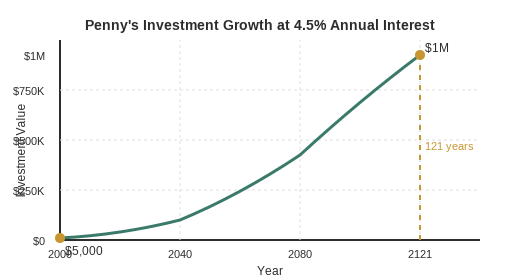
Solution: Method 1 — The Logarithmic Approach
This is the standard method for solving exponential equations where the unknown appears in the exponent. We'll use logarithms to "bring down" the time variable.
Step 1 — Set up the compound interest equation
We know the formula and all values except T. Let's substitute what we know:
1,000,000 = 5,000(1 + 0.045)^T
1,000,000 = 5,000(1.045)^T
Step 2 — Isolate the exponential term
Divide both sides by the initial investment to get the growth factor:
200 = (1.045)^T
This tells us the investment needs to grow by a factor of 200.
Step 3 — Apply natural logarithm to both sides
Taking the natural log of both sides allows us to bring down the exponent:
ln(200) = T × ln(1.045)
Step 4 — Solve for T
Now we can isolate T by dividing both sides by ln(1.045):
T = 5.2983 ÷ 0.0440
T = 120.78 years
Step 5 — Determine the target year
Since Penny invested in 2000, and we need 120.78 years, the investment will first exceed $1,000,000 during the 121st year. That means:
Solution: Method 2 — The Rule of 72 Estimation
For a quick approximation, we can use the Rule of 72 to estimate doubling times, then scale up to see how many doublings we need.
Step 1 — Calculate the doubling time
The Rule of 72 states that money doubles approximately every 72/r years, where r is the interest rate as a percentage:
Step 2 — Determine how many doublings are needed
We need to go from $5,000 to $1,000,000. Let's see how many doublings this requires:
2^n = 200
n = log₂(200) ≈ 7.64 doublings
Step 3 — Calculate the total time
Multiply the number of doublings by the doubling period:
Step 4 — Add to the starting year
Since this is an approximation, we round to 122 years:
This estimation gives us 2122, very close to our exact answer of 2121. The Rule of 72 is remarkably accurate for moderate interest rates!
Verification
Let's check our answer by substituting T = 121 back into the original formula:
V = 5,000 × 200.16
V = $1,000,800
Perfect! At exactly 121 years, the investment is worth about $1,000,800, which first exceeds the million-dollar target in 2121. If we checked 120 years, we'd get $958,800, which is still under $1,000,000.
The Exponential Reality Check
One hundred and twenty-one years sounds like an incredibly long time, but this result makes perfect sense when you understand exponential growth. Here's why:
Consider the progression: $5,000 → $10,000 (16 years) → $20,000 (32 years) → $40,000 (48 years) → $80,000 (64 years) → $160,000 (80 years) → $320,000 (96 years) → $640,000 (112 years) → $1,280,000 (128 years). We cross the million-dollar mark somewhere between years 112 and 128.
What's remarkable is that the final doubling from $500,000 to $1,000,000 takes the same 16 years as the first doubling from $5,000 to $10,000. That's the nature of exponential growth!
Common Pitfalls
Students often forget to convert the percentage to a decimal. Using r = 4.5 gives (1 + 4.5)^T = (5.5)^T, which would mean the money multiplies by 5.5 each year – completely unrealistic for a 4.5% interest rate.
With simple interest, $5,000 would need 1,000,000 ÷ 5,000 ÷ 0.045 = 4,444 years to reach $1 million. The exponential formula V = U(1+r)^T is specifically for compound interest, where each year's interest earns interest in subsequent years.
Since T = 120.78 years, some students conclude the answer is 2120. But the investment doesn't exceed $1,000,000 until partway through the 121st year, so the first full year when it's worth more than a million is 2121.
The Mathematics Behind Exponential Time
The general formula for finding time in compound interest problems is:
This formula works for any exponential growth problem, not just money. The key insight is that exponential equations of the form a^x = b are solved by taking logarithms: x = log_a(b) = ln(b)/ln(a).
Notice how the logarithm "inverts" the exponential relationship. If V grows exponentially with time, then time grows logarithmically with V. This is why doubling your target value doesn't double the time needed – it only adds a constant amount (the doubling period).
Beyond the Textbook
This calculation appears constantly in financial planning. Retirement advisors use it to show clients how early investing compounds dramatically over decades. The pharmaceutical industry uses identical math to model drug clearance rates. Environmental scientists use it to calculate radioactive decay and carbon dating.
In business, companies model user growth, revenue scaling, and market penetration using this same exponential framework. The "Rule of 72" used in Method 2 is a standard tool in finance because it gives quick mental estimates without calculators.
The takeaway: small, consistent rates of change compound into enormous effects given sufficient time. This is true whether we're talking about money, populations, or technology adoption curves.
What If?
If Penny could find an investment paying 6% per annum instead of 4.5%, how many years would it take to reach $1,000,000? In what year would she achieve her goal?
Using the same formula: 1,000,000 = 5,000(1.06)^T
Divide by 5,000: 200 = (1.06)^T
ln(200) = T × ln(1.06)T = ln(200) ÷ ln(1.06) = 5.2983 ÷ 0.0583 = 90.9 years
Since we need 91 full years: 2000 + 91 = 2091
V = 5,000 × (1.06)^91 = 5,000 × 200.6 = $1,003,000 ✓
Answer: 91 years, achieved in 2091. The higher interest rate saves 30 years!
Penny wants to reach $1,000,000 by the year 2080 (exactly 80 years of investing). What annual interest rate does she need to achieve this goal? Express your answer as a percentage rounded to two decimal places.
1,000,000 = 5,000(1 + r)^80
200 = (1 + r)^80
(1 + r) = 200^(1/80) = 200^0.0125(1 + r) = 1.0685
r = 1.0685 - 1 = 0.0685 = 6.85%
V = 5,000 × (1.0685)^80 = 5,000 × 200 = $1,000,000 ✓
Answer: Penny needs a 6.85% annual interest rate to reach her goal in exactly 80 years.
Suppose the bank compounds interest monthly at a nominal annual rate of 4.5% (monthly rate = 0.375%). Using the formula V = U(1+r/n)^(nT) where n=12, in what year does Penny's balance first exceed $1,000,000?
1,000,000 = 5,000(1 + 0.045/12)^(12T)1,000,000 = 5,000(1.00375)^(12T)
200 = (1.00375)^(12T)
ln(200) = 12T × ln(1.00375)5.2983 = 12T × 0.003745
T = 5.2983 ÷ (12 × 0.003745) = 5.2983 ÷ 0.04494 = 117.9 years
Since we need 118 years: 2000 + 118 = 2118
Answer: With monthly compounding, Penny reaches $1,000,000 in 2118, saving 3 years compared to annual compounding.
Penny starts with $5,000 and adds $2,000 every year to her investment, which still earns 4.5% annually. This becomes an annuity problem. After how many years will her total investment first exceed $1,000,000? (Hint: Use the future value of annuity formula along with the compound interest on her initial amount.)
Total value = Initial amount compounded + Annuity future valueV = 5,000(1.045)^T + 2,000 × [(1.045)^T - 1] / 0.045
1,000,000 = 5,000(1.045)^T + 44,444.44[(1.045)^T - 1]1,000,000 = 5,000(1.045)^T + 44,444.44(1.045)^T - 44,444.44
1,044,444.44 = 49,444.44(1.045)^T(1.045)^T = 1,044,444.44 / 49,444.44 = 21.12
T = ln(21.12) / ln(1.045) = 3.051 / 0.0440 = 69.3 years
After 70 years: 2000 + 70 = 2070
Answer: With $2,000 annual contributions, Penny reaches $1,000,000 in 2070, cutting 51 years off the time needed!
Frequently Asked Questions
2026-11-23