




Dividing Fractions to Share Equally: Real-World Popcorn Problem
What This Problem Builds
- Fraction multiplication as repeated addition — seeing that 3 × (1/6) equals 1/6 + 1/6 + 1/6
- Finding common denominators — converting 2/3 and 1/2 to compare and subtract them
- Real-world fraction applications — connecting abstract fraction operations to concrete sharing scenarios
- Multi-step problem solving — breaking complex questions into manageable calculation steps
- Verification through comparison — checking whether remaining amounts meet specific requirements
Visualizing the Problem
Let's draw what we know to make the sharing concrete:
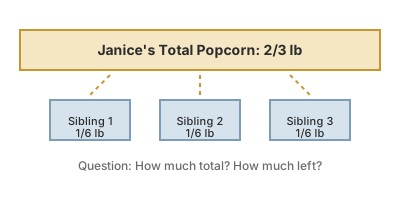
The diagram shows Janice's original popcorn being divided into three equal bags for her siblings, with the question of whether enough remains for a fourth bag.
Solution: Method 1 — Addition and Subtraction
Step 1 — Find the total popcorn used for siblings
Each sibling gets one bag holding 1/6 pound. There are 3 siblings, so we need to find:
When adding fractions with the same denominator, we add the numerators and keep the denominator:
Simplify by dividing both numerator and denominator by their greatest common divisor (3):
Step 2 — Find how much popcorn is left for Janice
Janice started with 2/3 pound and used 1/2 pound for her siblings. We need:
To subtract fractions with different denominators, find a common denominator. The LCD of 3 and 2 is 6:
Now subtract:
Step 3 — Check if Janice has enough for herself
One bag holds 1/6 pound. Janice has exactly 1/6 pound remaining.
Answer: Yes, she has exactly enough to fill one more bag for herself.
Solution: Method 2 — Multiplication Approach
Step 1 — Use multiplication for the total
Instead of adding 1/6 + 1/6 + 1/6, we can multiply:
Multiplication is simply a shortcut for repeated addition when we have equal amounts.
Step 2 — Calculate the remainder
Following the same subtraction as Method 1:
Step 3 — Compare to bag requirement
Since 1/6 = 1/6, Janice has exactly enough for one more bag.
Verification
Let's check our work by adding up all the popcorn use:
Convert to common denominator:
This equals exactly what Janice brought originally (2/3 pound), so our answer is correct.
Does This Seem Reasonable?
The answer passes a common-sense check. Janice brought about 0.67 pounds, used 0.5 pounds for siblings, leaving about 0.17 pounds. Since each bag needs about 0.17 pounds, having exactly enough for one more bag makes perfect sense.
Notice that the leftover amount (1/6) is relatively small compared to what she used for siblings (3/6). This makes intuitive sense — she's sharing with three people, so most of the popcorn goes to them, with just enough left for herself.
What Trips Students Up
Mistake 1: Adding the denominators
When adding fractions with the same denominator, students sometimes add both numerators AND denominators. The denominator stays the same — we're counting how many sixths, not creating smaller pieces.
Mistake 2: Subtracting without common denominators
Some students subtract numerators and denominators separately (2-1)/(3-2). This doesn't work because you're subtracting different-sized pieces. Always convert to common denominators first.
Mistake 3: Confusing "enough" with "exactly"
Students sometimes estimate rather than calculate precisely. The beauty of this problem is that the answer is exactly 1/6 — not more, not less. Being precise with fractions matters.
The Pattern Behind This
This problem follows the classic sharing and remainder structure that appears throughout elementary mathematics:
In fraction form:
This same pattern works for whole numbers (sharing 20 cookies among 6 people), decimals (sharing $5.50 among 3 people), and fractions. The key insight is that subtraction and addition are inverse operations, so we can always check our work by adding everything back together.
Where This Shows Up in Real Life
- Cooking and baking: Dividing recipe ingredients among portions, then checking if enough remains for another serving
- Medicine dosing: A nurse calculating individual doses from a larger vial and determining if enough medication remains for additional patients
- Manufacturing: Cutting material into specific lengths and calculating waste or leftover material for additional pieces
Four "What-If?" Problems
Four friends × 1/6 pound each = 4 × 1/6 = 4/6 = 2/3 pound
5/6 - 2/3 = 5/6 - 4/6 = 1/6 pound remaining
Since 1/6 = 1/6, yes, she has exactly enough for herself.
2/3 + 1/6 = 4/6 + 1/6 = 5/6 ✓
Total brought = Used for siblings + Left over
3/4 = Used for siblings + 3/8
Used for siblings = 3/4 - 3/8
Convert to common denominator: 6/8 - 3/8 = 3/8 pound
3 × 1/8 = 3/8 pound, which matches our calculation
3/8 + 3/8 = 6/8 = 3/4 ✓
First sibling: 1 bag, Second sibling: 2 bags, Third sibling: 1 bag
Total bags = 1 + 2 + 1 = 4 bags
4 × 1/6 = 4/6 = 2/3 pound used
1 - 2/3 = 3/3 - 2/3 = 1/3 pound remaining
Janice needs 1/6 pound. She has 1/3 = 2/6 pound.
Yes, with 2/6 - 1/6 = 1/6 pound extra remaining.
Used = Total - Leftover = 3/4 - 1/6
Convert to common denominator: 9/12 - 2/12 = 7/12 pound
Each bag = 7/12 ÷ 4 = 7/12 × 1/4 = 7/48 pound
Janice has 1/6 pound but needs 7/48 pound for a full bag
Convert: 1/6 = 8/48 and 7/48 = 7/48
Since 8/48 > 7/48, she has enough! Extra = 8/48 - 7/48 = 1/48 pound
Answer: Each bag holds 7/48 pound. She needs no additional popcorn.
Frequently Asked Questions
2026-06-01