




Theater Ticket Sales: Solving a System of Equations
Globe Theater at Odessa College sold 400 tickets to the evening musical for a total of 3,100.00. Each adult ticket was sold for 9.00 and each child ticket was sold for 5.00. How many adult and child tickets were sold? A] Show how you represent your variables, choose x and y. B] Show how you write the systems of equations. C] Find the solution - Show all work.
Note: the amounts are in dollars, so the revenue is $3,100.00, adult tickets cost $9.00, and child tickets cost $5.00.
Already Got the Answer?
Variables:x = adult tickets, y = child tickets.
System:x + y = 400 and 9x + 5y = 3100.
Answer: 275 adult tickets and 125 child tickets.
One-line check:9(275) + 5(125) = 2475 + 625 = 3100 ✓ and 275 + 125 = 400 ✓
If your numbers match, skip ahead to the pitfalls and the four extension problems. If they don't, the most common culprit is attaching a price to the wrong variable.
Skills This Problem Builds
- Translating a story into two equations. One equation counts things (tickets) and one counts value (dollars). This pairing shows up in almost every "two types of item" problem.
- Choosing and declaring variables. Part A of the problem is not busywork. A clearly defined variable is what keeps the later algebra honest.
- Substitution and elimination as two routes to the same place. You'll see why they must agree, and how to pick the more convenient one.
- Reasoning about weighted averages. The answer is pulled toward the cheaper or dearer ticket depending on how the revenue compares with the average price.
- Checking against the story. A solution must satisfy both equations and be a sensible number of tickets.
The Setup: Organize Before You Write Equations
Two ticket types, each with a price, a count, and a revenue. Putting them in a table first turns a paragraph of words into a grid you can read off, and the two equations come straight from the table.
| Ticket type | Price each | Number sold | Money collected |
|---|---|---|---|
| Adult | $9 | x | 9x |
| Child | $5 | y | 5y |
| Total | — | 400 | $3,100 |
Solution: Method 1 — Substitution
Substitution works well here because the ticket-count equation is already almost solved for one variable. We'll follow the three parts the problem asks for.
Part A — Represent the variables
Name exactly what each letter counts, with its unit. "x = adults" is too vague. Say what is being counted.
Part B — Write the system of equations
The first equation says the two kinds of tickets together make 400. The second says the money from each kind, price times quantity, adds up to $3,100.
Both equations are measured in different units: equation (1) is in tickets, equation (2) is in dollars. Never mix them. That is why you need two equations rather than one.
Part C, Step 1 — Solve equation (1) for y
Subtract x from both sides to express the child tickets in terms of the adult tickets:
Part C, Step 2 — Substitute into equation (2)
Wherever y appears in the revenue equation, write 400 − x instead. The parentheses matter: the 5 multiplies the whole quantity.
Part C, Step 3 — Solve for x
Part C, Step 4 — Back-substitute to find y
So 275 adult tickets and 125 child tickets were sold. Notice the number 4 in 4x: it's the difference between the two prices ($9 − $5). That's not a coincidence, and Method 3 and the pattern section both build on it.
Solution: Method 2 — Elimination
Elimination is different in structure: instead of solving for one variable, you add or subtract whole equations so a variable disappears. Both equations have a 5y-compatible term waiting to be matched.
Step 1 — Line up the equations
Step 2 — Multiply equation (1) so the y-coefficients match
Multiply every term of (1) by 5. This is legal because it applies the same operation to both sides.
Step 3 — Subtract (1′) from (2)
The 5y terms cancel, leaving one equation in one unknown.
Step 4 — Find y
Put x = 275 into the simpler equation (1): 275 + y = 400, so y = 125. Same answer as substitution, as it must be.
Solution: Method 3 — The "Everyone Buys a Child Ticket" Baseline
This approach needs no variables at all. It's the reasoning hiding inside the algebra, and it's worth knowing because it lets you do the problem on the back of an envelope.
- Pretend all 400 tickets were child tickets. Revenue would be
400 × $5 = $2,000. - Compare with reality. The actual revenue was $3,100, so there is a shortfall of
$3,100 − $2,000 = $1,100. - Each swap closes part of the gap. Changing one child ticket into an adult ticket adds
$9 − $5 = $4. - Count the swaps needed.
$1,100 ÷ $4 = 275swaps, meaning 275 adult tickets. The remaining400 − 275 = 125are child tickets.
Ancient problem-solvers used exactly this "assume all one kind, then correct" idea long before algebraic notation existed. The algebra in Methods 1 and 2 is the same computation: the 2000 and the 4x appear in both.
The Answer
Adult tickets: x = 275
Child tickets: y = 125
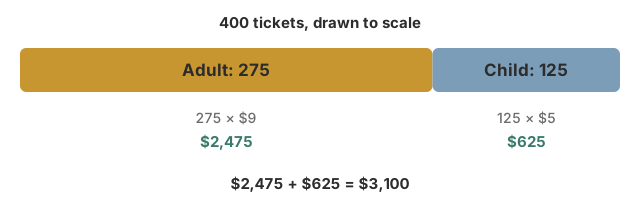
Total: 275 + 125 = 400 tickets, bringing in $3,100.00.
Verification: Test Both Equations
A solution to a system must satisfy every equation. Checking only one is the classic way to miss an error.
Equation (1), tickets:275 + 125 = 400 ✓
Equation (2), dollars:9(275) + 5(125) = 2475 + 625 = 3100 ✓
Context check: both counts are whole, positive numbers, so they make sense as tickets. ✓
Here is what the verified answer looks like. The bar is drawn to scale, with 400 tickets across its full width:
Sanity Check: The Average-Price Argument
You can predict roughly where the answer should land before doing any algebra. The average revenue per ticket is $3,100 ÷ 400 = $7.75. That has to sit between the child price ($5) and the adult price ($9), and it does.
| If the split were… | Average price | Revenue for 400 tickets | Matches $3,100? |
|---|---|---|---|
| All child (0 adult) | $5.00 | $2,000 | No, too low |
| Half and half (200 / 200) | $7.00 | $2,800 | No, still too low |
| 275 adult / 125 child | $7.75 | $3,100 | Yes ✓ |
| All adult (400 adult) | $9.00 | $3,600 | No, too high |
$7.75 is closer to $9 than to $5, so adults should be the majority, and 275 out of 400 (about 69%) fits. In fact, $7.75 is exactly 69% of the way from $5 to $9 (since 2.75 ÷ 4 = 0.6875), which is the same 275/400.
What Trips People Up
Prices attached to the wrong variable. If x is adults, then the $9 must multiply x. Students often write the terms in the order the numbers appear in the story, losing track of which letter means what. This is exactly why Part A asks you to define the variables first, and why the table above is worth building.
Swapping the totals. The 400 counts tickets, so it belongs with the equation whose terms are tickets (x + y). The $3,100 counts dollars, so it belongs with the equation whose terms are price × tickets. A quick unit check on each side catches this immediately.
Distributing the 5 to only one term. Substitution creates a parenthesis, and 5(400 − x) is 2000 − 5x, not 2000 − x. Dropping the 5 on the second term gives 8x = 1100 and the non-integer x = 137.5. A fractional ticket count is your warning that something went wrong.
Stopping after one variable. The question asks for both adult and child tickets. Always finish with a labeled sentence: 275 adult tickets and 125 child tickets.
If You See These Words…
This problem belongs to the most common family in applied algebra: two unknown quantities, two kinds of information. Look for:
- A total count ("sold 400 tickets," "30 coins," "50 animals") combined with a total value ("for a total of $3,100," "worth $4.10," "100 legs").
- Two items with different unit values ("each adult ticket…, each child ticket…").
- A question that asks "how many of each?"
The same structure hides behind very different stories: nickels and dimes, two grades of coffee mixed to a target price, or chickens and rabbits counted by legs. If you can fill in a table like the one above, you can write the system.
A disguised twin: "A farmer has 400 animals, chickens and pigs, with 1,100 legs in total." Using 2 legs and 4 legs in place of $5 and $9, it's the same shape, and the same "all one kind, then adjust" shortcut applies.
The Pattern Behind Every "Total Count, Total Value" Problem
Let there be N items in total with total value R. Item A is worth p each and item B is worth q each (with p > q). The system is:
Substituting b = N − a and solving gives a formula you can use directly:
The numerator, R − qN, is the "shortfall over the all-cheap baseline," and the denominator, p − q, is the gain per swap. That is Method 3 in symbols. For our theater: a = (3100 − 5·400) ÷ (9 − 5) = 1100 ÷ 4 = 275.
Limits of the shortcut: It requires exactly two item types, and it only makes sense if the result is a whole number between 0 and N. When a third type enters, you need a third equation (see What-If #3). Treat the formula as a way to check your work, not as a replacement for being able to set up the system.
When the Answer Isn't a Whole Number
Suppose a typo changed the revenue to $3,107 while everything else stayed the same. The method doesn't change at all:
You can't sell three-quarters of a ticket. A messy result for something that must be counted means the problem is inconsistent, not that your algebra is broken (provided you've rechecked your setup). Here, with $5 and $9 tickets, every possible revenue for 400 tickets is 2000 + 4x, so it must be a multiple of 4 more than 2,000, and 3,107 is not.
Beyond the Textbook
- Event budgeting. Box offices use exactly this reasoning to work backward from revenue and attendance to the ticket mix, which tells them how many discounted seats they gave away.
- Pharmacy and chemistry. Replace "adult" and "child" with a 10% solution and a 30% solution, and the same pair of equations (amount and amount-of-substance) governs mixtures.
- Retail and inventory. A shop that knows the number of items sold and the total sales can estimate how many were premium-priced versus standard-priced.
A Brief History
The "total count, total value" puzzle is ancient. The Chinese text Sunzi Suanjing (roughly 4th–5th century CE) poses the famous chickens-and-rabbits problem: given the number of heads and the number of feet, find how many of each. The classic solution is the same "assume all one kind, then adjust" trick used in Method 3. Methods of eliminating variables from simultaneous equations also appear in the Chinese Nine Chapters on the Mathematical Art, many centuries before Western algebra adopted them. These problems stay in the curriculum because they teach the central idea of algebra: one story can produce two constraints.
Extend Your Thinking
Four variations, roughly in order of difficulty. Try each on paper first, then reveal the solution to compare.
For the matinee, the theater sold 400 tickets for a total of $2,900. Adult tickets cost $8 and child tickets cost $5. How many adult and how many child tickets were sold?
Let x = adult tickets and y = child tickets.
Tickets: x + y = 400. Revenue: 8x + 5y = 2900.
From the first equation, y = 400 − x. Then 8x + 5(400 − x) = 2900, which simplifies to 3x + 2000 = 2900.
3x = 900, so x = 300. Then y = 400 − 300 = 100.
300 + 100 = 400 ✓ and 8(300) + 5(100) = 2400 + 500 = 2900 ✓
300 adult tickets and 100 child tickets. Notice the gain per swap is now $8 − $5 = $3, so the coefficient of x is 3 instead of 4.
At a family-night show, adult tickets cost $9 and child tickets cost $5. The theater sold 150 more child tickets than adult tickets, and the total revenue was $3,550. How many tickets of each type were sold?
Let x = adult tickets and y = child tickets.
This is a difference, not a total: y = x + 150. The revenue equation is 9x + 5y = 3550.
Since y is already isolated: 9x + 5(x + 150) = 3550, so 14x + 750 = 3550.
14x = 2800, so x = 200. Then y = 200 + 150 = 350.
350 − 200 = 150 ✓ and 9(200) + 5(350) = 1800 + 1750 = 3550 ✓
200 adult tickets and 350 child tickets. The "all-child baseline" shortcut does not apply directly here because the total count is not given, so the system is the right tool.
Now the theater also sells student tickets for $6. For one performance it sold 450 tickets in total for $3,150. Adult tickets cost $9 and child tickets cost $5, and the number of adult tickets was twice the number of student tickets. How many of each type were sold?
Let x = adult, y = child, z = student tickets. Three unknowns need three equations.
x + y + z = 450, 9x + 5y + 6z = 3150, and x = 2z.
Put x = 2z into the first equation: 2z + y + z = 450, so y = 450 − 3z.
9(2z) + 5(450 − 3z) + 6z = 3150 → 18z + 2250 − 15z + 6z = 3150 → 9z + 2250 = 3150.
9z = 900, so z = 100. Then x = 2(100) = 200 and y = 450 − 300 = 150.
200 + 150 + 100 = 450 ✓; 9(200) + 5(150) + 6(100) = 1800 + 750 + 600 = 3150 ✓; 200 = 2(100) ✓
200 adult, 150 child, and 100 student tickets.
Back to the original show: 400 tickets will be sold, adult tickets cost $9, and child tickets cost $5. The college needs the evening to bring in at least $3,400. What is the minimum number of adult tickets that must be sold? Then explain whether the goal is still reachable if only 320 adult tickets can be sold at most.
Let x = adult tickets, so child tickets are 400 − x. Revenue is R = 9x + 5(400 − x) = 4x + 2000.
"At least $3,400" means 4x + 2000 ≥ 3400.
4x ≥ 1400, so x ≥ 350. The coefficient 4 is positive, so the inequality direction is unchanged.
At x = 350: 9(350) + 5(50) = 3150 + 250 = 3400 ✓ (meets the goal exactly). At x = 349: 3141 + 255 = 3396, which falls short. So 350 is the minimum.
With at most 320 adult tickets, the largest possible revenue is 4(320) + 2000 = 3280, which is less than $3,400.
At least 350 adult tickets are needed (x ≥ 350). With a cap of 320 adults, the maximum revenue is $3,280, so the goal cannot be reached. Here every extra adult ticket adds $4, which is why the revenue line is easy to reason about.
Frequently Asked Questions
2026-08-21