




How to Solve Glucose Solution Mixture Problems
What This Problem Teaches
- Setting up mixture equations where one component has zero concentration
- Understanding that mass of the active ingredient is conserved during dilution
- Converting between percentage concentrations and actual amounts
- Applying algebra to real-world medical dosage scenarios
- Checking solutions by verifying the final concentration matches the target
Visualizing the Mixture
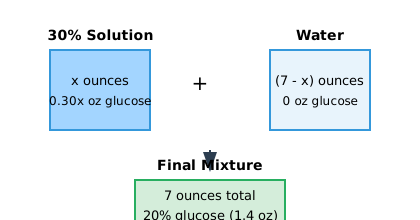
| Component | Volume (oz) | Glucose % | Pure Glucose (oz) |
|---|---|---|---|
| 30% Solution | x | 30% | 0.30x |
| Water | 7 - x | 0% | 0 |
| Final Mixture | 7 | 20% | 1.4 |
Solution: Method 1 — The Mass Conservation Approach
The key insight is that when we dilute a solution, the amount of pure glucose doesn't change—we're only adding water. Let's track the glucose mass through the mixing process.
Step 1 — Define the variable
Let x = ounces of 30% glucose solution needed
Then 7 - x = ounces of water to be added (since water has 0% glucose)
Step 2 — Calculate the target glucose amount
The final mixture should be 7 ounces at 20% concentration:
Step 3 — Set up the glucose mass equation
The glucose comes entirely from the 30% solution (water contributes zero glucose):
0.30x = 1.4
Step 4 — Solve for x
x = 1.4 ÷ 0.30
x = 4.67 ounces (rounded to nearest hundredth)
Step 5 — Calculate water needed
Solution: Method 2 — The Alligation Method
Alligation is a traditional technique for mixture problems that uses the concentration differences to find the proper ratio of components.
Step 1 — Set up the alligation grid
We're mixing 30% solution with 0% (water) to get 20%:
Step 2 — Calculate the ratio
The differences from the target concentration (20%) are:
20% - 0% = 20 (this becomes the ratio for 30% solution)
Step 3 — Apply the ratio to find amounts
The ratio is 20:10, or simplified, 2:1 (30% solution : water)
For every 3 parts total, 2 parts are 30% solution and 1 part is water.
Water needed = (1/3) × 7 = 2.33 ounces
Verification
Let's confirm our answer by checking that the final mixture has the correct concentration:
Total volume = 4.67 + 2.33 = 7.00 ounces
Final concentration = 1.40 ÷ 7.00 = 0.20 = 20% ✓
Perfect! Our mixture contains exactly 20% glucose as required.
Common Pitfalls
✗ Mistake 1: Confusing volume percentages with mass percentages
In medical contexts, glucose percentages are typically weight/volume (w/v), not volume/volume. Don't assume equal volumes when working with different concentrations.
✗ Mistake 2: Setting up the equation backwards
Writing 1.4 = 0.20x instead of 0.30x = 1.4. Remember: the glucose comes from the 30% solution, not from 20% of the unknown amount.
✗ Mistake 3: Unit confusion in medical dosing
In clinical practice, precise measurements are critical. Rounding 4.666... to 4.7 instead of 4.67 could be significant when dealing with actual medication preparation.
Clinical Safety Note: In real medical settings, always follow institutional protocols for solution preparation and double-check calculations. Even small errors in concentration can have serious consequences for patient safety.
How to Spot This Problem Type
Watch for these key phrases that signal a dilution mixture problem:
- "Decrease the concentration" or "dilute the solution"
- One component is water or has 0% concentration
- "Prepare [amount] of [concentration] solution using..."
- Medical contexts mentioning dosage adjustments for different patients
- Any problem asking for "how much of each" when mixing solutions
NCLEX Connection: This exact problem type appears frequently on nursing exams, particularly in pediatric dosage calculations where adult medications must be diluted for children.
The Pattern Behind This
For any dilution problem where you're mixing a concentrated solution with water:
When diluting with pure water, this simplifies to:
where x = amount of original solution needed
This formula works for any dilution scenario—from medical preparations to laboratory solutions to even diluting paint or cleaning products.
Important limitation: This assumes the volumes are additive (no significant volume change upon mixing). For most aqueous solutions at normal concentrations, this is valid, but be aware it may not hold for all chemical systems.
Where This Shows Up in Real Life
- Pharmacy: Diluting stock medications to appropriate pediatric concentrations
- Laboratory work: Preparing solutions of specific molarity from concentrated stock solutions
- Food service: Diluting concentrated syrups or cleaning solutions to working strength
Four "What-If?" Problems
We have 4 ounces of 30% solution, containing 0.30 × 4 = 1.2 ounces of pure glucose.
If 1.2 oz of glucose makes 20% concentration: 1.2 ÷ 0.20 = 6 ounces total volume needed.
Water needed = 6 - 4 = 2 ounces
Final: 6 ounces with 1.2 oz glucose = 1.2 ÷ 6 = 0.20 = 20% ✓
Answer: Add 2 ounces of water for 6 ounces total
From 30% solution: 5 × 0.30 = 1.5 ounces of glucose
From water: 3 × 0 = 0 ounces of glucose
Total volume = 5 + 3 = 8 ounces
Final concentration = 1.5 ÷ 8 = 0.1875 = 18.75%
Check: 18.75% × 8 = 1.5 ounces glucose ✓
Answer: The resulting solution is 18.75% glucose
Let x = ounces of 30% solution, 7-x = ounces of 5% solution
Glucose from both solutions = Final glucose amount
0.30x + 0.05(7-x) = 0.20(7)
0.30x + 0.35 - 0.05x = 1.4
0.25x = 1.05
x = 4.2 ounces
30% solution: 4.2 oz, 5% solution: 2.8 oz
Total glucose: 0.30(4.2) + 0.05(2.8) = 1.26 + 0.14 = 1.4 ✓
Answer: 4.2 ounces of 30% solution, 2.8 ounces of 5% solution
Let x = ounces of 30% solution, y = ounces of 15% solution
Volume: x + y = 7
Glucose: 0.30x + 0.15y = 0.25(7) = 1.75
From first equation: y = 7 - x
Substitute: 0.30x + 0.15(7-x) = 1.75
0.30x + 1.05 - 0.15x = 1.75
0.15x = 0.70
x = 4.67 ounces of 30% solution
y = 7 - 4.67 = 2.33 ounces of 15% solution
Total glucose: 0.30(4.67) + 0.15(2.33) = 1.40 + 0.35 = 1.75 ✓
Answer: 4.67 ounces of 30% solution, 2.33 ounces of 15% solution
Frequently Asked Questions
2026-05-29