




Probability That a Jury Consists of All Women
A jury pool has 24 men and 25 women, from which 12 jurors will be selected. Assuming that each person is equally likely to be chosen and that the jury is selected at random, find the probability that the jury consists of all women.
Already Got the Answer?
Setup: P = (ways to pick 12 of the 25 women) ÷ (ways to pick 12 of all 49 people) = C(25,12) ÷ C(49,12)
Answer: 5,200,300 ÷ 92,263,734,836 = 425/7,540,351 ≈ 0.0000564 ≈ 0.00564%
One-line check: 425/7,540,351 × 92,263,734,836 = 5,200,300, which equals C(25,12) exactly. Also, 0.0000564 is less than (25/49)¹² ≈ 0.000311, as it must be without replacement.
What You Will Learn
- Counting by groups, not by order. You will see why "choose 12 people" is a combinations count, and why the order of selection is irrelevant for a jury.
- The favorable ÷ total framework. This is the engine of equally-likely probability, and here both counts come from the same formula.
- Sampling without replacement. You will see the same answer arise two ways: a ratio of combinations and a chain of shrinking fractions.
- Reading a tiny probability. An answer like 0.0000564 looks like an error until you learn to judge it against a benchmark.
- The hypergeometric pattern. It governs every "draw a sample from two types" problem, from card hands to quality control.
Check Your Foundation
Make sure you are comfortable with these before diving in:
- Factorials: n! = n × (n−1) × … × 1, and 0! = 1.
- Combinations: C(n, k) = n! ÷ (k!(n−k)!), the number of ways to choose k items from n when order does not matter. Many calculators have an
nCrkey. - Basic probability: P(event) = favorable outcomes ÷ total equally likely outcomes.
- Simplifying fractions by cancelling common factors.
Picture This
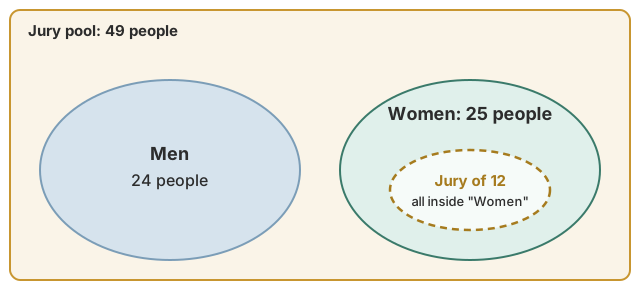
Before computing anything, look at the structure of the situation. Men and women are two separate groups with no overlap, and the jury is a sample of 12 drawn from the whole pool. We want the sample to land entirely inside the women's region.
Solution: Method 1 — The Ratio of Combinations
Because every person is equally likely to be chosen, every possible 12-person jury is equally likely too. That puts us in the simplest probability setting there is: count the successes, count everything, divide.
Step 1 — Count every possible jury
A jury is a group: if Ana and Ben are both on it, it does not matter who was drawn first. So we use combinations. There are 24 + 25 = 49 people, and we choose 12:
That is more than 92 billion different possible juries.
Step 2 — Count the all-women juries
For the jury to be all women, all 12 members must come from the 25 women, and the 24 men play no part. The number of ways to choose 12 women from 25 is:
Step 3 — Build the probability
= C(25, 12) / C(49, 12)
= 5,200,300 / 92,263,734,836
Step 4 — Simplify
Write both counts as products of primes and cancel. The numerator and denominator share 2¹², 3⁵, 5², 7², 11, 19 and 23, which leaves:
Denominator: 7 · 13 · 41 · 43 · 47 = 7,540,351
P = 425 / 7,540,351
Step 5 — Convert to a decimal and percentage
0.0000564 × 100 ≈ 0.00564%
1 ÷ 0.0000564 ≈ 17,742 → about 1 jury in 17,742
Solution: Method 2 — Drawing Jurors One at a Time
Method 1 treats the jury as one big group. Here we build it person by person, which shows why the probability is so small: every juror must be a woman, and each draw removes a woman from the pool.
Step 1 — First juror
25 of the 49 people are women, so P(woman) = 25/49.
Step 2 — Second juror, given the first was a woman
The chosen woman is gone. Now 24 women remain among 48 people, so the probability is 24/48. Both the favorable count and the total drop by one, which is what "without replacement" does.
Step 3 — Continue for all 12 jurors
Multiply the conditional probabilities. The running product is shown below:
| Juror | Fraction | Running product |
|---|---|---|
| 1 | 25/49 | 0.51020 |
| 2 | 24/48 | 0.25510 |
| 3 | 23/47 | 0.12485 |
| 4 | 22/46 | 0.05971 |
| 5 | 21/45 | 0.02787 |
| 6 | 20/44 | 0.01267 |
| 7 | 19/43 | 0.005597 |
| 8 | 18/42 | 0.002399 |
| 9 | 17/41 | 0.000995 |
| 10 | 16/40 | 0.000398 |
| 11 | 15/39 | 0.000153 |
| 12 | 14/38 | 0.0000564 |
Step 4 — Write the full product and match it to Method 1
= 425 / 7,540,351
This is exactly C(25,12)/C(49,12) written differently. Multiply top and bottom by 12! and the combinations formula appears. The two methods are the same calculation viewed from two angles.
Notice the row for juror 10. The running product after ten draws is the probability that a 10-person jury is all women. Each additional juror multiplies the chance by a fraction below one half, so the probability collapses quickly.
The Answer
Verification
Check 1 — Reverse the simplification. 92,263,734,836 ÷ 7,540,351 = 12,236. Then 425 × 12,236 = 5,200,300 = C(25,12) ✓. The reduced fraction therefore equals the original ratio exactly.
Check 2 — Two methods agree. The product of the twelve fractions in Method 2 reduces to 425/7,540,351, the same fraction as Method 1 ✓.
Check 3 — Bounds. Every fraction in the chain lies between 14/38 ≈ 0.368 and 25/49 ≈ 0.510. So the answer must lie between 0.368¹² ≈ 0.0000063 and 0.510¹² ≈ 0.000311. Our 0.0000564 sits inside that window ✓. It is also between 0 and 1, as any probability must be.
Does This Seem Reasonable?
Probabilities this small look suspicious, so it helps to compare the answer with some simple benchmarks.
| Benchmark | Value | What it tells you |
|---|---|---|
| "Coin flip" guess: (1/2)¹² | ≈ 0.000244 | Women are slightly more than half the pool, but this is a rough ceiling |
| With replacement: (25/49)¹² | ≈ 0.000311 | Too big, because it lets the same woman be chosen repeatedly |
| True answer (no replacement) | ≈ 0.0000564 | About 5 times smaller than the "with replacement" estimate |
Why is the true value so much smaller? Without replacement, every woman drawn leaves fewer women in a smaller pool. By the twelfth draw only 14 of the remaining 38 people are women, about 37%. That shrinking ratio is why the final product falls below even the "ceiling" guesses.
Three Mistakes That Are Easy to Make
✗ P = (25/49)¹² ≈ 0.000311
This treats the 12 draws as independent, as if each juror were picked from the full pool and then put back. A person cannot serve on the same jury twice, so the pool shrinks with each pick. This approach is only a reasonable approximation when the pool is huge compared with the sample.
✗ P = 12/25 or 25/49 or "about half"
These answers only describe a single person, not a whole jury of 12. The question is about every juror being a woman, which requires twelve things to go right at once. Whenever a problem says "all," expect the probability to be much smaller than the single-event probability.
✗ P = C(25,12) / P(49,12) (combinations on top, permutations on the bottom)
Mixing the two counting methods gives a ratio that is off by a factor of 12! = 479,001,600. Whatever you use on top, use on the bottom. Since the order of jurors does not matter here, use combinations in both places.
Decimal and percent slip: 0.0000564 is 0.00564%, not 0.0564% and not 5.64%. Multiplying by 100 moves the decimal point two places, so count carefully before you write a percentage.
The Pattern Behind This
This problem is a member of the hypergeometric family: you draw a sample without replacement from a population made of two kinds of items, and you ask how many of each kind you got. The general formula is:
Here A = 25 women, B = 24 men, n = 12, and we want k = 12. Because k = n, the second factor is C(24, 0) = 1, which is why only one combination appears in the numerator. The problem is the simplest corner of the formula.
The structure is the same in many other settings. Replace "women" with "aces," "defective parts," or "voters who support the measure," and the calculation does not change.
Limit of the formula: It requires a random sample without replacement in which every individual is equally likely. If some people were more likely to be chosen, the equal-likelihood counting argument would no longer hold.
Beyond the Textbook
- Jury fairness analysis. Lawyers and statisticians compute probabilities like this to ask whether a lopsided jury could plausibly be the result of a random draw. An event with a probability of 1 in 17,742 would raise serious questions about the selection process.
- Quality control. Pulling 12 parts from a crate and finding all of them defective, or all good, uses the same formula.
- Card games and lotteries. The odds of a specific kind of poker hand or a lottery jackpot are hypergeometric counts: C(favorable) ÷ C(total).
Try These Variations
Each variation changes one thing about the setup. Work it on paper first, then reveal the solution to compare.
Using the same pool of 24 men and 25 women and a jury of 12, what is the probability that the jury consists of all men?
The total does not change: C(49, 12) = 92,263,734,836.
Choose all 12 jurors from the 24 men: C(24, 12) = 2,704,156.
P = 2,704,156 / 92,263,734,836.
Cancelling common prime factors leaves 17 / 580,027, which is about 0.0000293, or 0.00293%.
The ratio to the all-women answer should be C(25,12)/C(24,12) = 25/13 ≈ 1.923. Dividing 0.0000564 by 0.0000293 gives about 1.92 ✓. So P(all men) = 17/580,027 ≈ 0.0000293, about half the all-women probability, as expected from the slightly smaller number of men.
If only 10 jurors are selected from the original pool of 24 men and 25 women, what is the probability that the jury is all women?
Choose 10 from 49: C(49, 10) = 8,217,822,536.
Choose 10 women from 25: C(25, 10) = 3,268,760.
P = 3,268,760 / 8,217,822,536. After cancelling, this equals 1,615 / 4,060,189.
1,615 ÷ 4,060,189 ≈ 0.000398, or about 1 chance in 2,514.
This matches the running product after ten draws in the Method 2 table (0.000398) ✓. P ≈ 0.000398, which is about 7 times more likely than with 12 jurors, because two fewer draws means two fewer fractions below one half.
Suppose the pool changes to 35 women and 14 men (still 49 people), and 12 jurors are selected at random. What is the probability that the jury is all women?
The pool is still 49 people and the jury still has 12 members, so C(49, 12) = 92,263,734,836.
Choose 12 from the 35 women: C(35, 12) = 834,451,800.
P = 834,451,800 / 92,263,734,836.
Dividing gives ≈ 0.00904, or about 0.904%, which is roughly 1 chance in 111.
Check against the chain of fractions: the first factor is 35/49 ≈ 0.714 and the last is 24/38 ≈ 0.632, so the answer lies between 0.632¹² ≈ 0.0041 and 0.714¹² ≈ 0.0175. Our 0.00904 fits ✓. P ≈ 0.00904, which is about 160 times larger than the original answer. Increasing the number of women from 25 to 35 has a huge effect, because the shrinking ratio is raised to the twelfth power.
In the original pool of 24 men and 25 women, what is the probability that the 12-person jury has exactly 6 women and 6 men?
As before, C(49, 12) = 92,263,734,836.
Choose 6 women from 25: C(25, 6) = 177,100.
Choose 6 men from 24: C(24, 6) = 134,596.
The two choices are independent, so multiply them: 177,100 × 134,596 = 23,836,951,600. Then P = 23,836,951,600 / 92,263,734,836 ≈ 0.2584.
The balanced split should be the single most likely composition, and a probability near 26% is plausible, since the other possibilities (from 0 to 12 women) share the remaining 74%. The all-women case (about 0.0056%) is vastly rarer ✓. P ≈ 0.258, or about 25.8%. The contrast with the original answer shows the effect of requiring a specific arrangement: all-women is one extreme out of 13 possible compositions, and a balanced one is the most typical.
Frequently Asked Questions
2026-10-17