




Systems of Equations: Lemonade Stand Cup Problem
Salma has set up a lemonade stand outside her house and sells small cups and large cups of lemonade. Each small cup holds 12 ounces of lemonade and each large cup hold 16 ounces of lemonade. Salma sold 60 cups of lemonade totaling 920 ounces. Determine the number of small cups sold and the number of large cups sold.
Already Got the Answer?
- Setup:
s + L = 60and12s + 16L = 920 - Answer: 10 small cups and 50 large cups
- One-line check:
12(10) + 16(50) = 120 + 800 = 920ounces, and10 + 50 = 60cups
If your numbers match, skip ahead to the pitfalls and the What-If problems. If they don't, the three methods below will show you where things diverged.
What You Will Learn
- Two quantities, two equations. The problem gives you a total count and a total amount. Each needs its own equation, and keeping these two ideas separate is the central skill.
- Turning "per-item size × number of items" into algebra. The term
12smeans "12 ounces per cup, times s cups," which is total ounces from small cups. - Substitution as a tool. When one equation says "these two add to a total," you can rewrite one variable in terms of the other and reduce the problem to one unknown.
- Reasoning without algebra. The "assume everything is small" trick and the weighted-average view reach the same answer using only arithmetic, and they explain why the algebra works.
- Checking against context. Counts of cups must be whole, non-negative numbers. A result like 12.5 cups tells you an equation is wrong.
Picture This
Before writing any equations, it helps to organize what the problem actually gives you. Two cup sizes, two totals:
| Cup size | Ounces per cup | Number sold | Ounces from this size |
|---|---|---|---|
| Small | 12 | s | 12s |
| Large | 16 | L | 16L |
| Total | — | 60 | 920 |
Read the "Total" row across: the "Number sold" column must add to 60, and the "Ounces from this size" column must add to 920. Those are the two equations, already waiting for us.
Solution: Method 1 — Substitution, One Variable at a Time
This is the standard classroom approach. We write the two facts from the table as equations, use the simpler one to eliminate a variable, and solve what's left.
Step 1 — Define the variables
Let s = the number of small (12 oz) cups sold and L = the number of large (16 oz) cups sold. Choosing letters that remind you of the quantity ("s" for small, "L" for large) helps avoid mix-ups later.
Step 2 — Write the cup-count equation
Salma sold 60 cups in total, so the small cups plus the large cups must equal 60:
Step 3 — Write the total-ounces equation
Each small cup contributes 12 ounces, so s small cups contribute 12s ounces. Each large cup contributes 16 ounces, so L large cups contribute 16L ounces. Together they total 920 ounces:
Step 4 — Solve the count equation for one variable
The first equation is the easiest to rearrange, since neither variable has a coefficient to divide out. Solving for L:
Step 5 — Substitute into the ounces equation
Replace L in 12s + 16L = 920 with (60 − s). The parentheses matter, because the 16 must multiply the entire expression:
Step 6 — Find the other variable
Go back to the simple equation: L = 60 − s = 60 − 10 = 50.
So Salma sold 10 small cups and 50 large cups.
Elimination works equally well. Multiply s + L = 60 by 12 to get 12s + 12L = 720, then subtract from 12s + 16L = 920. The s terms cancel, leaving 4L = 200, so L = 50. Same answer, different route.
Solution: Method 2 — The "Pretend They're All Small" Approach
You can solve this problem with arithmetic alone, no variables, by running an imaginary experiment. This is the same idea as the algebra above, stripped to its core.
Step 1 — Imagine all 60 cups were small
If every cup held 12 ounces, the total would be 60 × 12 = 720 ounces.
Step 2 — Measure the gap
The real total is 920 ounces, which is 920 − 720 = 200 ounces more than our imaginary total. Those 200 "extra" ounces have to come from somewhere.
Step 3 — Count what one swap adds
Replacing one small cup with one large cup adds 16 − 12 = 4 ounces. Every large cup in reality accounts for exactly one such swap.
Step 4 — Divide to find the number of swaps
200 ÷ 4 = 50 swaps, meaning 50 large cups. The remaining 60 − 50 = 10 cups are small.
The table below makes the idea tangible. Start at the bottom (all small, 720 oz) and move up one row at a time. Each block of 10 swaps adds 40 ounces:
| Small cups (s) | Large cups (L) | Total ounces |
|---|---|---|
| 60 | 0 | 720 |
| 50 | 10 | 760 |
| 40 | 20 | 800 |
| 30 | 30 | 840 |
| 20 | 40 | 880 |
| 10 | 50 | 920 ✓ |
| 0 | 60 | 960 |
Notice that the total climbs in a perfectly steady pattern. That steadiness is exactly what a linear system describes: every change of one cup between sizes shifts the total by a fixed 4 ounces.
Solution: Method 3 — The Weighted-Average (Balance Point) Approach
Here's another way to look at the data: what was the average cup size? The total ounces divided by the number of cups is
That average must lie between 12 and 16. It acts as a balance point on the number line, and it sits much closer to 16 than to 12, which tells us large cups dominate.
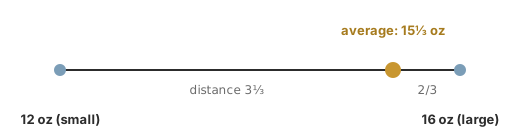
The average sits 3⅓ oz from the small cup size but only ⅔ oz from the large cup size.
Step 1 — Measure the distances to the average
From 12 to 15⅓ is 10/3. From 15⅓ to 16 is 2/3.
Step 2 — Flip the ratio
On a balance beam, the side with more weight sits closer to the pivot. So the counts are in the reverse ratio of the distances:
Step 3 — Split the 60 cups
A 1 : 5 ratio means 6 equal parts, each worth 60 ÷ 6 = 10 cups. That gives 1 part small = 10 small and 5 parts large = 50 large.
This is the same technique used to blend solutions of different strengths in chemistry (the "alligation" method), and it works whenever you know an overall average and two component values.
Salma sold 10 small cups (12 oz each) and 50 large cups (16 oz each).
Verification
Substitute s = 10 and L = 50 into both original equations. Checking only one of them can hide an error.
Both statements from the problem hold true, and both cup counts are whole, positive numbers, as they must be for physical cups. As an independent check, the three methods above (substitution, all-small baseline, and weighted average) arrived at the same pair of numbers by completely different routes.
Sanity Check
Could the answer have been, say, 30 small and 30 large? Look back at the table: an even split gives only 840 ounces. The actual total of 920 is only 40 ounces short of the maximum possible 960 (all large), so the mix must be heavily large-cup.
The average cup of 15⅓ ounces tells the same story: it's nearly 16. Any answer with more small cups than large cups should immediately look suspicious. This quick estimate catches the most common mistake in this problem, which is swapping the two sizes.
Common Pitfalls
Mixing up cups and ounces. Students sometimes put the 920 on the wrong equation. The first equation counts cups (total 60). The second counts ounces (total 920). A good habit: before writing any equation, say out loud what unit each side is measured in. If one side is "cups" and the other is "ounces," something's wrong.
Forgetting to multiply by the number of cups. The numbers 12 and 16 are per cup. The total contribution from small cups is 12 times the number of small cups, 12s, not 12 alone.
Distributing only to the first term. The 16 multiplies both 60 and −s, so the correct expansion is 12s + 960 − 16s. The incorrect version leads to 11s = −40, a negative, fractional number of cups. Whenever substitution gives you a nonsensical count, check the distribution first.
Stopping at one variable. The question asks for both the number of small cups and the number of large cups. After finding s = 10, you still need L = 60 − 10 = 50. Reread the question at the end and make sure every requested quantity appears in your answer, with units.
How to Spot This Problem Type
This is a two-types, two-totals problem, sometimes called a "mixture-style" or "total-count and total-value" problem. Look for these signals:
- Two categories of item, each with a fixed "per item" amount (ounces per cup, dollars per ticket, cents per coin).
- A total number of items, and a total amount (volume, money, weight, points).
- A question asking for "how many of each."
The same structure hides in other costumes:
Same problem, different story: A theater sold 60 tickets, adults at $12 and children at $16, for a total of $920. How many of each? Replace "ounces" with "dollars" and the equations are identical.
The Pattern Behind This
For any problem with two item types of sizes a and b, a total count N, and a total amount T:
The formula for y is Method 2 in symbols: a·N is the "all type-a" baseline, T − a·N is the excess, and b − a is the gain per swap. With our numbers: (920 − 12·60) ÷ (16 − 12) = 200 ÷ 4 = 50.
Limits of the shortcut. It requires a ≠ b (otherwise you'd divide by zero, and the amount would tell you nothing about the split). Also, for a physically sensible answer, T must lie between a·N and b·N, here between 720 and 960, and the division must produce a whole number. If it doesn't, the problem as stated can't be about whole items.
The broader idea is that a pair of linear equations describes two constraints that must hold at once. Here, every point on the line s + L = 60 uses 60 cups, and every point on 12s + 16L = 920 pours 920 ounces. Only one point, (10, 50), sits on both lines.
Beyond the Textbook
- Blending and pharmacy: Mixing a 12% solution with a 16% solution to hit a target concentration is Method 3 exactly. Pharmacists and chemists call it alligation.
- Inventory and logistics: A warehouse knows the total number of boxes on a truck and the total weight, and must work out how many are heavy versus light.
- Event pricing: Ticket sales totals (adult vs. student) are routinely reconstructed from a headcount and revenue, the same two-equation structure.
Push Further
Try each problem on your own first, then click to compare your work. They get harder as you go.
At a different stand, small cups hold 8 ounces and large cups hold 20 ounces. The stand sold 45 cups totaling 600 ounces. How many small cups and how many large cups were sold?
Let s = small cups and L = large cups.
Count: s + L = 45. Ounces: 8s + 20L = 600.
From the count equation, s = 45 − L. Then 8(45 − L) + 20L = 600, which becomes 360 − 8L + 20L = 600, so 360 + 12L = 600.
12L = 240, so L = 20. Then s = 45 − 20 = 25.
Cups: 25 + 20 = 45 ✓. Ounces: 8(25) + 20(20) = 200 + 400 = 600 ✓.
25 small cups and 20 large cups.
On Sunday, Salma sold 25 more large cups (16 oz) than small cups (12 oz), and she poured 960 ounces in total. How many cups of each size did she sell? (This time, the total number of cups is not given.)
"25 more large than small" means L = s + 25. The total volume gives 12s + 16L = 960.
Replace L: 12s + 16(s + 25) = 960, so 12s + 16s + 400 = 960.
28s + 400 = 960, so 28s = 560 and s = 20.
L = 20 + 25 = 45.
Difference: 45 − 20 = 25 ✓. Ounces: 12(20) + 16(45) = 240 + 720 = 960 ✓.
20 small cups and 45 large cups.
Salma adds a medium cup. Small cups hold 8 ounces, medium cups hold 12 ounces, and large cups hold 16 ounces. One day she sold 70 cups totaling 960 ounces, and she sold twice as many medium cups as small cups. How many of each size did she sell?
Let s, m, L be the numbers of small, medium, and large cups. Then s + m + L = 70, 8s + 12m + 16L = 960, and m = 2s.
Substitute m = 2s into the count equation: s + 2s + L = 70, so L = 70 − 3s.
8s + 12(2s) + 16(70 − 3s) = 960 becomes 8s + 24s + 1120 − 48s = 960.
−16s + 1120 = 960, so −16s = −160 and s = 10. Then m = 20 and L = 70 − 30 = 40.
Cups: 10 + 20 + 40 = 70 ✓. Ounces: 80 + 240 + 640 = 960 ✓. Medium is twice small ✓.
10 small, 20 medium, and 40 large cups.
On a busy Saturday, Salma sold 80 cups and poured 1,160 ounces in total. Small cups (12 oz) sell for $2 and large cups (16 oz) sell for $3. How much money did she collect?
Money depends on how many of each cup were sold, but the problem only gives cups and ounces. So first find the counts, then compute revenue.
s + L = 80 and 12s + 16L = 1160. Using the baseline idea: 80 small cups would be 80 × 12 = 960 oz, an excess of 1160 − 960 = 200 oz.
Each swap adds 4 oz, so L = 200 ÷ 4 = 50 and s = 80 − 50 = 30.
Revenue = 2(30) + 3(50) = 60 + 150 = 210 dollars.
Cups: 30 + 50 = 80 ✓. Ounces: 12(30) + 16(50) = 360 + 800 = 1160 ✓.
Salma collected $210 (from 30 small and 50 large cups).
Frequently Asked Questions
s + L = 60 and 12s + 16L = 920. Substituting s = 60 − L gives 12(60 − L) + 16L = 920, so 720 + 4L = 920, L = 50 large cups and s = 10 small cups.s + L = 60, because you can solve for that variable immediately. Use elimination when both equations are in standard form and the coefficients line up easily. Both methods always give the same answer. In this example, substitution works well because s + L = 60 rearranges to s = 60 − L, which you plug into 12s + 16L = 920.2026-10-18