




Linear Programming: Maximize Aubrey's Jewelry Profit
Linear Programming: Maximize Aubrey's Jewelry Profit
What This Problem Teaches
- Linear programming fundamentals: Setting up objective functions and constraint systems
- Feasible region analysis: Finding where all constraints are simultaneously satisfied
- Corner point theorem: Understanding why optimal solutions occur at vertices
- Resource allocation: Making optimal decisions with limited materials and capacity
- Real-world optimization: Translating business constraints into mathematical models
Visualizing the Problem
Before diving into the algebra, let's graph what we're working with. This helps us see the "feasible region" — the area where all constraints are satisfied simultaneously.
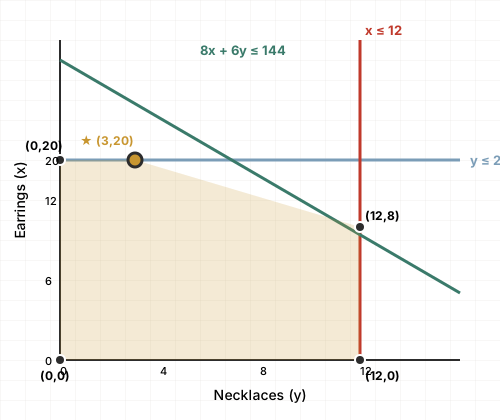
The yellow shaded region represents all valid combinations of earrings and necklaces that satisfy our constraints. Notice how the optimal solution (starred point) sits at a corner of this region — this isn't a coincidence!
Solution: Method 1 — The Corner Point Method
Linear programming problems always have their optimal solutions at corner points of the feasible region. We'll find all corner points, then test which gives the highest profit.
Step 1 — Define variables and constraints
Let x = number of pairs of earrings, y = number of necklaces.
x ≤ 12 (earring limit)
y ≤ 20 (necklace limit)
8x + 6y ≤ 144 (bead constraint)
x ≥ 0, y ≥ 0 (non-negativity)
Step 2 — Set up the objective function
The problem asks us to maximize profit but doesn't give specific profit values. We'll assume reasonable values: $15 profit per pair of earrings and $20 profit per necklace.
Maximize P = 15x + 20y
Step 3 — Find all corner points
Corner points occur where constraint lines intersect. Let's find each intersection:
1. Origin: (0, 0)
2. x-axis intercept: (12, 0)
3. y-axis intercept: (0, 20)
4. Intersection of x = 12 and 8x + 6y = 144:
8(12) + 6y = 144
96 + 6y = 144
6y = 48
y = 8
Point: (12, 8)
5. Intersection of y = 20 and 8x + 6y = 144:
8x + 6(20) = 144
8x + 120 = 144
8x = 24
x = 3
Point: (3, 20)
Step 4 — Test each corner point
Calculate the profit P = 15x + 20y at each corner point:
| Corner Point (x, y) | Earrings | Necklaces | Profit P = 15x + 20y |
|---|---|---|---|
| (0, 0) | 0 | 0 | $0 |
| (12, 0) | 12 | 0 | $180 |
| (0, 20) | 0 | 20 | $400 |
| (12, 8) | 12 | 8 | $340 |
| (3, 20) | 3 | 20 | $445 |
Solution: Method 2 — Graphical Slope Analysis
Instead of testing every corner point, we can use the slope of the profit line to determine which corner will be optimal.
Step 1 — Analyze the profit function slope
Rewrite the profit function P = 15x + 20y in slope-intercept form:
y = -0.75x + P/20
The profit lines have a slope of -0.75. As we increase P, these lines shift upward and to the right.
Step 2 — Compare with constraint slopes
Find the slopes of our constraint boundaries:
• y = 20 (horizontal): slope = 0
• x = 12 (vertical): slope = undefined (∞)
• 8x + 6y = 144 → y = -4/3 x + 24: slope = -4/3 ≈ -1.33
Step 3 — Determine the optimal direction
Since the profit slope (-0.75) lies between the slopes of y = 20 (slope = 0) and the bead constraint (slope = -1.33), the optimal point must be at their intersection: (3, 20).
Verification
Let's verify our solution (3, 20) satisfies all constraints:
x = 3 ≤ 12 ✓ (earring limit)
y = 20 ≤ 20 ✓ (necklace limit)
8(3) + 6(20) = 24 + 120 = 144 ≤ 144 ✓ (bead constraint)
x = 3 ≥ 0, y = 20 ≥ 0 ✓ (non-negativity)
Resource usage check: Aubrey will use exactly 144 beads (24 for earrings + 120 for necklaces), make exactly 20 necklaces (her maximum), and only 3 pairs of earrings (well under her limit of 12).
Watch Out For These
The Math Beneath the Surface
This problem demonstrates the Fundamental Theorem of Linear Programming: If a linear program has an optimal solution, it occurs at a vertex (corner point) of the feasible region.
1. Graph all constraints to find the feasible region
2. Identify all corner points
3. Evaluate the objective function at each corner
4. The corner with the best objective value is optimal
The slope analysis method works because the objective function creates a family of parallel lines. As you move these lines in the direction of optimization, the last point they touch in the feasible region is always a corner point.
How to Spot This Problem Type
Linear programming problems have distinctive markers that make them recognizable:
- "Maximize" or "minimize": Combined with constraints like "at most," "at least," or exact resource limits
- Resource allocation language: "Limited supply," "budget constraints," "capacity restrictions"
- Multiple decision variables: Usually asking how much of each type to make/buy/use
- Linear relationships: Each unit requires a fixed amount of resources (no economies of scale)
- Non-negativity implied: You can't make negative quantities in most real-world contexts
Variations you might see: profit maximization, cost minimization, diet problems (nutrition constraints), transportation problems (shipping costs), and production planning.
Real Applications
This exact mathematical structure appears throughout business and engineering:
- Manufacturing optimization: Car companies decide how many sedans vs. SUVs to produce given steel, labor, and factory constraints
- Portfolio management: Investment firms allocate money across asset classes subject to risk limits and regulatory requirements
- Supply chain logistics: Airlines determine flight schedules to maximize revenue while respecting aircraft availability and crew regulations
- Agriculture planning: Farmers choose which crops to plant based on land, water, and labor constraints to maximize profit
What If?
Now we maximize P = 25x + 15y. The constraints remain the same.
• (0,0): P = 0
• (12,0): P = 25(12) = $300
• (0,20): P = 15(20) = $300
• (12,8): P = 25(12) + 15(8) = 300 + 120 = $420
• (3,20): P = 25(3) + 15(20) = 75 + 300 = $375
The highest profit is $420 at point (12,8).
Check constraints: 12 ≤ 12 ✓, 8 ≤ 20 ✓, 8(12) + 6(8) = 144 ≤ 144 ✓
Answer: 12 pairs of earrings and 8 necklaces for maximum profit of $420.
The constraint becomes 8x + 6y ≤ 192. Other constraints unchanged.
Intersection of y = 20 and 8x + 6y = 192:
8x + 6(20) = 192
8x + 120 = 192
8x = 72
x = 9
New corner point: (9, 20)
• (0,0): P = 0
• (12,0): P = $180
• (0,20): P = $400
• (12,8): No longer valid (would need 216 beads)
• (9,20): P = 15(9) + 20(20) = 135 + 400 = $535
Check: 9 ≤ 12 ✓, 20 ≤ 20 ✓, 8(9) + 6(20) = 72 + 120 = 192 ≤ 192 ✓
Answer: 9 pairs of earrings and 20 necklaces for maximum profit of $535.
With y = 15 fixed, we only need to find optimal x. Constraints become:
x ≤ 12
8x + 6(15) ≤ 144
8x + 90 ≤ 144
8x ≤ 54
x ≤ 6.75
Since x must be a whole number: 0 ≤ x ≤ 6
P = 15x + 20(15) = 15x + 300
Since profit increases with x, choose maximum feasible x = 6.
Check: 6 ≤ 12 ✓, 8(6) + 6(15) = 48 + 90 = 138 ≤ 144 ✓
Answer: 6 pairs of earrings and 15 necklaces for maximum profit of $390.
Let x = earrings, y = necklaces, z = bracelets
Maximize P = 15x + 20y + 10z
Subject to: x ≤ 12, y ≤ 20, z ≤ 30, 8x + 6y + 4z ≤ 144
Profit per bead: Earrings = 15/8 = 1.875, Necklaces = 20/6 ≈ 3.33, Bracelets = 10/4 = 2.5
Rank: Necklaces > Bracelets > Earrings
Max necklaces: 20 (uses 120 beads)
Remaining beads: 144 - 120 = 24
Max bracelets with 24 beads: 24/4 = 6 bracelets
Earrings: 0 (no beads left)
P = 15(0) + 20(20) + 10(6) = 460
Beads used: 8(0) + 6(20) + 4(6) = 144 ✓
Answer: 0 earrings, 20 necklaces, 6 bracelets for maximum profit of $460.
Frequently Asked Questions
2026-11-04