




Find Maximum Garden Area with Fixed Perimeter
What This Problem Teaches
- Finding the vertex of a quadratic function to locate maximum or minimum values
- Understanding how geometric constraints translate into algebraic functions
- Recognizing that optimization problems often reduce to finding extrema of quadratics
- Connecting the mathematical result to the physical meaning (optimal garden dimensions)
- Working with functions in both factored and standard form
Visualizing the Problem
The area function A(x) = -x(x-80) represents a downward-opening parabola. The maximum area occurs at the vertex of this parabola.
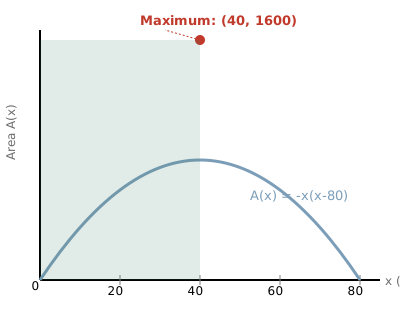
Solution: Method 1 — Finding the Vertex Directly
Since we have the area function A(x) = -x(x-80) in factored form, we can find the maximum by locating the vertex of this downward-opening parabola.
Step 1 — Identify the zeros of the function
The function A(x) = -x(x-80) equals zero when either factor is zero:
x = 0 or x = 80
So the parabola crosses the x-axis at x = 0 and x = 80.
Step 2 — Find the vertex x-coordinate
For a parabola, the vertex lies exactly halfway between the two zeros. The x-coordinate of the vertex is:
Step 3 — Calculate the maximum area
Substitute x = 40 into the area function:
A(40) = -40(-40)
A(40) = 1600
Solution: Method 2 — Using the Vertex Formula
Let's solve this by first expanding the function into standard form, then applying the vertex formula.
Step 1 — Expand the area function
Starting with A(x) = -x(x-80), we can expand this:
A(x) = -x² + 80x
Now we have the function in standard form: A(x) = -x² + 80x + 0.
Step 2 — Apply the vertex formula
For a quadratic function f(x) = ax² + bx + c, the x-coordinate of the vertex is x = -b/(2a).
Here, a = -1, b = 80, and c = 0:
Step 3 — Calculate the maximum area
Substitute x = 40 into the area function:
A(40) = -1600 + 3200
A(40) = 1600
Verification
Let's verify our answer by checking that the dimensions make sense and satisfy the constraint.
Check the dimensions: If the width is 40 meters, what is the length?
From the original factored form A(x) = -x(x-80), we can see that when x = 40:
This means the length is also 40 meters (since area = width × length = 40 × 40 = 1600).
Check the perimeter constraint: With width = 40m and length = 40m:
Check that this is indeed a maximum: Let's test nearby values:
- At x = 39: A(39) = -39(39-80) = -39(-41) = 1599 square meters
- At x = 41: A(41) = -41(41-80) = -41(-39) = 1599 square meters
Both values are less than 1600, confirming that x = 40 gives the maximum area.
The Physical Meaning
The mathematical result tells us something beautiful about rectangles: for any fixed perimeter, the rectangle with maximum area is always a square.
With 160 meters of fencing, Simon's optimal garden is a 40m × 40m square with area 1600 m². Any other rectangular shape with the same perimeter will have less area.
Common Pitfalls
Mistake 1: Confusing the constraint with the function
Mistake 2: Forgetting that the function gives area directly
Mistake 3: Mixing up maximum and minimum
Mistake 4: Using the wrong vertex formula
The General Pattern
This problem exemplifies a broader principle in optimization: constrained optimization problems often reduce to finding the vertex of a quadratic function.
The general pattern is:
- Express one variable in terms of another using the constraint
- Substitute to get the quantity you want to optimize as a function of one variable
- This function is often quadratic
- Find the vertex to locate the maximum or minimum
For any rectangle with fixed perimeter P, if the width is x, then:
Area = x(P/2 - x) = -x² + (P/2)x
The maximum area occurs at x = P/4, making both dimensions equal to P/4.
This is why squares are always the rectangles with maximum area for a given perimeter—and why circular enclosures beat rectangular ones (though that requires calculus to prove rigorously).
What If? Extend Your Thinking
A(x) = -x(x-160) = 0 when x = 0 or x = 160
Vertex x-coordinate: (0 + 160)/2 = 80
A(80) = -80(80-160) = -80(-80) = 6400
Garden is 80m × 80m. Perimeter: 2(80 + 80) = 320m ✓
Answer: 6400 square meters (exactly 4 times the original, since area scales with the square of linear dimensions)
Fencing needed: 2x + y = 160, so y = 160 - 2x
A(x) = x × y = x(160 - 2x) = 160x - 2x²
Using x = -b/(2a) with a = -2, b = 160:x = -160/(2(-2)) = 40
Width: x = 40m, Length: y = 160 - 2(40) = 80mA = 40 × 80 = 3200
Answer: 3200 square meters (double the area of the original square garden!)
From the original problem: 1600 square meters
Circumference = 2πr = 160, so r = 160/(2π) = 80/π ≈ 25.46m
A = πr² = π(80/π)² = π × 6400/π² = 6400/π ≈ 2037
Circle: ~2037 m²
Square: 1600 m²
Circle is about 27% larger!
Answer: The circular garden has ~2037 square meters, significantly more than the rectangular garden. This illustrates the isoperimetric inequality—among all shapes with the same perimeter, the circle has maximum area.
For maximum area with fixed perimeter, the rectangle must be a square.
If area = 2500 and it's a square: s² = 2500, so s = 50m
Perimeter = 4s = 4 × 50 = 200 meters
With P = 200, area function is A(x) = x(100-x)
Maximum at x = 50: A(50) = 50 × 50 = 2500 ✓
Answer: 200 meters of fencing creates a 50m × 50m square garden with area 2500 m².
Frequently Asked Questions
For a quadratic in the form f(x) = ax² + bx + c, the maximum (if a < 0) or minimum (if a > 0) occurs at x = -b/(2a). In this problem, A(x) = -x² + 80x gives x = -80/(2×-1) = 40, yielding maximum area of 1600 square meters. Alternatively, if the quadratic is in factored form like -x(x-80), the vertex lies halfway between the zeros.
This follows from the isoperimetric inequality. For any fixed perimeter, the rectangle with maximum area has equal length and width. Intuitively, if one dimension is much larger than the other, you're "wasting" perimeter on the long sides without gaining proportional area. Here, with 160m of fencing, the optimal dimensions are 40m × 40m, creating a square with area 1600 m². Any other rectangular configuration yields less area.
Start with the constraint equation. If width is x and length is y, then perimeter gives 2x + 2y = 160, which simplifies to y = 80 - x. Area equals length times width: A = xy = x(80 - x) = -x² + 80x. This quadratic opens downward (negative coefficient of x²), so it has a maximum at the vertex. The factored form A(x) = -x(x-80) makes finding the vertex even easier.
2026-11-22