




Optimization: Maximum Volume Box with Fixed Material
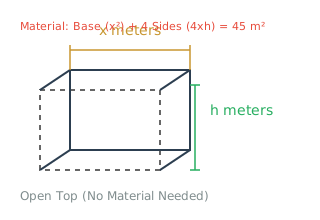
Visualizing the Problem
What This Problem Teaches
- Constraint optimization using single-variable calculus — Converting a two-variable problem into an optimization on one variable
- Physical interpretation of mathematical constraints — Understanding how material limitations translate into algebraic equations
- Critical point analysis and the second derivative test — Confirming that a critical point represents a maximum rather than a minimum
- Geometric optimization principles — Discovering the optimal proportions that emerge from mathematical optimization
- Domain considerations in applied problems — Recognizing that physical constraints limit the valid range of solutions
Solution: Method 1 — Single-Variable Calculus
This is a classic constrained optimization problem. We need to find the dimensions that give maximum volume while respecting the constraint on available material.
Step 1 — Define Variables and Set Up the Constraint
Let x be the side length of the square base (in meters) and h be the height of the box (in meters). Since there's no top, the material is used for:
- Base:
x²square meters - Four sides:
4xhsquare meters
The constraint equation is:
Step 2 — Express Volume as a Function of Both Variables
The volume of the box is:
Step 3 — Eliminate One Variable Using the Constraint
From the constraint equation, solve for h:
4xh = 45 - x²
h = (45 - x²)/(4x)
Substitute this into the volume function:
V(x) = x(45 - x²)/4
V(x) = (45x - x³)/4
Step 4 — Find Critical Points
Take the derivative and set it equal to zero:
Setting V'(x) = 0:
45 - 3x² = 0
3x² = 45
x² = 15
x = √15 ≈ 3.87 meters
Step 5 — Verify This Is a Maximum
Check the second derivative:
V''(√15) = -3√15/2 ≈ -5.81 < 0
Since the second derivative is negative, this critical point represents a maximum.
Step 6 — Find the Corresponding Height
Using x = √15 in our constraint:
h = (45 - 15)/(4√15)
h = 30/(4√15) = 30√15/60 = √15/2 ≈ 1.94 meters
Step 7 — Calculate Maximum Volume
Height: h = √15/2 ≈ 1.94 meters
Maximum volume: 15√15/2 ≈ 29.05 m³
Solution: Method 2 — Lagrange Multipliers
For students comfortable with multivariable calculus, we can solve this as a constrained optimization problem using Lagrange multipliers.
Step 1 — Set Up the Lagrangian
We want to maximize f(x,h) = x²h subject to g(x,h) = x² + 4xh - 45 = 0.
The Lagrangian is:
Step 2 — Find the Gradient Conditions
Set all partial derivatives equal to zero:
∂L/∂h = x² - λ(4x) = 0
∂L/∂λ = -(x² + 4xh - 45) = 0
Step 3 — Solve the System
From the second equation: λ = x²/(4x) = x/4
Substituting into the first equation:
2xh - (x²/2 + xh) = 0
2xh - x²/2 - xh = 0
xh - x²/2 = 0
h = x/2
Step 4 — Apply the Constraint
Substitute h = x/2 into the constraint:
x² + 2x² = 45
3x² = 45
x = √15
This gives us the same result: x = √15 and h = √15/2.
Verification
Let's verify our answer satisfies the constraint and gives the stated volume:
= 15 + 4 · 15/2 = 15 + 30 = 45 ✓
Volume check: V = x²h = (√15)² · (√15/2)
= 15 · √15/2 = 15√15/2 ≈ 29.05 m³ ✓
Where Students Go Wrong
Some students try to maximize
V = x²h by taking partial derivatives with respect to both variables, getting ∂V/∂x = 2xh = 0 and ∂V/∂h = x² = 0. This gives the nonsensical solution x = 0 or h = 0 because it ignores the material constraint entirely.
A common error is writing the constraint as
x² + x² + 4xh = 45 (counting the top). The problem clearly states "no top," so only the base and four sides use material. This error leads to h = (45 - 2x²)/(4x) and incorrect final dimensions.
Finding that
V'(x) = 0 when x = √15 is necessary but not sufficient. Without verifying V''(√15) < 0, you haven't confirmed this is a maximum rather than a minimum. In optimization problems, this verification step is crucial.
The constraint
h = (45 - x²)/(4x) requires h ≥ 0, which means 45 - x² ≥ 0, so x ≤ 3√5 ≈ 6.71. Also, x > 0 for a physical box. Students sometimes don't verify their solution lies within this valid domain.
The Pattern Behind This
This problem illustrates the general approach to constrained optimization in single-variable calculus:
1. Solve the constraint for one variable: y = h(x)
2. Substitute: F(x) = f(x, h(x))
3. Find critical points: F'(x) = 0
4. Verify maximum/minimum: F''(x) < 0 or > 0
5. Check endpoint behavior if domain is bounded
The beautiful result h = x/2 emerges from the specific constraint structure. When material is allocated optimally, the base area equals twice the total side area: x² = 2(4xh)/4 = 2xh, giving h = x/2.
Real Applications
- Manufacturing and packaging: Companies use these calculations to minimize material costs while maximizing product capacity, from shipping containers to food packaging.
- Architecture and construction: Designing storage tanks, silos, and buildings where material costs must be balanced against functional volume requirements.
- 3D printing and rapid prototyping: Optimizing designs to minimize filament usage while maintaining structural integrity and maximum internal volume.
What If?
Constraint: x² + 4xh = 72, so h = (72 - x²)/(4x)
V(x) = x² · (72 - x²)/(4x) = (72x - x³)/4
V'(x) = (72 - 3x²)/4 = 0, so x² = 24, giving x = 2√6 ≈ 4.90 m
h = (72 - 24)/(4 · 2√6) = 48/(8√6) = √6 ≈ 2.45 m
V = x²h = 24 · √6 = 24√6 ≈ 58.79 m³
Material: (2√6)² + 4(2√6)(√6) = 24 + 48 = 72 ✓
Answer: Base = 2√6 ≈ 4.90 m, Height = √6 ≈ 2.45 m, Volume = 24√6 ≈ 58.79 m³
Constraint: x²h = 32, so h = 32/x²
M(x) = x² + 4xh = x² + 4x(32/x²) = x² + 128/x
M'(x) = 2x - 128/x² = 0, so 2x³ = 128, giving x³ = 64, thus x = 4 m
h = 32/x² = 32/16 = 2 m
M = x² + 4xh = 16 + 4(4)(2) = 16 + 32 = 48 m²
Volume: 4² × 2 = 32 m³ ✓
Second derivative: M''(4) = 2 + 256/64 = 6 > 0 (minimum) ✓
Answer: Base = 4 m, Height = 2 m, Material = 48 m²
Base uses 2x² (double thickness), sides use 4xh
Constraint: 2x² + 4xh = 45
4xh = 45 - 2x², so h = (45 - 2x²)/(4x)
V(x) = x² · (45 - 2x²)/(4x) = (45x - 2x³)/4
V'(x) = (45 - 6x²)/4 = 0, so x² = 7.5, giving x = √7.5 = √(30/4) = √30/2 ≈ 2.74 m
h = (45 - 2(7.5))/(4√30/2) = 30/(2√30) = √30/2 ≈ 2.74 mV = (7.5)(√30/2) = 7.5√30/2 ≈ 20.54 m³
Material: 2(7.5) + 4(√30/2)(√30/2) = 15 + 30 = 45 ✓
Answer: Base = √30/2 ≈ 2.74 m, Height = √30/2 ≈ 2.74 m, Volume ≈ 20.54 m³
Base side length: x = √15 m
Height: h = √15/2 m
Base area: x² = (√15)² = 15 m²
Top area: x² = 15 m²
Four sides: 4xh = 4(√15)(√15/2) = 4 × 15/2 = 30 m²
Total material = Base + Top + Sides= 15 + 15 + 30 = 60 m²
Original (no top): 45 m²
With top: 60 m²
Additional material needed: 60 - 45 = 15 m²
The top area should equal the base area: √15 × √15 = 15 m² ✓
This makes sense because both are squares with side length √15.
Notice that the additional material (15 m²) equals exactly one-third of the original material (45 m²). This reflects the optimal 1:2 ratio between height and base—the top area is exactly 1/3 of the original surface area.
Answer: Total material with top = 60 m² (15 m² more than the no-top version)
Frequently Asked Questions
First, identify your objective function (what you want to maximize or minimize) and your constraint equation. Express both in terms of the same variables, then use the constraint to eliminate one variable from the objective function. In this problem, we maximize volume V = x²h subject to the material constraint x² + 4xh = 45, which lets us write h in terms of x and create a single-variable function to optimize.
Use the first derivative test to find critical points by setting f'(x) = 0. Use the second derivative test to classify those critical points: if f''(x) > 0, it's a minimum; if f''(x) < 0, it's a maximum. In this box problem, we find f'(x) = 0 gives x = √15, then f''(√15) = -3√15/2 < 0 confirms this is indeed a maximum.
This ratio emerges from the specific constraint structure. When material is fixed at x² + 4xh = 45 and we maximize x²h, calculus shows that optimal allocation occurs when the base area (x²) equals twice the total side area (4xh). This gives x² = 2(4xh)/4 = 2xh, so h = x/2. The 1:2 ratio is a beautiful consequence of the mathematical optimization, not an arbitrary design choice.
2026-08-12