




How Many Fewer Days Will Rations Last With More People?
Skills This Problem Builds
- Inverse proportional reasoning — recognizing when one quantity increases as another decreases
- Rate and unit analysis — working with compound units like "person-days" to represent total supply
- Resource allocation modeling — understanding how fixed resources divide among varying group sizes
- Problem interpretation — distinguishing between "how many days" and "how many fewer days" in the question
- Real-world mathematical modeling — connecting abstract proportion to concrete supply management scenarios
Visualizing the Problem
Let's picture what's happening with the rations:
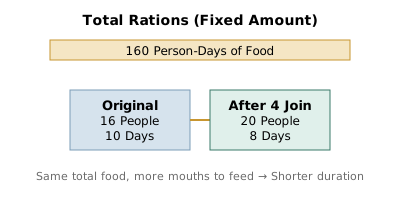
The key insight is that the total amount of food stays the same — we're just dividing it among more people, which means it won't last as long.
Solution: Method 1 — The Person-Days Approach
The most natural way to think about this problem is in terms of "person-days" — a unit that measures the total food supply.
Step 1 — Calculate total rations available
One person-day means enough food for one person for one day. If we have enough food for 16 people for 10 days, that's a total of:
Total rations = 16 people × 10 days = 160 person-daysStep 2 — Find the new group size
When 4 more people join the original 16:
New group size = 16 + 4 = 20 peopleStep 3 — Calculate how long rations last for the larger group
We still have 160 person-days of food, but now 20 people are consuming it:
New duration = 160 person-days ÷ 20 people = 8 daysStep 4 — Find how many fewer days
The question asks specifically for how many fewer days:
Difference = 10 days - 8 days = 2 daysSolution: Method 2 — The Inverse Proportion Formula
We can also solve this using the fact that people and days are inversely proportional when the total food supply is constant.
Step 1 — Set up the inverse proportion
For inverse proportion, when the product is constant:
People₁ × Days₁ = People₂ × Days₂Substituting our known values:
16 × 10 = 20 × Days₂Step 2 — Solve for the new duration
160 = 20 × Days₂Days₂ = 160 ÷ 20 = 8 daysStep 3 — Calculate the difference
Fewer days = 10 - 8 = 2 daysVerification
Let's verify by checking our answer using the person-days calculation:
Original situation:
16 people × 10 days = 160 person-days of food
New situation:
20 people × 8 days = 160 person-days of food ✓
Both scenarios use exactly 160 person-days of food, confirming that our answer is correct.
Checking the difference:
10 days - 8 days = 2 fewer days ✓
The Smell Test
Does 2 fewer days seem reasonable? Let's think about it:
| Scenario | People | Days | Daily Consumption |
|---|---|---|---|
| Original | 16 | 10 | 16 person-days/day |
| After 4 join | 20 | 8 | 20 person-days/day |
Adding 4 people increased the group size by 25% (from 16 to 20). The duration decreased from 10 days to 8 days, which is a 20% reduction. This makes sense because inverse relationships create these non-linear changes.
As a boundary check: if we doubled the people to 32, the rations would last 5 days instead of 10 — exactly half the time. Our answer of 8 days for 20 people fits nicely between 10 days (for 16 people) and 5 days (for 32 people).
Watch Out For These
✗ Mistake 1: Thinking that 4 more people means 4 fewer days
This assumes a direct (linear) relationship, but rations problems are inverse proportions. The relationship is people × days = constant, not people + days = constant.
✗ Mistake 2: Calculating 20/16 = 1.25, so food lasts 1.25 times longer
This gets the direction backwards. More people means the food lasts for a shorter time, not longer. The correct factor is 16/20 = 0.8, so the food lasts 0.8 times as long: 10 × 0.8 = 8 days.
✗ Mistake 3: Answering "8 days" instead of "2 fewer days"
Read the question carefully. It asks "for how many fewer days," not "how many days total." The answer is the difference: 10 - 8 = 2 fewer days.
The Pattern Behind This
This problem belongs to the family of inverse proportion problems, where two quantities multiply to give a constant:
People × Days = Total Supply (constant)The general formula for inverse proportion is:
If x₁ × y₁ = x₂ × y₂, then y₂ = (x₁ × y₁) ÷ x₂In supply problems specifically:
- If the number of people increases, the duration decreases
- If the number of people decreases, the duration increases
- The product (people × days) always equals the total supply in "person-units"
This same pattern appears whenever a fixed resource is shared among a variable number of users: splitting a pizza among more people, distributing bandwidth among more devices, or allocating budget among more projects.
How to Spot This Problem Type
Inverse proportion problems in disguise often contain these telltale phrases:
- "enough to feed/supply X people for Y time" — signals that total supply is fixed
- "if more people join" or "if the group size changes" — indicates the supply will be redistributed
- "how many fewer days" or "how much less time" — asks for the reduction in duration
- "the same rations/supplies/food" — confirms that total quantity stays constant
Key distinction: If the problem says "additional rations arrive" or "more supplies are purchased," then the total increases and you're not in inverse proportion territory anymore — you'd add the supplies before calculating.
In contrast to direct proportion problems that use phrases like "rate," "speed," or "cost per unit," inverse proportion problems focus on sharing, distributing, or consuming a fixed total amount.
This Calculation in the Real World
- Emergency management: Hurricane shelters calculate how long emergency supplies will last as more evacuees arrive — the same math applies to distributing food, water, and medical supplies.
- Project management: When additional team members join a project late, the remaining budget gets spread thinner, affecting how long the money will last at current spending rates.
- Network bandwidth: When more devices connect to the same internet connection, each device gets a smaller share of the total bandwidth — the total capacity stays fixed while being divided among more users.
What If?
Total supplies = 24 people × 15 days = 360 person-days
New group = 24 + 8 = 32 people
New duration = 360 ÷ 32 = 11.25 days
Fewer days = 15 - 11.25 = 3.75 days
Check: 32 × 11.25 = 360 person-days ✓
Answer: The supplies will last 3.75 days (or 3 days and 18 hours) fewer.
Total rations = 20 people × 12 days = 240 person-days
If rations last 8 days: New group size = 240 ÷ 8 = 30 people
People who joined = 30 - 20 = 10 people
Check: 30 people × 8 days = 240 person-days ✓
Answer: 10 people joined the original detachment.
Total food = 15 people × 20 days = 300 person-days
New duration = 300 ÷ 25 = 12 days
Decrease = 20 - 12 = 8 days
Percentage decrease = (8 ÷ 20) × 100% = 40%
Check: 25 × 12 = 300 person-days ✓
Answer: The number of days decreases by 40%.
Team A rations = 12 people × 8 days = 96 person-days
Team B rations = 18 people × 6 days = 108 person-days
Total rations = 96 + 108 = 204 person-days
Total people = 12 + 18 = 30 people
Duration = 204 ÷ 30 = 6.8 days
Check: 30 × 6.8 = 204 person-days ✓
Answer: The combined rations will last 6.8 days (about 6 days and 19 hours).
Frequently Asked Questions
2026-05-31