




Normal Distribution: Finding Sample Mean Thresholds
What You Will Learn
- How to apply the Central Limit Theorem to find the distribution of sample means
- The distinction between population standard deviation and standard error
- How to work backwards from probability to find critical values using z-scores
- When sample means follow normal distributions regardless of population normality
- Real-world interpretation of statistical thresholds and percentiles
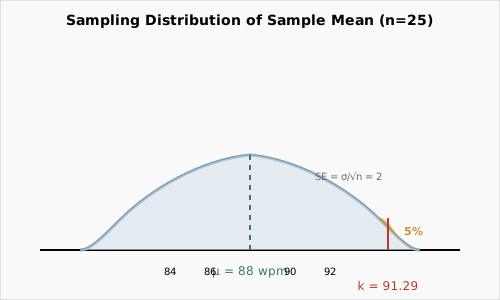
Solution: Method 1 — The Standard Error Approach
This problem asks us to find a threshold value where there's only a 5% chance the sample mean exceeds it. We're working with the sampling distribution of the mean, not individual student scores.
Step 1 — Identify the sampling distribution parameters
For a sample of size n = 25 from a normal population:
Standard error: SE = σ/√n = 10/√25 = 10/5 = 2 wpm
The key insight: individual students vary with standard deviation 10 wpm, but sample means of 25 students only vary with standard error 2 wpm. Sample means cluster much closer to the population mean.
Step 2 — Find the critical z-value
We want P(X̄ > k) = 0.05, which means P(X̄ ≤ k) = 0.95. We need the 95th percentile of the standard normal distribution:
Step 3 — Apply the z-score formula
Convert from the standard normal back to our sampling distribution:
1.645 = (k - 88)/2
k - 88 = 1.645 × 2
k - 88 = 3.29
k = 91.29 wpm
Solution: Method 2 — The Inverse Normal Approach
Instead of working through z-scores step by step, we can think of this as a single inverse normal calculation on the sampling distribution X̄ ~ N(88, 2²).
Step 1 — Set up the inverse normal problem
We want the value k such that only 5% of sample means exceed it. This is the 95th percentile of the sampling distribution:
Step 2 — Calculate directly
Using the inverse normal formula:
k = 88 + 1.645 × 2
k = 88 + 3.29
k = 91.29 wpm
This method treats the sampling distribution as our "new normal" and finds its 95th percentile directly.
Verification
Let's confirm that P(X̄ > 91.29) = 0.05 by computing the z-score:
Looking up z = 1.645 in the standard normal table: P(Z > 1.645) = 1 - 0.95 = 0.05 ✓
We can also verify our standard error calculation. With σ = 10 and n = 25:
Common Pitfalls
Wrong: k = 88 + 1.645 × 10 = 104.45 wpm
This treats individual scores and sample means as having the same variability. Sample means are much less variable than individual scores because extreme values average out.
Wrong: Using z = -1.645 (5th percentile instead of 95th)
k = 88 + (-1.645) × 2 = 84.71 wpm
"5% chance of exceeding k" means k is at the 95th percentile, not the 5th percentile.
Wrong: Thinking we need n ≥ 30 for normality
Since the population is already normal, sample means follow a normal distribution for any sample size. The CLT's n ≥ 30 rule only applies when the population isn't normal.
The Underlying Pattern
This problem follows the general structure for finding critical values in sampling distributions:
k = μ ± z_α × (σ/√n)
Where:
• μ = population mean
• z_α = critical z-value for probability α
• σ/√n = standard error of the mean
• Use + for "upper tail" problems (exceed)
• Use - for "lower tail" problems (fall below)
This pattern appears in confidence intervals, hypothesis testing, and quality control. The key insight is that sample means have reduced variability compared to individual observations—they cluster around μ with spread determined by the standard error, not the population standard deviation.
Why This Shows Up in the Real World
- Quality Control: Manufacturing processes monitor average measurements from batches to detect when production goes off-spec
- Medical Testing: Clinical trials evaluate whether average treatment effects exceed meaningful thresholds
- Educational Assessment: School districts track whether average test scores meet proficiency standards
What If?
With n = 9: SE = σ/√n = 10/√9 = 10/3 = 3.33 wpm
k = μ + z₀.₀₅ × SE = 88 + 1.645 × 3.33 = 88 + 5.48 = 93.48 wpm
z = (93.48 - 88)/3.33 = 1.645 ✓
Answer: 93.48 wpm
Note: Smaller samples have larger standard errors, so the threshold is higher.
X̄ ~ N(88, 2²) where SE = 10/√25 = 2
z₁ = (86 - 88)/2 = -1z₂ = (90 - 88)/2 = 1
P(-1 < Z < 1) = P(Z < 1) - P(Z < -1) = 0.8413 - 0.1587 = 0.6826
Answer: 68.26% or about 68%
This is the familiar "68% within one standard error" rule.
For 1% in upper tail: z₀.₀₁ = 2.326
SE = 10/√25 = 2 wpm
k = 88 + 2.326 × 2 = 88 + 4.65 = 92.65 wpm
z = (92.65 - 88)/2 = 2.326 ✓
Answer: 92.65 wpm
1.645 = (92 - 88)/(σ/√25)
1.645 = 4/(σ/5)1.645 = 20/σσ = 20/1.645 = 12.16
SE = 12.16/√25 = 2.43k = 88 + 1.645 × 2.43 = 92 ✓
Answer: σ = 12.16 wpm
Frequently Asked Questions
2026-07-10