




Find Paint Cans Needed for Wall Minus Whiteboard
What You Will Learn
- How to calculate area when you need to exclude sections
- When and why to round up in real-world problems
- Converting area calculations into practical purchasing decisions
- The difference between total coverage and usable coverage
- How geometric visualization helps solve word problems
Let's Draw It
Here's what Ms. Baker's wall looks like with the whiteboard that won't be painted:
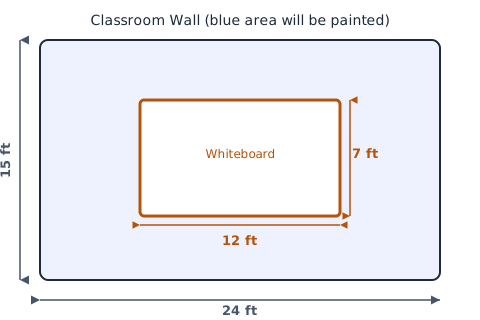
Solution: Method 1 — The Subtraction Approach
The most intuitive way is to find the total wall area, then subtract the whiteboard area that won't be painted.
Step 1 — Calculate the total wall area
The wall is a rectangle, so its area is length times width:
Step 2 — Calculate the whiteboard area
The whiteboard is also rectangular:
Step 3 — Find the area that needs paint
Subtract the whiteboard area from the total wall area:
Step 4 — Calculate how many cans are needed
Divide the paintable area by the coverage per can:
Step 5 — Round up to whole cans
Since Ms. Baker can't buy 0.68 of a can, she needs to round up to the next whole number:
Solution: Method 2 — The Panel-by-Panel Approach
Another way is to think of the wall as separate rectangular panels around the whiteboard.
Step 1 — Identify the four panels
Looking at our diagram, we can divide the paintable area into four rectangles:
- Top panel: above the whiteboard
- Bottom panel: below the whiteboard
- Left panel: to the left of the whiteboard
- Right panel: to the right of the whiteboard
Step 2 — Calculate each panel area
If the whiteboard is centered on the wall (we'll assume this for simplicity):
Step 3 — Add up all panels
Step 4 — Convert to cans and round up
Notice we get the same answer! This confirms our subtraction method was correct.
Verification
Let's verify our answer makes sense:
Check the area calculation:
- Wall area:
24 × 15 = 360 ft²✓ - Whiteboard area:
12 × 7 = 84 ft²✓ - Paintable area:
360 - 84 = 276 ft²✓
Check the paint calculation:
- 3 cans cover:
3 × 75 = 225 ft²(not enough) - 4 cans cover:
4 × 75 = 300 ft²(enough for 276 ft²) ✓
The verification confirms that 4 cans is correct.
Does This Seem Reasonable?
Let's do a quick sanity check on our answer.
The whiteboard takes up 84 ÷ 360 = 23% of the wall. So we're painting about 77% of the wall.
If the whole wall needed painting, it would require 360 ÷ 75 = 4.8 cans, so 5 cans total. Since we're painting about 77% of it, we'd expect roughly 5 × 0.77 = 3.85 cans.
Our answer of 4 cans is right in that ballpark, so it passes the smell test!
Common Pitfalls
Some students calculate
360 ÷ 75 = 4.8 → 5 cans by painting the whole wall. But the whiteboard won't be painted, so this wastes money on an extra can.
Calculating
276 ÷ 75 = 3.68 and rounding to 3 cans. But 3 cans only cover 225 ft², leaving 51 ft² unpainted. Always round up for purchasing problems.
Computing
360 + 84 = 444 ft² because the problem mentions both areas. But we need wall area minus whiteboard area, not their sum.
Calculating
(24 + 15) × 2 = 78 because they're thinking about the wall's edges. But paint coverage is always about area (square feet), not perimeter.
The General Formula
This problem follows the standard "area with exclusion" pattern:
Cans Needed = ⌈Paintable Area ÷ Coverage per Can⌉
The ceiling symbol ⌈⌉ means "round up to the next integer." This formula works for any paint problem where you need to avoid certain areas.
You'll see this pattern again with:
- Painting rooms with windows and doors
- Carpeting floors with built-in furniture
- Fertilizing lawns with gardens or pools
- Any "coverage minus obstacles" problem
Where This Shows Up in Real Life
Home renovation: Contractors constantly calculate paint, tile, or carpet needed while excluding fixtures, cabinets, and appliances. Getting this wrong means costly return trips to the store.
Commercial flooring: Office managers need to know how much carpet to order for a floor plan with cubicles, pillars, and permanent fixtures already in place.
Landscaping: Calculating mulch or grass seed needed for a yard minus the area occupied by trees, flower beds, patios, and walkways.
What If?
This is the same as before: 360 - 84 = 276 ft²
276 ÷ 60 = 4.6 cans
Since we can't buy 0.6 of a can, round up to 5 cans
5 cans cover 5 × 60 = 300 ft², which is more than the needed 276 ft² ✓
24 × 15 = 360 ft²
Whiteboard: 12 × 7 = 84 ft²
Window: 4 × 6 = 24 ft²
Total excluded: 84 + 24 = 108 ft²
360 - 108 = 252 ft²
252 ÷ 75 = 3.36 → 4 cans (rounded up)
4 cans cover 4 × 75 = 300 ft², which exceeds 252 ft² ✓
From our original problem: 276 ft² per wall
276 × 2 = 552 ft²
552 ÷ 75 = 7.36 cans
8 cans are needed for both walls
8 cans cover 8 × 75 = 600 ft², which exceeds 552 ft² ✓
3 cans × 75 ft²/can = 225 ft²
24 × 15 = 360 ft²
If paintable area = 225 ft², then:Whiteboard area = 360 - 225 = 135 ft²
For a square: side² = 135side = √135 ≈ 11.6 ft
11.6 ft × 11.6 ft = 134.6 ft² whiteboard
360 - 134.6 = 225.4 ft² to paint ≈ 3 cans ✓
Frequently Asked Questions
2026-07-12