




Paint Mixture: What Percent Yellow Must Be Added?
What You Will Learn
- How to set up equations for concentration problems where adding one component changes both the numerator and denominator
- Why you cannot simply calculate percentage differences when dealing with changing total volumes
- The algebraic technique of cross-multiplication to solve proportions in mixture problems
- How to verify mixture calculations by checking final percentages
- Pattern recognition for problems where "equal amounts" means 50% of each component
Solution: Method 1 — The Concentration Equation
When we add paint to a mixture, we change both the amount of the target color and the total volume. This requires careful equation setup.
Step 1 — Analyze the current mixture
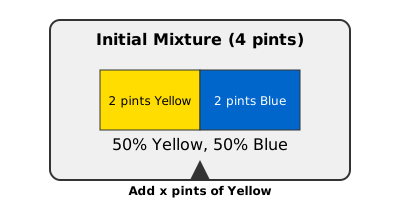
The problem states we have 4 pints of green paint made from "equal amounts" of yellow and blue. This means:
Current blue paint = 2 pints
Total volume = 4 pints
Current yellow percentage = 2/4 = 50%
Step 2 — Set up the target equation
Let x = pints of yellow paint to add. After adding yellow paint:
New total volume = 4 + x pints
Target percentage = 80% = 0.8
The concentration equation becomes:
(2 + x) ÷ (4 + x) = 0.8
Step 3 — Solve using cross-multiplication
Cross-multiply to eliminate the fraction:
2 + x = 3.2 + 0.8x
x - 0.8x = 3.2 - 2
0.2x = 1.2
x = 6
Step 4 — Evaluate Brandon's claim
Brandon claims 6 pints are needed. Our calculation shows x = 6, so Brandon is correct.
Solution: Method 2 — The Fixed Blue Reference
Since we're only adding yellow paint, the amount of blue stays constant at 2 pints. We can use this as our reference point.
Step 1 — Set up the percentage relationship
If the final mixture is 80% yellow, then it must be 20% blue:
Step 2 — Use the fixed blue amount
Since blue remains at 2 pints and represents 20% of the final mixture:
Total final volume = 2 ÷ 0.2 = 10 pints
Step 3 — Calculate yellow paint needed
We started with 4 pints and need 10 pints total:
This confirms Brandon's answer of 6 pints.
Verification
Let's check our answer by calculating the final mixture composition:
• Yellow paint: 2 + 6 = 8 pints
• Blue paint: 2 pints (unchanged)
• Total volume: 4 + 6 = 10 pints
• Yellow percentage: 8 ÷ 10 = 0.8 = 80% ✓
• Blue percentage: 2 ÷ 10 = 0.2 = 20% ✓
The percentages add to 100% and match our target, confirming the solution is correct.
Where Students Go Wrong
Some students think: "I need to go from 50% to 80%, that's a 30% increase, so I need 4 × 0.3 = 1.2 pints of yellow." This ignores that adding paint changes the total volume, making this approach completely wrong.
Students might write (2 + x) ÷ 4 = 0.8, keeping the original total of 4 pints. This gives x = 1.2 pints, which would actually make the mixture (2 + 1.2) ÷ (4 + 1.2) ≈ 60% yellow, not 80%.
Students sometimes calculate what's needed for 80% blue instead of 80% yellow, especially when the problem mentions both colors prominently. Always double-check which color the problem is asking about.
The Pattern Behind This
Mixture concentration problems follow a standard template:
The key insight is that when you add pure substance, both the numerator and denominator change. If you add x units of pure substance to a mixture:
New denominator = Original total + x
This creates the fundamental equation structure for all mixture problems where you're adding pure components to reach a target concentration.
Why This Matters
This type of calculation appears in many real-world contexts:
- Pharmacy: Diluting or concentrating medication solutions to achieve precise dosing
- Chemistry: Preparing solutions with specific molarity or concentration for experiments
- Food Industry: Adjusting sugar content, alcohol percentage, or salt concentration in products
- Manufacturing: Creating alloys with specific metal percentages or adjusting chemical compositions
What If?
Let x = pints of blue paint to add. Current: 2 pints yellow, 2 pints blue.
New blue amount = 2 + x, total volume = 4 + x. We want: (2 + x) ÷ (4 + x) = 0.8
2 + x = 0.8(4 + x)2 + x = 3.2 + 0.8x0.2x = 1.2x = 6
Final: 8 pints blue, 2 pints yellow, 10 total. Blue percentage: 8/10 = 80% ✓
Answer: 6 pints of blue paint
Current yellow: 6 × 0.4 = 2.4 pints. Current blue: 6 × 0.6 = 3.6 pints.
Let x = yellow to add. Want: (2.4 + x) ÷ (6 + x) = 0.75
2.4 + x = 0.75(6 + x)2.4 + x = 4.5 + 0.75x0.25x = 2.1x = 8.4
Final: 10.8 pints yellow, 3.6 pints blue, 14.4 total. Yellow: 10.8/14.4 = 0.75 = 75% ✓
Answer: 8.4 pints of yellow paint
Let y = blue paint added, then 2y = yellow paint added (twice as much yellow).
New yellow: 2 + 2y, New total: 4 + y + 2y = 4 + 3y. Want: (2 + 2y)/(4 + 3y) = 0.8
2 + 2y = 0.8(4 + 3y)2 + 2y = 3.2 + 2.4y-0.4y = 1.2y = -3
Since y = -3, this means we need to remove 3 pints of blue and remove 6 pints of yellow. This makes the problem impossible as stated since we can't remove more than we have.
Answer: This constraint makes 80% yellow impossible
Original: 2 yellow, 2 blue. Add 2 blue: now 2 yellow, 4 blue, 6 total. Yellow %: 2/6 = 33.3%
Let x = yellow added. Want: (2 + x) ÷ (6 + x) = 0.8
2 + x = 0.8(6 + x)2 + x = 4.8 + 0.8x0.2x = 2.8x = 14
Final: 16 yellow, 4 blue, 20 total. Yellow percentage: 16/20 = 0.8 = 80% ✓
Answer: 14 pints of yellow paint in the second step
Frequently Asked Questions
2026-09-18