




Weight-Based Pediatric Dose: mL Per Dose Calculation
What This Problem Teaches
- Weight-based dosing calculations using mg/kg formulations
- Converting total daily doses into individual administration amounts
- Dimensional analysis for medication concentration conversions
- Unit safety and precision in clinical calculations
- Connecting mathematical ratios to real-world medical practice
Visualizing the Calculation
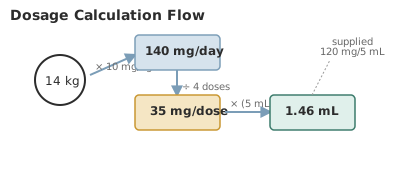
This diagram shows the three-step conversion: weight to daily dose, daily dose to single dose, then mg to mL using the concentration.
Solution: The Step-by-Step Method
Step 1 — Calculate the total daily dose
The prescription calls for 10 mg per kilogram per day. The child weighs 14 kg.
Step 2 — Find the dose per administration
The daily dose is divided into four equal doses throughout the day.
Step 3 — Convert mg to mL using the supplied concentration
The medication is supplied at 120 mg per 5 mL. We need to find how many mL contain 35 mg.
Step 4 — Round to appropriate precision
For clinical dosing, we round to two decimal places, which gives us 1.46 mL per dose.
Solution: Method 2 — Dimensional Analysis Chain
This method links all conversions in one continuous calculation, canceling units as we go.
Step 1 — Set up the conversion chain
Start with the child's weight and multiply by all the conversion factors in sequence:
Step 2 — Cancel units systematically
Watch how kg, day, and mg all cancel out, leaving only mL/dose:
Step 3 — Simplify the fraction
Divide both numerator and denominator by their greatest common factor:
Verification
Let's check our answer by working backwards from the final dose to the original prescription:
Check the mg content per dose
Check the total daily dose
Check the weight-based dosing
Our answer checks out perfectly within rounding precision.
Watch Out For These
Calculating 140 mg total and converting directly to mL gives 5.83 mL — but that's the entire daily amount, not per dose. In clinical practice, this error could lead to dangerous overdosing.
Using (120 mg / 5 mL) instead of (5 mL / 120 mg) gives 35 × 24 = 840 mL per dose — an impossibly large volume that should trigger immediate rechecking.
Misreading milligrams as micrograms or vice versa creates thousand-fold errors. Always double-check that your prescription units match your calculation units.
How to Spot This Problem Type
You'll recognize weight-based dosing problems by these key phrases:
- "mg/kg/day" or "mg per kilogram per day" — signals weight-based calculation
- "divided into X doses" or "X times daily" — means you need to split the total
- "supplied as" or "concentration is" — gives you the mg/mL conversion factor
- "how many mL" — tells you the final unit needed
These problems appear frequently on nursing exams (NCLEX) and in pharmacy school curricula, where precise dosing calculations are critical for patient safety.
The Pattern Behind This
All weight-based dosing problems follow the same three-step structure:
Daily mg ÷ doses/day → mg per dose
mg per dose × (mL/mg) → mL per dose
This formula generalizes to any weight-based medication where you need to find the volume per administration. The middle step (dividing by frequency) is often forgotten but crucial — it's the difference between a single dose and a dangerous overdose.
Four "What-If?" Problems
Total daily dose = 22 kg × 10 mg/kg/day = 220 mg/day
Per dose = 220 mg/day ÷ 4 doses/day = 55 mg/dose
Volume = 55 mg × (5 mL/120 mg) = 275/120 = 2.29 mL
Check: 2.29 mL × 4 doses × (120 mg/5 mL) = 219.8 mg/day ≈ 220 mg/day ✓
Answer: 2.29 mL per dose
Total daily dose = 14 kg × 10 mg/kg/day = 140 mg/day
Per dose = 140 mg/day ÷ 3 doses/day = 46.67 mg/dose
Volume = 46.67 mg × (5 mL/120 mg) = 233.33/120 = 1.94 mL
Check: 1.94 mL × 3 doses × (120 mg/5 mL) = 139.7 mg/day ≈ 140 mg/day ✓
Answer: 1.94 mL per dose
mg per dose = 2.5 mL × (120 mg/5 mL) = 60 mg/dose
Daily dose = 60 mg/dose × 4 doses/day = 240 mg/day
Weight = 240 mg/day ÷ 10 mg/kg/day = 24 kg
Check: 24 kg × 10 mg/kg/day = 240 mg/day ✓
Answer: The child weighs 24 kg
Total daily dose = 14 kg × 10 mg/kg/day = 140 mg/day
Per dose = 140 mg/day ÷ 4 doses/day = 35 mg/dose
Volume = 35 mg × (2 mL/80 mg) = 70/80 = 0.875 mL
Check: 0.875 mL × 4 doses × (80 mg/2 mL) = 140 mg/day ✓
Answer: 0.88 mL per dose
Frequently Asked Questions
Multiply the child's weight by the per-kilogram dose to get the total daily amount, then divide by the number of doses per day. In this problem: 14 kg × 10 mg/kg = 140 mg daily, then 140 mg ÷ 4 doses = 35 mg per dose.
Use dimensional analysis whenever you need to convert between different units in dosing calculations. Here we convert from mg per dose to mL per dose using the medication concentration: 35 mg/dose × (5 mL/120 mg) = 1.46 mL per dose.
Children of the same age can vary significantly in body size, but medication dosing is based on how the body processes drugs, which correlates better with weight than age. Weight-based dosing (mg/kg) ensures each child receives a dose proportional to their body size.
2026-07-03