


Medication Dosage: Calculate 30% Decrease

Medication Dosage 6th-7th Grade
PROBLEM
A patient is receiving 325 mg of medication. Due to an upcoming procedure, the doctor decreased the dosage of medication by 30%. What will the new dosage be in milligrams?

What This Problem Teaches

  • Understanding percentage decrease as the complement of what remains
  • Converting percentages to decimals for accurate calculations
  • Applying dimensional analysis principles in clinical contexts
  • Recognizing that dosage adjustments require precise mathematical reasoning
  • Verifying answers make clinical sense (decreased dosage should be smaller)

Visualizing the Decrease
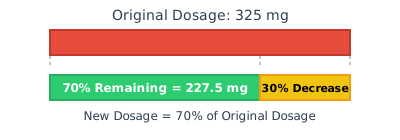
A patient is receiving 325 mg of medication. Due to an upcoming procedure, the doctor decreased the dosage of...

Solution: Method 1 — The Remaining Percentage Approach

When medication is decreased by a percentage, the most direct approach is to calculate what percentage remains, then find that portion of the original dosage.

Step 1 — Find the remaining percentage

If the dosage decreases by 30%, then the remaining amount is:

Remaining percentage = 100% - 30% = 70%

Step 2 — Convert to decimal form

Convert 70% to decimal form for multiplication:

70% = 70/100 = 0.70

Step 3 — Calculate the new dosage

Multiply the original dosage by the remaining percentage:

New dosage = 325 mg × 0.70 = 227.5 mg

Solution: Method 2 — Direct Subtraction of Decrease Amount

An alternative approach calculates exactly how much medication is being removed, then subtracts that amount from the original dosage.

Step 1 — Calculate the decrease amount

Find 30% of the original 325 mg dosage:

Decrease amount = 30% of 325 mg = 0.30 × 325 mg = 97.5 mg

Step 2 — Subtract from original dosage

Remove the decrease amount from the original:

New dosage = 325 mg - 97.5 mg = 227.5 mg

Both methods yield the same result, confirming our calculation.

The new dosage will be 227.5 mg.

Verification

Let's verify our answer makes sense:

Check 1: Is the new dosage smaller than the original?
227.5 mg < 325 mg ✓
Check 2: Does the decrease equal 30% of the original?
Actual decrease: 325 - 227.5 = 97.5 mg
Expected decrease: 30% of 325 = 0.30 × 325 = 97.5 mg ✓
Check 3: Does the new dosage equal 70% of the original?
70% of 325 = 0.70 × 325 = 227.5 mg ✓

Watch Out for These Mistakes

✗ Confusing decrease with remaining amount
Wrong: "30% decrease means multiply by 0.30"
Why it's wrong: A 30% decrease means you keep 70%, not 30%. Always subtract the decrease percentage from 100% first.
✗ Unit confusion in clinical settings
Wrong: Mixing up mg (milligrams) with mcg (micrograms) or mL (volume)
Why it's dangerous: In healthcare, unit errors can be life-threatening. 227.5 mg is not the same as 227.5 mcg (which would be 1000 times smaller).
✗ Rounding too early
Wrong: Converting 70% to 0.7 and getting 325 × 0.7 = 227
Why it's wrong: Keep full precision until the final answer. The exact calculation gives 227.5 mg, which could matter for proper dosing.

The General Pattern

For any percentage decrease problem, you can use this universal formula:

New Amount = Original Amount × (100% - Decrease%)

In decimal form:

New Amount = Original Amount × (1 - Decrease as decimal)
Clinical note: This formula works for any dosage adjustment. A 25% increase would use (1 + 0.25) = 1.25 as the multiplier. Always double-check that increases produce larger amounts and decreases produce smaller amounts.

You'll See This Again In...

  • Nursing calculations: Adjusting IV drip rates, pediatric dosing based on weight changes
  • Pharmacy: Compounding medications with different concentrations, calculating insurance copays
  • Business applications: Sales discounts, tax calculations, markup and markdown pricing

What If?

1
Different Decrease
A patient is receiving 450 mg of medication. The doctor decreased the dosage by 25% due to side effects. What is the new dosage in milligrams?
Step 1 — Find remaining percentage

Remaining = 100% - 25% = 75%

Step 2 — Convert to decimal

75% = 0.75

Step 3 — Calculate new dosage

450 mg × 0.75 = 337.5 mg

Step 4 — Verify

Decrease: 450 - 337.5 = 112.5 mg
Check: 25% of 450 = 0.25 × 450 = 112.5 mg

Answer: 337.5 mg

2
Two Sequential Changes
A dosage of 500 mg is first decreased by 20% for a procedure. After recovery, it is then increased by 25% of the reduced amount. What is the final dosage?
Step 1 — First decrease of 20%

Remaining: 100% - 20% = 80%
After decrease: 500 × 0.80 = 400 mg

Step 2 — Second change: increase by 25%

New percentage: 100% + 25% = 125%
After increase: 400 × 1.25 = 500 mg

Step 3 — Verify the sequence

First change: 500 → 400 (decreased by 100 mg)
Second change: 400 → 500 (increased by 100 mg)

Answer: 500 mg (back to original!)

3
Reverse the Unknown
After a procedure, a patient's medication dosage is increased by 25% from its current level. The new dosage is 400 mg. What was the original dosage before the increase?
Step 1 — Set up the equation

Let x = original dosage
After 25% increase: x × 1.25 = 400

Step 2 — Solve for original dosage

x = 400 ÷ 1.25 = 320 mg

Step 3 — Verify the answer

Check: 320 × 1.25 = 400
Increase amount: 400 - 320 = 80 mg
Percentage: 80 ÷ 320 = 0.25 = 25%

Answer: 320 mg

4
Split Dosing
A 300 mg dosage is decreased by 40%. The remaining amount is to be split equally into two daily doses. How many milligrams are in each of the two daily doses?
Step 1 — Calculate dosage after decrease

Remaining: 100% - 40% = 60%
New total: 300 × 0.60 = 180 mg

Step 2 — Split into two equal doses

Each dose: 180 ÷ 2 = 90 mg

Step 3 — Verify the calculation

Two doses: 90 + 90 = 180 mg
Original decrease: 300 - 180 = 120 mg
Check: 40% of 300 = 0.40 × 300 = 120 mg

Answer: 90 mg per dose

Frequently Asked Questions

How do you calculate a percentage decrease in medication dosage?+
To decrease a dosage by a percentage, subtract the percentage from 100% to find what remains, then multiply. For a 30% decrease from 325 mg: 100% - 30% = 70%, so 325 × 0.70 = 227.5 mg.
What's the difference between calculating the decrease amount versus the remaining amount?+
You can either find what's removed (30% of 325 = 97.5 mg, then subtract: 325 - 97.5 = 227.5 mg) or find what remains (70% of 325 = 227.5 mg directly). Both give the same answer, but the remaining percentage method is often faster.
Why is precision important in medication dosage calculations?+
In clinical practice, dosage accuracy can affect patient safety and treatment effectiveness. Always double-check calculations and verify that your answer makes sense - a decrease should result in a smaller amount than the original.
NJ
Neven Jurkovic, PhD

Professor of Computer Science, Palo Alto College, Alamo Colleges District, San Antonio, TX

Developer of Algebrator

Contact

This solution was prepared with AI assistance and reviewed by Dr. Jurkovic for mathematical accuracy and pedagogical clarity.

2026-09-08