




Dosage Calculation: Phenobarbital Tablets from Grams
Skills This Problem Builds
- Unit conversion mastery — Converting between metric units (grams to milligrams) accurately and efficiently
- Dimensional analysis — Using systematic factor-label method to track units through calculations
- Medication safety awareness — Understanding that precise dosing requires careful unit management
- Clinical calculation fluency — Applying the fundamental dosage formula used in healthcare settings
- Critical verification skills — Checking that calculated doses make practical sense for patient safety
Picture This
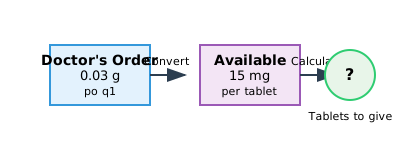
Every medication calculation starts with this flow: identify what's ordered, see what's available, convert to matching units, then calculate the quantity to administer.
Solution: Method 1 — Unit Conversion Bridge
Step 1 — Identify the unit mismatch
The doctor ordered phenobarbital in grams (0.03 g), but the pharmacy stocks tablets measured in milligrams (15 mg per tablet). Before we can calculate how many tablets to give, we need both quantities in the same unit.
Step 2 — Convert grams to milligrams
Use the metric conversion: 1 g = 1000 mg
So the ordered dose is 30 mg of phenobarbital.
Step 3 — Apply the dosage formula
Now that both values are in milligrams, we can use the standard dosage calculation:
Step 4 — Interpret the result
The nurse should administer 2 tablets of phenobarbital to deliver the ordered 0.03 g dose.
Solution: Method 2 — Dimensional Analysis Chain
Step 1 — Set up the conversion chain
Start with the ordered dose and arrange conversion factors so unwanted units cancel out, leaving only tablets:
Step 2 — Check unit cancellation
Watch how the units cancel: grams cancel with grams, milligrams cancel with milligrams, leaving only tablets.
Step 3 — Calculate the final result
This one-step calculation gives us the same answer: 2 tablets.
Verification
Let's verify by working backwards from our answer:
Perfect! Two tablets deliver exactly 0.03 g of phenobarbital, matching the doctor's order.
Watch Out For These
Calculation:
0.03 ÷ 15 = 0.002 tabletsThis treats 0.03 g as if it were 0.03 mg, resulting in a 1000-fold underdose. In clinical practice, this error could be life-threatening.
Calculation:
0.03 g × 0.001 = 0.00003 mgUsing "divide by 1000" instead of "multiply by 1000" when going from grams to milligrams. Remember: smaller units mean bigger numbers.
Calculation:
15 mg/tablet ÷ 30 mg = 0.5 tablets/mgThis gives tablets per milligram instead of total tablets needed. Always put the required dose in the numerator.
How to Spot This Problem Type
You're looking at a medication dosage calculation when you see:
- "Available:" or "On hand:" followed by a concentration (mg per tablet, mg/mL, etc.)
- Mixed units: The ordered dose and available concentration use different metric units
- "How many [units] will the nurse administer?" This signals you need to calculate a quantity
- Medical abbreviations: "po" (by mouth), "q1" (every 1 hour), "bid" (twice daily) — these indicate clinical context
- Drug names: Phenobarbital, acetaminophen, digoxin — real medication names point to dosage calculations
The Pattern Behind This
All medication dosage calculations follow this universal structure:
The conversion factor equals 1 when units already match. When they don't match:
- Grams to milligrams: multiply by 1000
- Milligrams to micrograms: multiply by 1000
- Kilograms to grams: multiply by 1000
- Going the other direction: divide by 1000
What If?
0.03 g × 1000 mg/g = 30 mg
Number of tablets = 30 mg ÷ 30 mg/tablet = 1 tablet
1 tablet × 30 mg/tablet = 30 mg = 0.03 g ✓
Answer: 1 tablet
4 tablets × 15 mg/tablet = 60 mg
60 mg × (1 g / 1000 mg) = 60/1000 = 0.06 g
0.06 g × 1000 = 60 mg ÷ 15 mg/tablet = 4 tablets ✓
Answer: 0.06 g
q6h means every 6 hours. In 24 hours: 24 ÷ 6 = 4 doses per day
0.03 g = 30 mg. Tablets needed: 30 mg ÷ 15 mg/tablet = 2 tablets per dose
2 tablets/dose × 4 doses/day = 8 tablets per day
8 tablets × 15 mg/tablet = 120 mg = 0.12 g total daily dose
4 doses × 0.03 g/dose = 0.12 g ✓
Answer: 8 tablets per day
0.045 g × 1000 mg/g = 45 mg
20 mg/5 mL = 4 mg/mL
Volume needed = Required dose ÷ Concentration
Volume = 45 mg ÷ 4 mg/mL = 11.25 mL
11.25 mL × 4 mg/mL = 45 mg = 0.045 g ✓
Answer: 11.25 mL
Frequently Asked Questions
2026-08-25