




Pigeonhole Principle: Guaranteed Demographic Match
What This Problem Teaches
- Pigeonhole Principle Application: Understanding when outcomes are guaranteed vs. merely possible
- Combinatorial Counting: Computing total arrangements using the multiplication principle
- Worst-Case Reasoning: Thinking about what must happen in the most unfavorable scenario
- Generalized Pigeonhole Principle: Finding minimum requirements for multiple matches
- Mathematical Communication: Expressing answers in unevaluated form for clarity
Visualizing the Problem
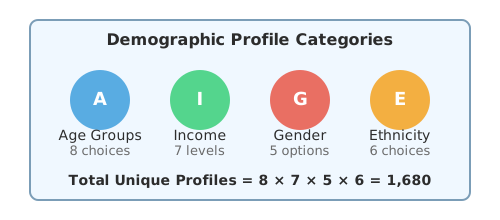
Solution: Method 1 — Direct Pigeonhole Application
The pigeonhole principle guarantees that if you have more items than containers, at least one container must hold multiple items. But this problem asks for a stronger guarantee: at least three people with identical information.
Step 1 — Calculate the total number of distinct demographic profiles
Each person chooses one option from each category simultaneously. Using the multiplication principle:
Total profiles = 8 × 7 × 5 × 6 = 1,680 distinct combinationsStep 2 — Apply the generalized pigeonhole principle
To guarantee that at least k items fall into the same category when you have n categories, you need at least (k-1) × n + 1 items total.
For k = 3 matches: Minimum people = (3-1) × 1,680 + 1= 2 × 1,680 + 1 = 3,361 peopleStep 3 — Express in unevaluated form
Since the problem asks for the unevaluated form, we substitute back:
Answer = 2(8 × 7 × 5 × 6) + 1Step 4 — Explain the logic
Why does this formula work? In the worst-case scenario, the first 3,360 people could all have different demographic profiles — exactly 2 people for each of the 1,680 possible combinations. The 3,361st person must then match the profile of two others, creating the first group of three.
Solution: Method 2 — Contradiction Approach
We can also solve this by asking: what's the maximum number of people we can survey without guaranteeing three matches?
Step 1 — Establish the maximum without three matches
If we want to avoid having three people with identical demographics, we can have at most 2 people for each demographic profile.
Maximum people without 3 matches = 2 × (number of profiles)= 2 × (8 × 7 × 5 × 6) = 2 × 1,680 = 3,360Step 2 — Add one more person to guarantee the match
With 3,360 people, it's possible (in the worst case) that each demographic profile has exactly 2 people. Adding one more person forces a third match:
Minimum for guarantee = 3,360 + 1 = 3,361= 2(8 × 7 × 5 × 6) + 1Step 3 — Verify the reasoning
This approach confirms our answer. The 3,361st person has no choice but to select a demographic combination that already has 2 people, creating the guaranteed third match.
This equals 3,361 people in evaluated form.
Verification
Let's verify our answer makes logical sense:
- Check the boundary case: With 3,360 people, we could have exactly 2 people in each of the 1,680 demographic categories. No group of three yet exists.
- Check the guarantee: Person number 3,361 must choose some demographic profile. Since all 1,680 profiles already have 2 people, this person creates the first group of 3.
- Verify the formula:
2(8 × 7 × 5 × 6) + 1 = 2(1,680) + 1 = 3,360 + 1 = 3,361✓ - Sanity check: This number is much larger than the number of profiles (3,361 > 1,680), which makes sense since we need multiple people per profile.
Where Students Go Wrong
Calculating total profiles as 8 + 7 + 5 + 6 = 26. This counts the number of choices available, not the number of distinct combinations possible.
Using 1,680 + 1 = 1,681 people. This would guarantee that at least 2 people share demographics, not 3. The basic principle ensures one duplicate, not multiple duplicates.
Giving the answer as 2(8 × 7 × 5 × 6) = 3,360. With exactly 3,360 people, it's possible to avoid any group of three — you need one more person to guarantee it.
Saying you need only 3 people because you might get lucky. The problem asks what makes it inevitable — what happens in the worst-case scenario where you're maximally unlucky.
The Underlying Pattern
This problem illustrates the Generalized Pigeonhole Principle, which extends the basic version to guarantee multiple items in the same category:
k items fall into the same category when there are n categories, you need at least (k-1)n + 1 items.
In our demographic problem:
n = 8 × 7 × 5 × 6(total demographic profiles)k = 3(we want 3 people with identical information)- Answer:
(3-1) × (8 × 7 × 5 × 6) + 1 = 2(8 × 7 × 5 × 6) + 1
This formula works because in the worst case, you can have k-1 items in each of the n categories before being forced to create a group of k.
Real Applications
- Computer Science: Hash table collisions — determining when duplicate hash values are guaranteed with certain table sizes and number of insertions.
- Quality Control: Manufacturing defect analysis — calculating how many products must be tested to guarantee finding multiple items from the same defective batch.
- Cryptography: Birthday paradox applications — finding minimum conditions for hash collisions in security protocols.
- Genetics: Population studies — determining sample sizes needed to guarantee finding multiple individuals with identical genetic markers.
What If?
We need (k-1) × n + 1 where k = 5 and n = 8 × 7 × 5 × 6
Minimum people = (5-1) × (8 × 7 × 5 × 6) + 1 = 4(8 × 7 × 5 × 6) + 1
In the worst case, the first 6,720 people could have exactly 4 people for each demographic profile. The 6,721st person creates the first group of 5.
4(8 × 7 × 5 × 6) + 1 people (equals 6,721 people)
We know that 2P + 1 = 843, where P is the number of profiles
2P = 843 - 1 = 842, so P = 421
With 421 profiles, we can have 2 people in each profile for 842 people total. The 843rd person creates the guaranteed third match.
421 distinct demographic profiles
With the education category: 8 × 7 × 5 × 6 × 4 = 6,720 distinct profiles
For 3 guaranteed matches: 2 × (number of profiles) + 1
2(8 × 7 × 5 × 6 × 4) + 1
2(8 × 7 × 5 × 6 × 4) + 1 people (equals 13,441 people)
We only care about age and income combinations: 8 × 7 = 56 possible combinations
To guarantee 3 people with the same age-income pair: 2 × 56 + 1
2 × 56 + 1 = 112 + 1 = 113
113 people are needed to guarantee at least 3 share the same age-income combination
Frequently Asked Questions
2026-10-24