




Permutation Problem: Dinner Party Arrival Order
a. In how many ways can they arrive?
b. In how many ways can Maria arrive first and Kim last?
c. Find the probability that Maria will arrive first and Kim last.
What This Problem Teaches
- Permutation fundamentals: Understanding how to count ordered arrangements of distinct objects
- Conditional probability: Calculating probability when certain positions are fixed
- Factorial reasoning: Recognizing when to use n! versus modified counting
- Multi-step problem solving: Breaking complex probability questions into manageable parts
- Connection between counting and probability: Using favorable outcomes over total outcomes
Solution: Method 1 — Direct Counting & Factorial Reasoning
Step 1 — Count total arrangements (Part a)
We have 5 distinct people arriving at 5 distinct time slots (first, second, third, fourth, fifth). Each person can only occupy one time slot, and each slot can only have one person.
Total arrangements = 5! = 5 × 4 × 3 × 2 × 1 = 120This uses the fundamental counting principle: 5 choices for who arrives first, then 4 remaining choices for second, 3 for third, 2 for fourth, and 1 for last.
Step 2 — Count arrangements with Maria first and Kim last (Part b)
When Maria must arrive first and Kim must arrive last, we fix those two positions. This leaves us with arranging the remaining 3 people (Simone, Tyrone, Sarah) in the 3 middle positions.
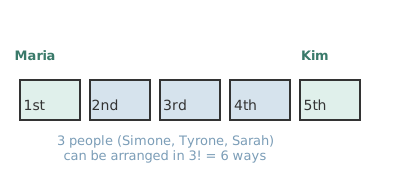
Favorable arrangements = 3! = 3 × 2 × 1 = 6Step 3 — Calculate the probability (Part c)
Probability equals the number of favorable outcomes divided by the total number of outcomes.
P(Maria first AND Kim last) = 6/120 = 1/20 = 0.05Solution: Method 2 — Slot-Filling Approach
Step 1 — Fill slots one by one (Part a)
Think of 5 arrival slots that need to be filled sequentially:
- First slot: 5 choices (any of the 5 people)
- Second slot: 4 choices (anyone except who's already first)
- Third slot: 3 choices
- Fourth slot: 2 choices
- Fifth slot: 1 choice (whoever remains)
Total arrangements = 5 × 4 × 3 × 2 × 1 = 120Step 2 — Apply constraints for Part b
With Maria forced into first position and Kim forced into last position:
- First slot: 1 choice (must be Maria)
- Second slot: 3 choices (Simone, Tyrone, or Sarah)
- Third slot: 2 choices (two of the three remain)
- Fourth slot: 1 choice (last of the three)
- Fifth slot: 1 choice (must be Kim)
Constrained arrangements = 1 × 3 × 2 × 1 × 1 = 6Step 3 — Convert to probability
The probability is the ratio of constrained arrangements to total arrangements.
P = 6/120 = 1/20 = 5%a. 120 ways
b. 6 ways
c. P = 1/20 = 0.05 = 5%
Verification
Check Part a
For 5 distinct people in 5 distinct positions, the factorial formula must give 5! = 5 × 4 × 3 × 2 × 1 = 120. ✓
Check Part b
With Maria fixed first and Kim fixed last, we arrange 3 people in 3 positions: 3! = 3 × 2 × 1 = 6. Let's list them all:
- Maria, Simone, Tyrone, Sarah, Kim
- Maria, Simone, Sarah, Tyrone, Kim
- Maria, Tyrone, Simone, Sarah, Kim
- Maria, Tyrone, Sarah, Simone, Kim
- Maria, Sarah, Simone, Tyrone, Kim
- Maria, Sarah, Tyrone, Simone, Kim
Count: 6 arrangements. ✓
Check Part c
Probability = favorable/total = 6/120 = 1/20 = 0.05. This equals 5%, which makes intuitive sense since we're constraining 2 out of 5 positions. ✓
Watch Out For These Mistakes
Some students calculate C(5,5) = 1 thinking order doesn't matter. But arrival order absolutely matters—arriving first versus last makes a difference in this context.
Calculating 4! instead of 3! because they forget that BOTH Maria's and Kim's positions are constrained. Only the 3 middle people can be rearranged.
Using 6 favorable outcomes but calculating probability as 6/6 = 1 instead of 6/120. The denominator must always be the total number of equally likely outcomes.
The General Formula
For n people arriving in order with specific people fixed in specific positions:
Total arrangements = n!Arrangements with k fixed positions = (n-k)!Probability = (n-k)! / n!In our problem: n = 5, k = 2 (Maria first, Kim last), so the probability is (5-2)! / 5! = 3! / 5! = 6/120 = 1/20.
This pattern works for any permutation problem where certain positions are constrained. The key insight is that fixing positions reduces the problem to arranging fewer objects.
How to Spot This Problem Type
Look for these telltale signs that signal a permutation problem:
- "In how many ways..." followed by an ordering scenario
- "Arrive in order" or similar language about sequence
- "Each person arrives at a different time" (ensures no ties)
- Probability questions about specific arrangements
- Constraints like "first," "last," "before," "after"
These problems often appear in contexts like: race finishing orders, appointment scheduling, seating arrangements, or any scenario where the sequence of events matters and no two events happen simultaneously.
Does the Answer Make Sense?
Let's check our intuition against the calculated probability of 5%:
Maria arriving first: She has a 1 in 5 chance = 20%
Kim arriving last: She has a 1 in 5 chance = 20%
Both events together: Since these events are not independent (fixing Maria first affects Kim's probability of being last), we can't just multiply 20% × 20% = 4%.
The correct calculation gives us 5%, which is slightly higher than 4% because once Maria is fixed in first place, Kim has a slightly better chance of ending up last (1 in 4 chance among the remaining unfixed positions, considering the constraint structure).
As a sanity check: 5% means this specific arrangement happens about once every 20 times people arrive randomly—which feels reasonable for a fairly specific constraint.
What If?
With 7 people, total arrangements = 7! = 7 × 6 × 5 × 4 × 3 × 2 × 1 = 5,040
This leaves 5 people to arrange in the 5 middle positions: 5! = 5 × 4 × 3 × 2 × 1 = 120
P = 120/5,040 = 1/42 ≈ 0.0238 = 2.38%
Using the formula: (n-2)!/n! = 5!/7! = 120/5,040 = 1/42 ✓
Answer: 1/42 ≈ 2.38%
Think of (Maria-Kim) as one "super person." Now we're arranging 4 units: (Maria-Kim), Simone, Tyrone, Sarah
These 4 units can be arranged in 4! = 24 ways
Within their unit, Maria and Kim can be in 2 orders: Maria-Kim or Kim-Maria
Total favorable arrangements = 4! × 2 = 24 × 2 = 48
Probability = 48/120 = 2/5 = 0.4 = 40%
Answer: 2/5 = 40%
For any two specific people, by symmetry, each is equally likely to arrive before the other
In any random arrangement of the 5 people, Simone arrives before Tyrone in exactly half of all arrangements
P(Simone before Tyrone) = 1/2 = 0.5 = 50%
Total arrangements = 120. Arrangements with Simone before Tyrone = 60. So P = 60/120 = 1/2 ✓
Answer: 1/2 = 50%
Using our formula: (n-2)!/n! = 1/42, where n is the number of people
(n-2)!/n! = (n-2)!/[n × (n-1) × (n-2)!] = 1/[n(n-1)]
1/[n(n-1)] = 1/42
Therefore: n(n-1) = 42
n² - n - 42 = 0
(n-7)(n+6) = 0
Since n must be positive: n = 7
Check: 7 × 6 = 42 ✓ and (7-2)!/7! = 5!/7! = 120/5040 = 1/42 ✓
Answer: 7 people
Frequently Asked Questions
2026-11-06