




Calculating Plane Airspeed and Wind Speed From Opposing Trips
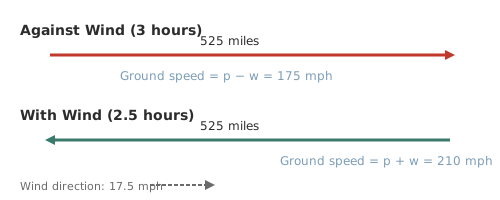
What This Problem Teaches
- Setting up systems of equations from real-world distance-rate-time scenarios
- Understanding how wind affects ground speed versus airspeed
- Working with fractional time measurements (2.5 hours) in rate calculations
- Solving two-variable systems using elimination or substitution methods
- Interpreting solutions in context: distinguishing between airspeed and wind speed
Solution: Method 1 — The System of Equations Approach
When a plane flies against or with the wind, its ground speed (speed relative to the earth) differs from its airspeed (speed through the air). We need to set up equations that capture this relationship.
Step 1 — Define the variables
Let p = the plane's speed in still air (airspeed) in mph
Let w = the wind speed in mph
Step 2 — Set up the equation for flying against the wind
When flying against the wind, the plane's ground speed is reduced: ground speed = p - w
Using distance = rate × time:
Step 3 — Set up the equation for flying with the wind
When flying with the wind, the plane's ground speed is increased: ground speed = p + w
The return trip takes 2.5 hours:
Step 4 — Simplify both equations
From the first equation: 525 = 3(p - w)
Divide by 3: 175 = p - w
From the second equation: 525 = 2.5(p + w)
Divide by 2.5: 210 = p + w
p + w = 210
Step 5 — Solve using elimination
Add the two equations to eliminate w:
2p = 385
p = 192.5
Step 6 — Find the wind speed
Substitute p = 192.5 into either equation. Using p + w = 210:
w = 17.5
Solution: Method 2 — The Ground Speed First Approach
Instead of setting up variables immediately, we can first calculate the actual ground speeds for each leg of the trip, then work backwards to find airspeed and wind speed.
Step 1 — Calculate ground speed against the wind
Using speed = distance ÷ time:
Step 2 — Calculate ground speed with the wind
Step 3 — Recognize the relationship
If the plane's airspeed is p and wind speed is w, then:
With wind: p + w = 210
Step 4 — Find airspeed by averaging
The airspeed is the average of the two ground speeds:
Step 5 — Find wind speed by finding the difference
The wind speed is half the difference between the ground speeds:
Verification
Let's check our answer by substituting back into the original conditions:
Check the trip against the wind
Ground speed = 192.5 - 17.5 = 175 mph
Time = 525 ÷ 175 = 3 hours ✓
Check the return trip with the wind
Ground speed = 192.5 + 17.5 = 210 mph
Time = 525 ÷ 210 = 2.5 hours ✓
Both conditions are satisfied, confirming our solution is correct.
Does This Seem Reasonable?
Our answers pass several sanity checks:
Wind speed of 17.5 mph: This represents moderate wind conditions - strong enough to significantly affect flight time but not extreme.
Time difference: The 30-minute difference (3 hours vs 2.5 hours) for the same distance shows a meaningful but realistic wind effect.
Notice that the wind has a larger proportional effect on the slower leg: reducing speed by 9% against the wind but only increasing speed by 9% with the wind, which explains why headwinds feel worse than tailwinds help.
Watch Out For These
Some students try to use 192.5 mph as the ground speed in both directions. Remember: airspeed stays constant, but ground speed changes with wind conditions.
"2 hours and 30 minutes" must be converted to 2.5 hours, not 2.3 hours. Always convert minutes to decimal form: 30 minutes = 0.5 hours.
Against the wind means
p - w, not p + w. With the wind means p + w. The wind opposes motion when it's a headwind and assists when it's a tailwind.
The airspeed is NOT the average of 3 hours and 2.5 hours. You must first find ground speeds, then average those speeds to get airspeed.
The Pattern Behind This
All airplane wind problems follow this general structure:
Ground speed against wind = a - w
Ground speed with wind = a + w
For the same distance d:
Time against wind = d ÷ (a - w)
Time with wind = d ÷ (a + w)
This pattern works because adding the ground speeds eliminates the wind effect: (a - w) + (a + w) = 2a, while subtracting them isolates the wind effect: (a + w) - (a - w) = 2w.
Real Applications
This calculation appears in several practical contexts:
Flight planning: Commercial pilots use wind forecasts to calculate fuel requirements and arrival times, accounting for seasonal jet stream patterns that can add or subtract 100+ mph from ground speed.
Marine navigation: Boats face the same math with ocean currents - a sailboat's speed through water versus speed over ground depends on current direction and strength.
Sports timing: Track and field officials adjust wind-legal times for sprints when tailwinds or headwinds exceed 2 meters per second, using similar calculations to determine the wind's effect on performance.
What If?
Against wind: 420 ÷ 3.5 = 120 mph
With wind: 420 ÷ 2.5 = 168 mph
Airspeed = (120 + 168) ÷ 2 = 288 ÷ 2 = 144 mph
Wind speed = (168 - 120) ÷ 2 = 48 ÷ 2 = 24 mph
Against wind: 144 - 24 = 120 mph, time = 420 ÷ 120 = 3.5 hrs ✓
With wind: 144 + 24 = 168 mph, time = 420 ÷ 168 = 2.5 hrs ✓
Answer: Airspeed = 144 mph, Wind speed = 24 mph
Ground speed = 300 ÷ 2 = 150 mph
Since ground speed against wind = airspeed - wind speed:150 = p - 20, so p = 170 mph
Ground speed with wind = 170 + 20 = 190 mph
Time = 450 ÷ 190 = 2.37 hours = 2 hours 22 minutes
Check original: 170 - 20 = 150 mph, time = 300 ÷ 150 = 2 hrs ✓
Answer: 2 hours 22 minutes
Ground speed north = 200 ÷ 1.25 = 160 mph
Since this is against 15 mph wind: 160 = p - 15
Airspeed p = 175 mph
No wind effect, so ground speed = airspeed = 175 mph
Time = 200 ÷ 175 = 1.14 hours
With 15 mph tailwind: ground speed = 175 + 15 = 190 mph
Time = 200 ÷ 190 = 1.05 hours
Total time = 1.25 + 1.14 + 1.05 = 3.44 hours = 3 hours 26 minutes
Answer: 3 hours 26 minutes total flight time
Let w = wind speed
Time against wind + Time with wind = 7600/(180-w) + 600/(180+w) = 7
Multiply through by (180-w)(180+w):600(180+w) + 600(180-w) = 7(180-w)(180+w)
600(180) + 600w + 600(180) - 600w = 216000
The w terms cancel: 216000
7(180² - w²) = 7(32400 - w²) = 226800 - 7w²216000 = 226800 - 7w²7w² = 10800w² = 1543w = 39.3 mph
Against wind: 600/(180-39.3) = 4.27 hrs
With wind: 600/(180+39.3) = 2.74 hrs
Total: 4.27 + 2.74 = 7.01 hrs ≈ 7 hrs ✓
Answer: Wind speed ≈ 39.3 mph
Frequently Asked Questions
2026-11-11