




Probability of Union: Female OR Mathematics Major
What This Problem Teaches
- Understanding probability notation and the meaning of "or" in mathematical contexts
- Applying the inclusion-exclusion principle to avoid double-counting overlapping events
- Converting word problems into probability notation using unions and intersections
- Interpreting Venn diagrams to visualize overlapping categories in probability
- Recognizing when to add, subtract, or combine probabilities in union problems
Picture This
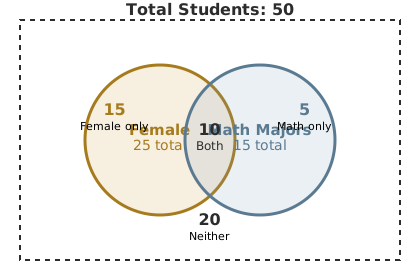
This Venn diagram shows how the 50 students are distributed across the categories. The overlapping region represents students who are both female and math majors.
Solution: Method 1 — The Inclusion-Exclusion Approach
The phrase "female or a mathematics major or both" signals we need to find the probability of the union of these two events. The key insight is that simply adding the individual probabilities would double-count students who belong to both categories.
Step 1 — Define the events and organize the given information
Let's define our events clearly:
M = event that a randomly selected student is a math major
Given information:
• Total students: 50
• Female students: 25
• Math majors: 15
• Students who are both female AND math majors: 10
Step 2 — Calculate the individual probabilities
We can now find the probability of each individual event:
P(M) = Number of math majors / Total students = 15/50 = 3/10
P(F ∩ M) = Number who are both / Total students = 10/50 = 1/5
Step 3 — Apply the inclusion-exclusion principle
For any two events A and B, the probability of "A or B" is given by the inclusion-exclusion formula. This prevents us from counting the overlap twice:
Step 4 — Substitute and calculate
Now we substitute our known values:
P(F ∪ M) = (25 + 15 - 10)/50
P(F ∪ M) = 30/50 = 3/5
Step 5 — Convert to decimal and percentage
For completeness, let's express this in different forms:
Solution: Method 2 — Direct Counting via Venn Diagram
Instead of using a formula, we can solve this by directly counting students in each region of the Venn diagram and adding up those who satisfy our condition.
Step 1 — Identify all the regions
Looking at our Venn diagram, we can break down the 50 students into four distinct groups:
Region 2: Math major only = 15 - 10 = 5 students
Region 3: Both female AND math major = 10 students
Region 4: Neither female nor math major = 50 - (15 + 5 + 10) = 20 students
Step 2 — Count students who are "female OR math major"
We want students who fall into any of the first three regions (any student who is female, or a math major, or both):
Students in the union = 15 + 5 + 10 = 30 students
Step 3 — Calculate the probability
The probability is simply the favorable outcomes divided by the total:
Notice how this method gives us the same answer as the inclusion-exclusion approach, but provides a more visual understanding of what we're counting.
Verification
Let's verify our answer using a different approach: we'll check that all probabilities account for every student exactly once.
Method 1 verification: Using inclusion-exclusion backwards
This means 30 students are in the union.
Check: 15 (female only) + 5 (math only) + 10 (both) = 30 ✓
Remaining students: 50 - 30 = 20 (neither) ✓
Method 2 verification: Checking our probability makes sense
P(female OR math major) + P(neither) = 3/5 + 2/5 = 5/5 = 1 ✓
Both checks confirm our answer is correct. The probabilities sum to 1, as they must, and our region counting matches our formula result.
Watch Out For These
✗ Adding without subtracting the overlap
The most common error is calculating P(F) + P(M) = 25/50 + 15/50 = 40/50 = 4/5. This is wrong because it counts the 10 students who are both female and math majors twice. You must subtract the intersection to avoid double-counting.
✗ Using "and" instead of "or"
Some students mistakenly find P(F ∩ M) = 10/50 = 1/5, which is the probability of selecting someone who is both female AND a math major. But the problem asks for "female OR math major OR both," which requires the union formula.
✗ Misinterpreting "10 of the math majors are female"
This statement means there are 10 students who belong to both categories, not that there are 10 additional female students. The 10 students are already counted within both the 25 female students and the 15 math majors.
The Pattern Behind This
This problem demonstrates the fundamental inclusion-exclusion principle, which appears throughout probability and combinatorics. For any two events A and B:
The principle extends to three or more events, though the formula becomes more complex. For three events A, B, and C:
- P(A ∩ B) - P(A ∩ C) - P(B ∩ C)
+ P(A ∩ B ∩ C)
The alternating pattern of addition and subtraction ensures that every element in the union is counted exactly once. This principle is the foundation for solving complex probability problems involving multiple overlapping categories.
Key insight: Whenever you see "or" in probability, think "union" and remember that overlapping regions need special attention to avoid double-counting.
How to Spot This Problem Type
You're dealing with a union probability problem when you see these phrases:
- "A or B" / "A or B or both" / "at least one of A or B"
- "Female or mathematics major" / "Senior or honor student"
- Problems that give you overlapping categories with specific intersection counts
- Venn diagram scenarios where you need the total area of overlapping circles
- "What is the probability that a randomly selected person has property X or property Y?"
Structure to look for: The problem gives you the size of two groups, tells you how much they overlap, and asks for the probability of being in either group (or both). The word "or" is the key signal that you need union probability, not intersection.
Watch out for disguises: Sometimes these problems are framed as "What is the probability of NOT being in neither category?" This is actually asking for the same union probability, just using the complement principle.
What If?
P(F) = 25/50 = 1/2, P(M) = 15/50 = 3/10, P(F ∩ M) = 5/50 = 1/10
P(F ∪ M) = P(F) + P(M) - P(F ∩ M) = 25/50 + 15/50 - 5/50
P(F ∪ M) = (25 + 15 - 5)/50 = 35/50 = 7/10 = 0.7 = 70%
Female only: 20, Math only: 10, Both: 5, Neither: 15. Total in union: 20 + 10 + 5 = 35 ✓
Let M = number of math majors. We know P(F ∪ M) = 2/3, so the union contains (2/3) × 60 = 40 students.
Union count = Female count + Math major count - Both count40 = 30 + M - 12
40 = 30 + M - 1240 = 18 + MM = 22
Check: P(F ∪ M) = (30 + 22 - 12)/60 = 40/60 = 2/3 ✓
F = 25, M = 15, S = 20, F∩S = 8, M∩S = 6, F∩M∩S = 3. From original: F∩M = 10.
P(F ∪ M ∪ S) = P(F) + P(M) + P(S) - P(F∩M) - P(F∩S) - P(M∩S) + P(F∩M∩S)
(25 + 15 + 20 - 10 - 8 - 6 + 3)/50 = 39/50 = 0.78 = 78%
Count regions: F only + M only + S only + (F∩M only) + (F∩S only) + (M∩S only) + (all three) should equal 39.
We want P(Female | Math Major), which reads "probability of female given that the student is a math major."
P(F|M) = P(F ∩ M) / P(M) = (Number both) / (Total math majors)
P(F|M) = 10/15 = 2/3 ≈ 0.667 = 66.7%
Of the 15 math majors, 10 are female and 5 are male. So 10/15 = 2/3 makes sense. ✓
Frequently Asked Questions
2026-08-05