




Selection Without Replacement: Probability Both Good
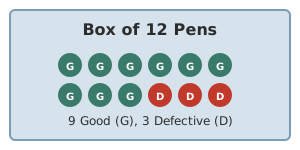
In a box of 12 pens, a total of 3 are defective. If a customer buys 2 pens selected at random from the box, what is the probability that neither pen will be defective?
Already Got the Answer? Check It Here
(9/12) × (8/11)6/11 ≈ 0.545 (about 54.5%)C(9,2) / C(12,2) = 36/66 = 6/11 ✓9/16 or 0.5625, you treated the draws as if the first pen were put back. Read on to see why that is not quite right.What You Will Learn
- Why the second pick depends on the first. Without replacement, every draw changes the box, and the probabilities have to change with it.
- How to multiply along a path. "Both" means "and," and "and" for dependent events means chaining conditional probabilities.
- How to count equally likely groups. The combination method turns the same problem into favorable ÷ total, with no sequence needed.
- How to use the complement. Sometimes it is easier to count what you do not want and subtract, and it gives you a built-in cross-check.
- How to recognize the hypergeometric pattern. It is the structure behind quality control, card hands, and lotteries.
Picture This: The Tree of Possible Draws
Sequential picks from a shrinking box are exactly what a tree diagram was invented for. Each branch carries the probability of that pick given everything that has already happened. Notice that the numbers on the second set of branches are different depending on which first branch you took.
Solution: Method 1 — Chaining Probabilities Draw by Draw
The most natural way to think about this problem is the way it physically happens: the customer takes out one pen, then another. We find the chance that the first is good, then the chance that the second is good in the box that is left, and combine them.
Step 1 — Count the good pens
The problem tells us about the defective pens, but "neither is defective" is really a statement about good pens. Subtract: 12 − 3 = 9 good pens.
Step 2 — Probability that the first pen is good
Each of the 12 pens is equally likely to be picked first, and 9 of them are good:
Step 3 — Probability that the second pen is good, given the first was
Suppose the first pen was good. It is now in the customer's hand, not in the box. The box has 11 pens, and only 8 of them are good (we used one good pen up):
Step 4 — Multiply along the path
For both things to happen, the first pen must be good and then the second must be good. For dependent events like these, we multiply:
= 72/132
Step 5 — Simplify
Both 72 and 132 are divisible by 12, so 72/132 = 6/11. As a decimal, 6 ÷ 11 ≈ 0.5455.
6/11 ≈ 0.545 ≈ 54.5%. Slightly better than a coin flip, the customer gets two working pens.
Solution: Method 2 — Counting Favorable Pairs Out of All Pairs
This approach ignores the order in which the pens come out. A customer who "buys 2 pens" simply ends up with a pair. If every pair is equally likely, the probability is a ratio of counts:
Step 1 — Count all possible pairs
The number of ways to choose 2 pens from 12, order not mattering, is a combination:
Step 2 — Count the favorable pairs
A pair with no defective pen must come entirely from the 9 good pens:
Step 3 — Form the ratio
The same answer, reached without a single conditional probability. The two methods are secretly the same calculation. Writing out C(9,2)/C(12,2) gives (9·8/2)/(12·11/2), and the 2s cancel to leave exactly (9·8)/(12·11) from Method 1.
Why this works: Every pair of pens is equally likely to be the one the customer receives. When outcomes are equally likely, probability is just "how many of the ones I want" divided by "how many there are."
Solution: Method 3 — Counting the Opposite and Subtracting
Rather than count good pairs directly, we can count the pairs that fail, meaning the pairs with at least one defective pen, and subtract from 1. It is more work here, but it produces a built-in cross-check and is the better route when the "good" event has many cases.
Step 1 — Split "at least one defective" into cases
- Exactly one defective: pick 1 of 3 defective and 1 of 9 good, so
3 × 9 = 27pairs. - Both defective:
C(3,2) = 3pairs.
Step 2 — Add the cases and divide
Step 3 — Subtract from 1
Three different roads, one destination. That agreement is strong evidence we have it right.
Verification
The three methods agree, but let's also run a check that does not depend on any of them being set up the same way. Split every possible pair by how many defective pens it contains. All the cases together must account for every pair, so their probabilities must sum to exactly 1.
| Defective pens in the pair | Number of pairs | Probability |
|---|---|---|
| 0 (neither defective) | C(9,2) = 36 | 36/66 = 6/11 |
| 1 | 3 × 9 = 27 | 27/66 = 9/22 |
| 2 | C(3,2) = 3 | 3/66 = 1/22 |
| Total | 66 | 66/66 = 1 |
✓ Verified. 36 + 27 + 3 = 66 = C(12,2), so every pair is accounted for. The tree agrees too: the four leaf probabilities 72/132 + 27/132 + 27/132 + 6/132 = 132/132 = 1. And 0 ≤ 6/11 ≤ 1, as any probability must be.
Sanity Check: Is 54.5% Reasonable?
One quarter of the box (3 of 12) is defective, so each pen is good about 75% of the time. If the two picks were independent, we would expect roughly 0.75 × 0.75 = 0.5625. Our answer, 0.5455, is a little lower. Is that the right direction?
Yes. If the first pen is good, the pool of remaining pens contains slightly more defectives proportionally (3 of 11 instead of 3 of 12), so the second pick is a bit riskier. The "good luck" of the first pick is slightly used up.
| Scenario | Calculation | Result |
|---|---|---|
| With replacement (pen returned) | 9/12 × 9/12 | 0.5625 |
| Without replacement (this problem) | 9/12 × 8/11 | 0.5455 |
| No defectives in the box | 12/12 × 11/11 | 1 |
| Only 1 good pen in the box | 1/12 × 0/11 | 0 |
The two boundary rows are a useful test of any setup: with no defectives the answer must be 1, and with fewer than 2 good pens it must be 0. Our formula passes both.
What Trips People Up
This treats the draws as independent, as if the first pen were returned to the box. Nothing in the problem says that happens. A customer takes the pens home. After the first pen leaves, the box has 11 pens, not 12.
This fixes the denominator (11 pens left) but forgets the numerator. The pen we removed was good, so only 8 good pens remain. Always ask: "What did the first pick take out of the box, and does that change the count of what I want?"
This mixes two counting systems. C(9,2) = 36 counts unordered pairs, while 12 × 11 = 132 counts ordered pairs. Stay consistent: unordered over unordered (36/66), or ordered over ordered (72/132). Both give 6/11.
When using the complement, be careful about what the "opposite" really is. The opposite of "neither is defective" is at least one is defective, not "both are defective." That leaves out the 27 pairs with exactly one defective pen.
How to Spot This Problem Type
The wording tends to hide the key idea, so look for these signals:
- "Selected at random from the box/bag/class" with a group of fixed size, picking more than one item.
- No mention of putting things back. If a problem says "drawn," "chosen," "buys," or "picks" without "replaces," assume without replacement.
- "Neither," "both," "none," "all." These signal an and structure, meaning you multiply (or count combined choices).
- A known split of the population (here 9 good and 3 defective).
Same problem, different costume: "A club has 12 members, 3 of whom are seniors. Two members are chosen at random for a committee. What is the probability that no seniors are chosen?" The computation is identical: C(9,2)/C(12,2) = 6/11. Pens, members, marbles, and cards are all the same problem underneath.
The Pattern Behind This: The Hypergeometric Family
Take a population of N items, of which D are "special" (defective). Draw n items without replacement. The probability of getting exactly k special items is:
This is called the hypergeometric distribution. The three terms have simple meanings: choose which special items you get, choose which ordinary items you get, and divide by all the ways to choose n items.
For this problem, N = 12, D = 3, n = 2, k = 0:
Limitation: This formula is only for sampling without replacement from a finite group. With replacement, the picks are independent and the model becomes binomial. Interestingly, when the box is very large compared with the sample (say 10,000 pens, buying 2), the two models give almost identical answers, because removing one pen barely changes the box.
Beyond the Textbook
- Quality control. Factories rarely test every item. They inspect a small random sample from each batch and accept or reject the batch based on how many defectives appear. This is exactly the hypergeometric calculation, often called acceptance sampling.
- Card games. The probability of being dealt a hand with no aces, or a flush, is a count of favorable hands over all C(52,5) hands.
- Wildlife ecology. Biologists tag some animals, release them, and later catch a second sample. The fraction of tagged animals in the second catch is hypergeometric and is used to estimate population size.
Try These Variations
Each variation changes one thing about the original. Work it out on paper first, then open the solution to compare.
The same box has 12 pens with 3 defective. If the customer buys 3 pens at random, what is the probability that none of them is defective?
We need three good pens in a row, so we chain three probabilities. There are 9 good pens among 12.
First pen: 9/12. Second pen: 8/11. Third pen: 7/10, since two good pens are gone and 10 pens remain.
9/12 × 8/11 × 7/10 = 504/1320 = 21/55
C(9,3) / C(12,3) = 84 / 220 = 21/55 ✓
P = 21/55 ≈ 0.382. Buying more pens makes a clean sample less likely, so it makes sense that this is lower than 6/11.
In the original box (12 pens, 3 defective), the customer buys 2 pens. What is the probability that exactly one of the two pens is defective?
"Exactly one" means one defective and one good, in either order. Counting pairs handles the order issue automatically.
Choose 1 of the 3 defective pens and 1 of the 9 good pens: 3 × 9 = 27 pairs.
27 / C(12,2) = 27/66 = 9/22
The two orders: (9/12)(3/11) + (3/12)(9/11) = 27/132 + 27/132 = 54/132 = 9/22 ✓
P = 9/22 ≈ 0.409. A common slip is to count only one order and get half of this.
A different box holds 10 pens, and some of them are defective. A customer picks 2 pens at random, and the probability that neither is defective is 28/45. How many pens in the box are defective?
Let g be the number of good pens. The number of defectives is then 10 − g.
(g/10) × ((g − 1)/9) = 28/45
Multiply both sides by 90: g(g − 1) = 90 × 28/45 = 56, so g² − g − 56 = 0.
(g − 8)(g + 7) = 0, so g = 8 or g = −7. A negative count of pens is impossible, so g = 8.
8/10 × 7/9 = 56/90 = 28/45 ✓
There are 8 good pens, so 2 pens are defective.
Pens are drawn one at a time, without replacement, from the original box of 12 with 3 defective. What is the probability that the first defective pen appears on the third draw?
"First defective on draw 3" means the sequence is exactly good, good, defective. No other pattern qualifies.
Draw 1 good: 9/12. Draw 2 good: 8/11. Draw 3 defective: all 3 defectives are still in the box, and 10 pens remain, so 3/10.
9/12 × 8/11 × 3/10 = 216/1320 = 9/55
Ordered sequences of this type: 9 × 8 × 3 = 216. All ordered triples: 12 × 11 × 10 = 1320. So 216/1320 = 9/55 ✓
P = 9/55 ≈ 0.164. Notice that this is smaller than the chance of the first defective appearing on draw 1 (3/12 = 0.25), because we first need to get through two good pens.
Frequently Asked Questions
How do you find the probability of picking items without replacement?
What is the difference between with replacement and without replacement in probability?
When should you use combinations to solve a probability problem?
2026-06-27