




Dependent Events: Probability Without Replacement
What This Problem Teaches
- Recognizing dependent events where one outcome affects the next
- Calculating conditional probability when the sample space changes
- Applying the multiplication rule for sequential events
- Understanding the difference between "with replacement" and "without replacement"
- Setting up and solving probability problems with changing conditions
Visualizing the Problem
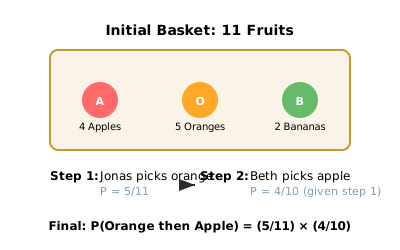
Solution: Method 1 — Sequential Probability
This is a classic "without replacement" problem where we need to track how each selection changes what's available for the next person.
Step 1 — Calculate Jonas's probability of getting an orange
Initially, the basket contains 11 pieces of fruit total, with 5 oranges available.
Step 2 — Determine the new basket state
After Jonas takes an orange, the basket changes:
- Total fruits:
11 - 1 = 10fruits remain - Oranges:
5 - 1 = 4oranges remain - Apples:
4apples still available (unchanged) - Bananas:
2bananas still available (unchanged)
Step 3 — Calculate Beth's conditional probability
Now Beth picks from the remaining 10 fruits, and we want her to get one of the 4 apples.
Step 4 — Apply the multiplication rule for dependent events
Since we want Jonas to get an orange AND Beth to get an apple, we multiply the probabilities:
= (5/11) × (4/10) = 20/110
Step 5 — Simplify the fraction
Reduce the fraction by finding the greatest common divisor of 20 and 110:
Solution: Method 2 — Counting Favorable Outcomes
We can also solve this by counting the total number of ways to pick two fruits in sequence and finding how many result in our desired outcome.
Step 1 — Count total possible outcomes
Jonas has 11 choices for his pick, then Beth has 10 remaining choices:
Step 2 — Count favorable outcomes
For Jonas to pick an orange and Beth to pick an apple:
- Jonas has 5 orange choices
- After Jonas picks an orange, Beth has 4 apple choices
Step 3 — Calculate the probability
Verification
Check our calculation:
Method 1: (5/11) × (4/10) = 20/110 = 2/11 ✓
Method 2: 20 favorable outcomes ÷ 110 total outcomes = 2/11 ✓
Reasonableness check: Since oranges make up 5/11 ≈ 45% of the basket and apples make up 4/11 ≈ 36%, an outcome around 18% seems reasonable for this specific sequence.
Common Pitfalls
✗ Mistake 1: Using the original count for Beth's probability
Wrong calculation: P = (5/11) × (4/11) = 20/121
Why it's wrong: This treats the events as independent, but Beth's choices depend on what Jonas took. After Jonas removes an orange, only 10 fruits remain, not 11.
✗ Mistake 2: Adding probabilities instead of multiplying
Wrong calculation: P = 5/11 + 4/10 = 50/110 + 44/110 = 94/110
Why it's wrong: Addition gives the probability that Jonas gets an orange OR Beth gets an apple. We want Jonas to get an orange AND Beth to get an apple, which requires multiplication.
✗ Mistake 3: Forgetting the order matters
Wrong thinking: "It doesn't matter who picks what first"
Why it's wrong: The problem specifically asks for Jonas to get an orange and Beth to get an apple. The probability for Beth getting an orange and Jonas getting an apple is different: (4/11) × (5/10) = 2/11. While the answer is the same here, the calculation path matters.
Recognizing This Problem Type
Watch for these key phrases that signal dependent probability problems:
- "Without replacement" or "doesn't put it back"
- "Then the second person picks" — indicates sequential events
- "One after another" or "in succession"
- Questions asking for the probability of a specific sequence of events
- Scenarios involving drawing from a finite collection (cards, marbles, fruits)
Key distinction: If the problem says "with replacement" or "puts it back," then the events are independent and you use the original counts for all subsequent draws.
The General Pattern
For any sequence of dependent events without replacement:
Where each conditional probability uses the updated counts after previous events have occurred.
For this specific problem pattern:
This formula only works when Person A and Person B want different types of items, or when taking Type X doesn't affect the count of Type Y.
What If?
P(Jonas gets apple) = 4/11
After Jonas takes an apple: 10 fruits remain (3 apples, 5 oranges, 2 bananas)
P(Beth gets orange | Jonas got apple) = 5/10 = 1/2
P(Apple then Orange) = (4/11) × (5/10) = 20/110 = 2/11
Answer: 2/11 ≈ 0.182 or 18.2% - Same probability as the original problem!
P(Jonas gets orange) = 5/11
Basket returns to original state: 4 apples, 5 oranges, 2 bananas (11 total)
P(Beth gets apple) = 4/11 (unchanged from original)
P(Orange then Apple) = (5/11) × (4/11) = 20/121
Answer: 20/121 ≈ 0.165 or 16.5% - Slightly lower than without replacement (2/11 ≈ 18.2%)
Scenario A: Jonas gets orange, Beth gets apple
Scenario B: Jonas gets apple, Beth gets orange
P(Jonas orange, Beth apple) = (5/11) × (4/10) = 2/11
P(Jonas apple, Beth orange) = (4/11) × (5/10) = 2/11
P(one orange, one apple) = 2/11 + 2/11 = 4/11
Answer: 4/11 ≈ 0.364 or 36.4% - Doubles the original probability since order doesn't matter
P(Jonas gets orange) = 5/11
Remaining: 10 fruits (4 apples, 4 oranges, 2 bananas)
P(Beth gets apple | Jonas got orange) = 4/10
Remaining: 9 fruits (3 apples, 4 oranges, 2 bananas)
P(Carlos gets banana | Jonas got orange, Beth got apple) = 2/9
P(Orange, Apple, Banana) = (5/11) × (4/10) × (2/9) = 40/990 = 4/99
Answer: 4/99 ≈ 0.040 or 4.0% - Much lower probability as we add more constraints
Frequently Asked Questions
2026-08-16