




Projectile Motion: Solving Quadratic Equations for Flight Time
What This Problem Teaches
- Setting up and solving quadratic equations from physics formulas
- Using the quadratic formula when factoring isn't practical
- Interpreting negative solutions in real-world contexts
- Understanding the physical meaning of projectile motion equations
- Converting between mathematical solutions and meaningful answers
Visualizing the Problem
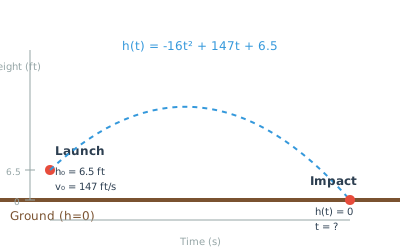
The diagram shows the ball's trajectory from launch to impact. We need to find when the height equals zero.
Solution: Method 1 — The Quadratic Formula Approach
When the ball hits the ground, its height is zero. We need to solve the equation when h(t) = 0.
Step 1 — Set up the equation
The ball hits the ground when h(t) = 0, so we solve:
Step 2 — Identify the quadratic coefficients
In the standard form at² + bt + c = 0, we have:
a = -16b = 147c = 6.5
Step 3 — Apply the quadratic formula
Using t = (-b ± √(b² - 4ac)) / (2a):
Step 4 — Calculate the discriminant
First, let's compute b² - 4ac:
Since √22,025 = 148.41 (approximately), we get:
Step 5 — Find both solutions
This gives us two solutions:
t = (-147 + 148.41) / (-32) = 1.41 / (-32) ≈ -0.044t = (-147 - 148.41) / (-32) = -295.41 / (-32) ≈ 9.23
Step 6 — Choose the physically meaningful solution
Since time cannot be negative in this context, we take the positive solution: t ≈ 9.23 seconds.
Solution: Method 2 — Completing the Square Approach
We can also solve by completing the square, which reveals insights about the maximum height along the way.
Step 1 — Factor out the coefficient of t²
Starting with -16t² + 147t + 6.5 = 0, factor out -16:
Step 2 — Complete the square inside the parentheses
To complete the square for t² - 9.1875t, we add and subtract (9.1875/2)² = (4.59375)² ≈ 21.10:
Step 3 — Simplify and solve
Expanding:
Step 4 — Take the square root
Taking the square root of both sides:
This gives us t ≈ 9.23 or t ≈ -0.05, confirming our previous result.
Verification
Let's verify our answer by substituting t = 9.23 back into the original equation:
The result is very close to zero (0.27 feet), confirming our answer. The small difference is due to rounding in our calculations.
We can also verify that the negative solution doesn't make physical sense. At t = -0.044:
While mathematically correct, negative time represents a moment before the ball was thrown, which isn't physically meaningful for our problem.
Watch Out For These Pitfalls
Some students try to solve the equation as given, forgetting that "hits the ground" means h(t) = 0. The ground represents zero height, not the formula itself.
The quadratic formula gives two solutions: t ≈ -0.04 and t ≈ 9.23. Students sometimes report both answers, but negative time doesn't make sense for when the ball hits the ground after being thrown.
Computing b² - 4ac = 147² - 4(-16)(6.5) requires careful attention to signs. Remember that 4(-16)(6.5) = -416, so subtracting it gives +416, making the discriminant 21,609 + 416 = 22,025.
The -16 comes from gravity (-32 ft/s²) divided by 2 in the kinematic equation. Some students confuse this with other physics constants or try to "correct" the sign.
The Physics Behind the Formula
The height equation h(t) = -16t² + 147t + 6.5 comes from the kinematic equation for motion under constant acceleration:
Where:
h₀ = 6.5feet (initial height)v₀ = 147ft/s (initial velocity)a = -32ft/s² (acceleration due to gravity)½a = ½(-32) = -16
This formula applies to any projectile in Earth's gravitational field, assuming air resistance is negligible. The -16t² term dominates for large values of t, which is why the ball eventually comes down despite its initial upward velocity.
Real Applications
Sports ballistics: Baseball analysts use similar equations to predict where fly balls will land, helping outfielders position themselves optimally.
Engineering safety: When designing protective barriers around construction sites, engineers calculate projectile paths to determine safe distances from falling objects.
Military and aerospace: Artillery targeting and rocket trajectory calculations use these same quadratic motion principles, though with additional complexity for air resistance and rotation effects.
What If?
Set h(t) = 0: -16t² + 180t + 6.5 = 0
With a = -16, b = 180, c = 6.5: t = (-180 ± √(180² - 4(-16)(6.5))) / (2(-16))
180² + 4(16)(6.5) = 32,400 + 416 = 32,816, so √32,816 ≈ 181.15
t = (-180 ± 181.15) / (-32) gives t ≈ 11.29 or t ≈ -0.036
The ball hits the ground after approximately 11.29 seconds.
We know h(8) = 0, so: -16(8)² + v₀(8) + 6.5 = 0
-16(64) + 8v₀ + 6.5 = 0, which gives -1024 + 8v₀ + 6.5 = 0
8v₀ = 1024 - 6.5 = 1017.5, so v₀ = 127.19 ft/s
Check: h(8) = -16(64) + 127.19(8) + 6.5 = -1024 + 1017.5 + 6.5 = 0 ✓
The initial velocity was approximately 127.19 ft/s.
For a quadratic at² + bt + c, the vertex occurs at t = -b/(2a)
t = -147/(2(-16)) = -147/(-32) = 4.59 seconds
h(4.59) = -16(4.59)² + 147(4.59) + 6.5
h(4.59) = -16(21.07) + 674.73 + 6.5 = -337.1 + 674.73 + 6.5 = 344.13
The ball reaches maximum height of 344.13 feet at t = 4.59 seconds.
Set h(t) = 0: -2.67t² + 147t + 6.5 = 0
With a = -2.67, b = 147, c = 6.5
147² - 4(-2.67)(6.5) = 21,609 + 69.42 = 21,678.42, so √21,678.42 ≈ 147.22
t = (-147 ± 147.22) / (-5.34) gives t ≈ 55.08 or t ≈ -0.04
On the Moon, the ball would hit the ground after approximately 55.08 seconds — about 6 times longer than on Earth!
Frequently Asked Questions
2026-08-06