




Vertical Motion: Time, Height & Acceleration
Mrs. Johnson tosses an apple straight up into the air with a velocity of 3.25 m/s. How long before the apple returns to her hand? (3) What is the maximum height that the apple reaches above her hand? (3) What is the acceleration of the apple at the maximum height? (1)
Already Got the Answer? Check Here First
- Setup: up is positive,
v₀ = +3.25 m/s,a = −9.80 m/s²,v = 0at the peak. - Flight time:
T = 2v₀/g = 6.50 ÷ 9.80 ≈ 0.663 s - Max height:
H = v₀²/(2g) = 10.5625 ÷ 19.6 ≈ 0.539 m - Acceleration at the top:
−9.80 m/s²(9.80 m/s² downward). It is not zero. - Quick check: the apple must come back down at
−3.25 m/s:3.25 − 9.80(0.663) ≈ −3.25✓
What's Really Going On Here
The three questions look different, but they are one idea viewed three ways. The apple moves under a constant acceleration, and everything it does is dictated by that single number. The most instructive part is the last question, because most students instinctively give the wrong answer to it.
- Reading hidden information from the story. "Maximum height" means velocity = 0. "Returns to her hand" means displacement = 0. The problem never states either number, but both are given.
- Choosing and keeping a sign convention. Once "up is positive" is chosen, gravity is
−9.80for the whole trip, rising or falling. - Using symmetry to save work. Rising and falling are mirror images, so half the trip tells you the whole trip.
- Separating velocity from acceleration. The velocity at the top is zero, yet the acceleration is not. This distinction runs through all of mechanics.
- Solving one problem three ways. Kinematics, energy conservation, and the parabola
h(t)must all agree, which is a strong check on your work.
Picture This: Height Against Time
Before computing anything, look at what the apple's motion looks like when plotted. The graph below shows height above the hand as a function of time. It is the path of the apple unrolled in time, not a sideways trajectory.
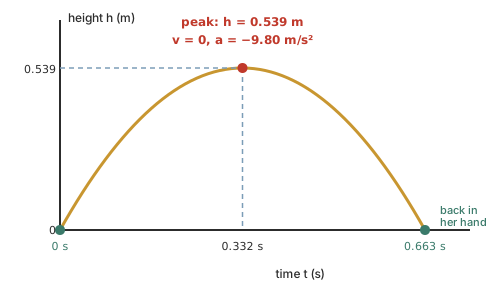
The graph is a parabola, symmetric about the peak. The slope of the curve is the velocity: positive on the way up, zero at the top, negative on the way down. The way the slope itself keeps decreasing is the constant downward acceleration.
Solution: Method 1 — Kinematics with Symmetry
Constant-acceleration equationsFree flight is the textbook case of constant acceleration, so we use the standard kinematic equations. We take g = 9.80 m/s², as is standard in most courses.
Step 1 — Choose a sign convention and list what you know
Take upward as positive. Gravity pulls down, so the acceleration is negative for the entire flight. Two pieces of information are hidden in the wording, so write them down explicitly.
a = −9.80 m/s² (gravity, downward)
v = 0 at the maximum height
Δy = 0 when the apple is back in her hand
Step 2 — Find the time to reach the top
The velocity changes at a steady rate, so use v = v₀ + at. At the peak v = 0:
t = 3.25 ÷ 9.80 ≈ 0.3316 s
In words: gravity removes 9.80 m/s of upward speed every second, so it takes about a third of a second to remove all 3.25 m/s.
Step 3 — Get the full flight time
The fall mirrors the rise: the apple passes through each height with the same speed going down as going up. So it must return to the hand moving at v = −3.25 m/s. Apply the same velocity equation to the whole trip:
9.80T = 6.50
T = 6.50 ÷ 9.80 ≈ 0.6633 s
This is exactly twice the rise time from Step 2, 2 × 0.3316 = 0.6633 s, which confirms the symmetry argument.
Step 4 — Find the maximum height
Here time is not needed, so use the time-free equation v² = v₀² + 2aΔy with v = 0:
19.6 h = 10.5625
h = 10.5625 ÷ 19.6 ≈ 0.5389 m
The height is measured above her hand, which is exactly what the question asks for and exactly what the equation gives, since h is measured from the launch point.
Step 5 — The acceleration at the top
Once the apple leaves her hand, the only force acting on it is gravity (ignoring air resistance). The acceleration is therefore the same at every moment of the flight: a = −9.80 m/s², which is 9.80 m/s² directed downward. The velocity is momentarily zero at the peak, but the rate of change of velocity is not.
Solution: Method 2 — Energy Conservation
Conservation of mechanical energyThis approach comes from a different physical principle. Instead of tracking velocity second by second, it compares the apple at two instants: leaving the hand, and sitting at the top.
Step 1 — Height from energy
At launch the apple has only kinetic energy. At the top it has only gravitational potential energy (speed is zero). With no air resistance, energy is conserved:
h = v₀² ÷ (2g) = 10.5625 ÷ 19.6 ≈ 0.539 m The mass m cancels. A heavier apple would rise to exactly the same height.
Step 2 — Time from the average speed
During the rise the speed drops steadily from 3.25 m/s to 0, so the average speed is the midpoint, 1.625 m/s. Distance equals average speed times time:
T = 2 × 0.3316 ≈ 0.663 s
Step 3 — Acceleration from the force
Newton's second law says the acceleration is determined by the net force. The only force on the apple in flight is its weight mg, so a = F/m = g = 9.80 m/s² downward, at the peak just as everywhere else.
All three answers match Method 1, but they came from different physical reasoning. That agreement is itself strong evidence they are right.
Solution: Method 3 — The Position Parabola
Quadratic function h(t)Method 1 solved for one thing at a time. Here we write the height as one function of time and read off everything from it. This is the graph from earlier, now in algebraic form.
Step 1 — Write the position function
With the hand as the origin, the general constant-acceleration formula h = v₀t + ½at² becomes:
Step 2 — Flight time: where does the parabola hit zero?
t(3.25 − 4.90t) = 0
t = 0 (the toss) or t = 3.25 ÷ 4.90 ≈ 0.6633 s
The two roots are the two moments the apple is at hand level: the instant of release and the instant of return. The flight time is the second root.
Step 3 — Maximum height: the vertex
For at² + bt + c, the vertex sits at t = −b/(2a). Here that is t = −3.25 ÷ (2 × −4.90) ≈ 0.3316 s, which is exactly halfway between the two roots. Substituting:
= 1.0778 − 0.5389 ≈ 0.539 m
Step 4 — Acceleration: read the t² coefficient
The coefficient of t² is ½a. Since ½a = −4.90, we get a = −9.80 m/s². This coefficient is constant, which is why the acceleration is the same at the peak as anywhere else. Differentiating twice gives h″(t) = −9.80, the same result for students who have seen calculus.
The Answer
The apple returns to her hand after T ≈ 0.663 s, reaches a maximum height of H ≈ 0.539 m (about 54 cm) above her hand, and at the top its acceleration is −9.80 m/s², that is, 9.80 m/s² directed downward.
Verification
Check 1 — Does the position function return to zero? At t = 0.6633 s: 3.25(0.6633) − 4.90(0.6633)² = 2.1557 − 2.1557 = 0 ✓
Check 2 — Is the return speed equal to the launch speed?v = 3.25 − 9.80(0.6633) = 3.25 − 6.50 = −3.25 m/s. The apple comes back at the same speed it left, now pointing downward ✓
Check 3 — Does the height agree between methods? Kinematics gave 10.5625 ÷ 19.6, energy gave v₀²/(2g), and the vertex gave 1.0778 − 0.5389. All equal 0.539 m ✓
Check 4 — Consistency between time and height. Free-fall from the top for 0.3316 s should cover the height: ½(9.80)(0.3316)² = 4.90 × 0.10997 ≈ 0.539 m ✓
Does This Seem Reasonable?
Half a meter and two-thirds of a second is about what you see when you flip an apple gently from your palm. That is a soft toss, and 3.25 m/s is only about 7 mph. The table shows the whole trip at quarter-flight intervals. Watch the acceleration column.
| Time (s) | Velocity (m/s) | Height (m) | Acceleration (m/s²) |
|---|---|---|---|
| 0 (release) | +3.25 | 0 | −9.80 |
| 0.166 | +1.63 | 0.404 | −9.80 |
| 0.332 (peak) | 0 | 0.539 | −9.80 |
| 0.497 | −1.63 | 0.404 | −9.80 |
| 0.663 (caught) | −3.25 | 0 | −9.80 |
Velocity changes by the same amount in each interval, about 1.63 m/s per quarter-flight, and the height is symmetric around the peak. The table also shows why the third answer is what it is: the acceleration column never changes.
Note on g. If your course uses g = 9.81 m/s², you will get T = 0.663 s and H = 0.538 m. The tiny difference in the height comes only from that choice, so both answers are correct for their value of g.
What Trips People Up
This is the most common error, and it is worth the one mark this part of the problem carries. At the top the velocity is zero for an instant, and students conflate "not moving" with "not accelerating." But the velocity is changing from positive to negative, and that change requires acceleration. If the acceleration really were zero at the peak, the apple would hover there forever. The correct answer is −9.80 m/s².
Solving v = 0 correctly produces the time to reach the top, not the time to return to the hand. The question asks for the full round trip, so double it (or use v = −3.25 as the final velocity). A good habit: after solving, re-read the question and ask, "Which event does this time describe?"
This sign error mixes conventions: up is positive for the velocity, but gravity was entered as positive too. A negative time is the equation's way of telling you something is inconsistent. Decide on a direction once and keep it: if up is positive, gravity is −9.80.
The problem asks for the height above her hand, and the ground is never mentioned. The result measures how far the apple climbs from the release point. Its height above the floor would be that plus the height of her hand, which we aren't told.
How to Spot This Problem Type
These phrases signal free-flight kinematics:
- "Tosses straight up" / "thrown vertically" / "dropped": constant acceleration of 9.80 m/s², and only gravity acts.
- "Maximum height" / "highest point" / "at the top": the velocity is zero there. This is the hidden given.
- "Returns to her hand" / "back at the starting point": the displacement is zero, and the final speed equals the initial speed.
- "Acceleration at the peak": a conceptual trap, and the answer is always g.
The same structure appears in algebra courses as "a ball's height is given by h = −4.9t² + v₀t," and in physics courses as "constant acceleration." It is the same quadratic with different labels, and the vertex of that quadratic is the maximum height. Recognizing that connection makes a physics problem feel like algebra you already know.
The Pattern Behind This
Solving with letters instead of numbers gives two formulas that work for any vertical toss that returns to its starting height:
Max height: H = v₀² ÷ (2g)
Eliminate v₀: H = g T² ÷ 8
Look at how the numbers sit inside these formulas, because that is where the insight lies. Time is proportional to v₀: double the launch speed and the flight lasts twice as long. Height is proportional to v₀²: double the launch speed and the apple rises four times as high. Strengthening a toss pays off more in height than in time. It also explains why a ball thrown at 10 m/s goes dramatically higher than one thrown at 5 m/s.
Applying it to our case: T = 6.50/9.80 = 0.663 s, H = 10.5625/19.6 = 0.539 m, and the third formula agrees, 9.80 × 0.4399 ÷ 8 = 0.539 m. These formulas hold only when the object lands at the height it started from and air resistance is negligible. For a toss from a rooftop (see the What-If problems), you must return to the quadratic.
Beyond the Textbook
- Measuring vertical jumps. Sports scientists use contact mats that record only how long an athlete is airborne. The formula
H = gT²/8converts that single number into jump height. A half-second hang time means about 31 cm. - Fountains and water jets. Designers choose the nozzle speed using
H = v₀²/(2g). A fountain that must reach 5 m needs the water to leave at about 9.9 m/s. - Space and planetary science. The same equations, with a different g, predict how high a rover's dropped tool or a thrown stone will go on the Moon or Mars. The What-If section below tries it.
A Brief History
For nearly two thousand years, the dominant view followed Aristotle: heavier objects fall faster, and a thrown object needs a continual push to keep moving. Around 1600 Galileo challenged this with careful experiments using inclined planes and pendulums, finding that falling bodies gain speed at a constant rate regardless of weight. His result, that distance fallen grows with the square of time, is the origin of the ½gt² term in our parabola. Newton later explained why the acceleration is constant: a steady force acts on the object throughout its flight. The point about the peak, that zero velocity does not mean zero acceleration, was one of the conceptual shifts of that revolution.
Where This Leads
Two natural extensions follow. First, toss the apple at an angle instead of straight up: the vertical part behaves exactly as in this problem, while the horizontal part moves at constant speed, which gives the parabolic paths of projectile motion. Second, include air resistance, so the acceleration depends on velocity and the rise and fall are no longer symmetric. That problem is typically handled with differential equations. A good first step toward it: at the peak, what direction does air drag point on the way up versus the way down?
Extend Your Thinking
Four variations, in increasing order of difficulty. Try each before you open the solution. Use g = 9.80 m/s² unless a problem says otherwise.
Suppose Mrs. Johnson tosses the apple upward at 6.50 m/s, twice the original speed. What are the new flight time and maximum height, and by what factor did each change compared with the 3.25 m/s toss?
The apple returns to hand level, so T = 2v₀/g and H = v₀²/(2g) both apply.
T = 2(6.50) ÷ 9.80 = 13.0 ÷ 9.80 ≈ 1.327 s
H = (6.50)² ÷ (2 × 9.80) = 42.25 ÷ 19.6 ≈ 2.156 m
Time: 1.327 ÷ 0.663 = 2.00. Height: 2.156 ÷ 0.539 = 4.00.
Using the vertex form: h(0.6633) = 6.50(0.6633) − 4.90(0.6633)² = 4.311 − 2.156 ≈ 2.156 m ✓
Doubling the speed doubles the flight time (≈ 1.33 s) and quadruples the maximum height (≈ 2.16 m).
An astronaut on the Moon, where g = 1.62 m/s², tosses an apple straight up at the same 3.25 m/s. Find the flight time and maximum height, and say how they compare with the Earth values of 0.663 s and 0.539 m.
The setup is identical, with a = −1.62 m/s² instead of −9.80 m/s².
T = 2v₀/g = 6.50 ÷ 1.62 ≈ 4.012 s
H = v₀²/(2g) = 10.5625 ÷ 3.24 ≈ 3.260 m
Both quantities have g in the denominator, so both grow by the same factor: 9.80 ÷ 1.62 ≈ 6.05. Indeed 4.012 ÷ 0.663 ≈ 6.05 and 3.260 ÷ 0.539 ≈ 6.05.
Peak at t = 2.006 s: h = 3.25(2.006) − 0.81(2.006)² = 6.520 − 3.260 = 3.260 m ✓
On the Moon the apple stays up about 4.01 s and rises about 3.26 m, roughly six times longer and six times higher than on Earth.
Mrs. Johnson wants the apple to rise exactly 1.80 m above her hand. What launch velocity must she give it, and how long will the apple then take to return to her hand?
From v² = v₀² − 2gH with v = 0: v₀ = √(2gH).
v₀ = √(2 × 9.80 × 1.80) = √35.28 ≈ 5.94 m/s
T = 2v₀/g = 2(5.940) ÷ 9.80 = 11.88 ÷ 9.80 ≈ 1.212 s
H = gT²/8 = 9.80 × (1.2122)² ÷ 8 = 9.80 × 1.4694 ÷ 8 ≈ 1.80 m ✓
She must toss the apple at about 5.94 m/s, and it will be airborne for about 1.21 s.
Mrs. Johnson stands on a roof and tosses the apple straight up at 3.25 m/s from a point 10.0 m above the ground. If she misses it and it falls all the way down, how long after the toss does it hit the ground, and how fast is it moving at impact?
Measured from the ground: h(t) = 10.0 + 3.25t − 4.90t². The shortcut T = 2v₀/g no longer applies, because the apple lands below its starting height.
4.90t² − 3.25t − 10.0 = 0
t = [3.25 ± √(3.25² + 4(4.90)(10.0))] ÷ (2 × 4.90) = [3.25 ± √206.5625] ÷ 9.80, where √206.5625 ≈ 14.372.
t = (3.25 + 14.372) ÷ 9.80 ≈ 1.798 s. The other root, (3.25 − 14.372) ÷ 9.80 ≈ −1.135 s, is a time before the toss and is rejected.
v = 3.25 − 9.80(1.798) ≈ −14.37 m/s, so the speed is about 14.4 m/s. As a check, the time-free equation gives v² = 3.25² + 2(9.80)(10.0) = 206.56, so |v| = 14.37 m/s ✓
10.0 + 3.25(1.798) − 4.90(1.798)² = 10.0 + 5.844 − 15.844 = 0 ✓
The apple hits the ground about 1.80 s after the toss, moving at about 14.4 m/s downward.
Frequently Asked Questions
How do you find how long an object thrown straight up takes to return to its starting point?
At the top of the flight the velocity is zero, so use v = v₀ − gt with v = 0 to get the time to rise: t = v₀/g. The fall takes exactly as long as the rise, so the total flight time is T = 2v₀/g. In this example, an apple launched at 3.25 m/s with g = 9.80 m/s² rises for 3.25 ÷ 9.80 = 0.332 s, so it returns to the hand after 0.663 s.
What is the acceleration of a ball at the top of its flight?
The acceleration is still 9.80 m/s² directed downward, not zero. At the peak the velocity is momentarily zero, but gravity keeps changing the velocity at the same steady rate of 9.80 m/s every second. In this example, an apple tossed upward at 3.25 m/s has a = −9.80 m/s² (up taken as positive) at every instant of its flight, including the peak.
How do you calculate the maximum height of an object thrown upward?
Use v² = v₀² − 2gh with v = 0 at the peak, which gives h = v₀²/(2g). Energy conservation gives the same result: ½mv₀² = mgh, and the mass cancels. In this example, with v₀ = 3.25 m/s and g = 9.80 m/s², h = (3.25)² ÷ (2 × 9.80) = 10.5625 ÷ 19.6 ≈ 0.539 m above the launch point.
2026-10-28