




Projectile Motion: Find Time Using Position Equation
What This Problem Teaches
- Writing kinematic equations from physical parameters
- Understanding the role of gravity in projectile motion
- Solving quadratic equations in physics contexts
- Interpreting multiple solutions and choosing the physically meaningful one
- Connecting algebraic expressions to real-world motion
Visualizing the Motion
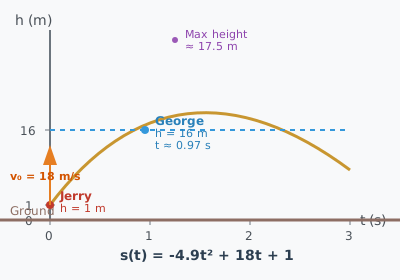
Solution: Method 1 — The Kinematic Approach
Step 1 — Apply the kinematic position equation
For vertical motion under gravity, the position equation is:
where s₀ is initial height, v₀ is initial velocity, and a is acceleration due to gravity.
Step 2 — Substitute the known values
From the problem:
- Initial height:
s₀ = 1 m - Initial velocity:
v₀ = 18 m/s(upward) - Acceleration:
a = -g = -9.8 m/s²(downward)
s(t) = 1 + 18t - 4.9t²
s(t) = -4.9t² + 18t + 1
Step 3 — Set up the equation for the target height
To find when the bread reaches 16 meters, set s(t) = 16:
-4.9t² + 18t + 1 - 16 = 0
-4.9t² + 18t - 15 = 0
Step 4 — Solve using the quadratic formula
For equation at² + bt + c = 0 with a = -4.9, b = 18, c = -15:
t = (-18 ± √(18² - 4(-4.9)(-15))) / (2(-4.9))
t = (-18 ± √(324 - 294)) / (-9.8)
t = (-18 ± √30) / (-9.8)
t = (-18 ± 5.477) / (-9.8)
Step 5 — Calculate both solutions
This gives us two times:
t₂ = (-18 - 5.477) / (-9.8) = -23.477 / (-9.8) ≈ 2.396 s
Step 6 — Choose the "way up" solution
Since we want the time on the way up, we need the earlier time: t ≈ 1.28 seconds
Solution: Method 2 — The Vertex Form Approach
Step 1 — Find the vertex of the parabola
The position equation s(t) = -4.9t² + 18t + 1 is a downward-opening parabola. Its vertex (maximum height) occurs at:
Step 2 — Determine which solution is "on the way up"
Since the maximum occurs at t ≈ 1.84 seconds, any time before this is "on the way up" and any time after is "on the way down."
Step 3 — Solve the quadratic as before
Setting -4.9t² + 18t + 1 = 16 gives us the same quadratic: -4.9t² + 18t - 15 = 0
Solutions: t ≈ 1.28 s and t ≈ 2.40 s
Step 4 — Select the upward solution
Since 1.28 < 1.84, the bread reaches 16 meters at t ≈ 1.28 seconds on the way up.
Time to reach 16 m (going up): t ≈ 1.28 seconds
Verification
Let's check our answer by substituting t ≈ 1.278 back into the position equation:
s(1.278) = -4.9(1.633) + 23.004 + 1
s(1.278) = -8.002 + 23.004 + 1
s(1.278) = 16.002 ≈ 16 meters ✓
The small difference from exactly 16 is due to rounding in our calculations. Our answer is correct.
Watch Out For These
✗ Forgetting the negative sign for gravity: Using +9.8 instead of -9.8 m/s²
Gravity pulls downward, opposite to the positive upward direction. Using +9.8 would model an object accelerating upward forever.
✗ Taking the wrong solution: Choosing t ≈ 2.40 s instead of t ≈ 1.28 s
Both times give height 16 m, but 2.40 s is when the bread passes 16 m on the way down. The problem asks for "on the way up."
✗ Mixing up the kinematic equation: Writing s(t) = v₀ + s₀t + ½at²
The correct order is s(t) = s₀ + v₀t + ½at². Initial position comes first, then velocity term, then acceleration term.
The Pattern Behind This
All projectile motion problems follow the same kinematic template:
where g = -9.8 m/s² for Earth's surface gravity. The quadratic nature means objects pass through most heights twice: once going up, once coming down. The vertex of the parabola represents maximum height.
When solving for a specific height, you'll always get two solutions (unless you're solving for maximum height). The physical context tells you which one to choose - earlier time for "way up," later time for "way down."
Beyond the Textbook
Sports: Basketball players use projectile motion when shooting. The ball follows a parabolic path, and players instinctively adjust angle and velocity for different distances.
Engineering: Fountain designers use these equations to calculate water trajectory heights and distances, ensuring water lands in the intended basins.
Safety: Construction workers dropping tools (accidentally) can predict impact times and zones using projectile motion, crucial for jobsite safety protocols.
What If?
With s₀ = 3, v₀ = 18, a = -9.8:
s(t) = 3 + 18t - 4.9t²
16 = 3 + 18t - 4.9t²
-4.9t² + 18t - 13 = 0
t = (-18 ± √(324 - 254.8))/(-9.8)
t = (-18 ± √69.2)/(-9.8)
t = (-18 ± 8.32)/(-9.8)
t₁ = (-18 + 8.32)/(-9.8) ≈ 0.99 s
t₂ = (-18 - 8.32)/(-9.8) ≈ 2.68 s
t ≈ 0.99 seconds (earlier time = going up)
s(t) = 1 + v₀t - 4.9t²
We know at t = 1.5, s = 16
16 = 1 + v₀(1.5) - 4.9(1.5)²
16 = 1 + 1.5v₀ - 4.9(2.25)
16 = 1 + 1.5v₀ - 11.025
16 = 1.5v₀ - 10.025
26.025 = 1.5v₀
v₀ = 17.35 m/s
s(1.5) = 1 + 17.35(1.5) - 4.9(2.25) = 1 + 26.025 - 11.025 = 16 ✓
Initial velocity: 17.35 m/s
For parabola s(t) = -4.9t² + 18t + 1
t_max = -b/(2a) = -18/(2(-4.9)) = 1.837 s
s(1.837) = -4.9(1.837)² + 18(1.837) + 1
s(1.837) = -4.9(3.374) + 33.066 + 1
s(1.837) = -16.533 + 33.066 + 1 = 17.533 m
Maximum value of at² + bt + c is c - b²/(4a)
s_max = 1 - 18²/(4(-4.9)) = 1 + 324/19.6 = 17.53 m
Maximum height: 17.53 m at t = 1.84 seconds
Bread: s_bread(t) = -4.9t² + 18t + 1
George: s_george(t) = 2t (starts at ground, moves up at 2 m/s)
-4.9t² + 18t + 1 = 2t
-4.9t² + 16t + 1 = 0
t = (-16 ± √(256 + 19.6))/(-9.8)
t = (-16 ± √275.6)/(-9.8)
t = (-16 ± 16.6)/(-9.8)
t₁ = (-16 + 16.6)/(-9.8) ≈ -0.06 s (not physical)
t₂ = (-16 - 16.6)/(-9.8) ≈ 3.33 s
Height: s = 2(3.33) = 6.66 m
They meet at t = 3.33 s at height 6.66 m
Frequently Asked Questions
2026-05-26