




Projectile Motion: Finding Horizontal Distance in Package Drop
Visualizing the Problem
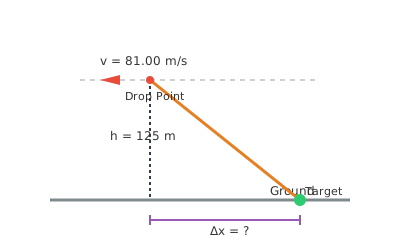
What This Problem Teaches
- Understanding projectile motion as independent horizontal and vertical components
- Applying kinematic equations to find fall time from height
- Recognizing that horizontal velocity remains constant during free fall
- Connecting physics concepts to real-world rescue and delivery scenarios
- Using the relationship between distance, velocity, and time in two dimensions
Solution: Method 1 — Independent Motion Analysis
The key insight is that horizontal and vertical motions are completely independent in projectile motion. We'll find the fall time first, then calculate how far the package travels horizontally during that time.
Step 1 — Identify the initial conditions
When the package is dropped from the plane:
Vertical velocity: v₀y = 0 m/s (dropped, not thrown)
Height: h = 125 m
Gravity: g = 9.8 m/s²
Step 2 — Calculate the fall time
Use the kinematic equation for vertical motion. Since the package starts with zero vertical velocity:
125 = ½(9.8)t²
125 = 4.9t²
t² = 125/4.9 = 25.51
t = √25.51 = 5.05 seconds
Step 3 — Calculate horizontal distance
During the 5.05 seconds of fall time, the package maintains its horizontal velocity of 81.00 m/s:
Δx = vₓ × t
Δx = 81.00 × 5.05
Δx = 409 meters
Solution: Method 2 — Trajectory Equation Approach
We can also solve this by deriving the parabolic trajectory equation and finding where it intersects the ground.
Step 1 — Set up coordinate system
Place the origin at the drop point, with positive x to the right and positive y downward:
y = ½gt² = 4.9t²
Step 2 — Eliminate time to get trajectory
From the first equation: t = x/81.00. Substitute into the second equation:
y = 4.9x²/6561
y = 0.000747x²
Step 3 — Find where package hits ground
The package hits the ground when y = 125 meters:
x² = 125/0.000747 = 167,336
x = √167,336 = 409 meters
Verification
Let's verify by checking our fall time calculation and ensuring the physics makes sense:
Check the fall time
Check the horizontal distance
Reality check
The package falls for about 5 seconds while traveling at 81 m/s horizontally. This gives roughly 400 meters, which matches our precise calculation. A football field is about 100 meters long, so dropping the package 4 football fields away makes intuitive sense for this speed and height.
Watch Out For These
The package maintains the plane's horizontal velocity of 81.00 m/s. It does not have an initial vertical velocity of 81.00 m/s - that would be if the pilot threw it downward at 81 m/s.
Students sometimes try h = v₀t + ½gt² with v₀ = 81 m/s. This treats the 81 m/s as vertical velocity, which is incorrect. The initial vertical velocity is zero when dropping.
Some students think the horizontal distance should account for gravity somehow. In projectile motion (ignoring air resistance), horizontal velocity remains constant throughout the flight.
The Physics Behind This
This problem demonstrates Galilean independence of motion - one of the foundational principles of classical mechanics. Horizontal and vertical motions are completely separate:
x(t) = v₀ₓt
y(t) = v₀y·t + ½gt²
For horizontal launch: v₀y = 0
Range formula: R = v₀ₓ√(2h/g)
This principle appears everywhere from ballistics to planetary motion. The same math applies whether you're dropping relief supplies, calculating artillery trajectories, or predicting where a ball will land when thrown from a building.
Beyond the Textbook
This calculation is crucial in several real-world scenarios:
Humanitarian aid drops: Relief organizations use these calculations to ensure supplies land in accessible locations rather than dangerous terrain or water.
Military operations: Paratroop drops and supply missions require precise timing to account for aircraft speed and drop height.
Firefighting: Water and fire retardant drops from aircraft must account for the plane's forward motion to hit the target area effectively.
Space missions: Spacecraft releasing satellites or landing probes use similar projectile motion calculations, though orbital mechanics adds complexity.
What If?
Using h = ½gt²: 200 = ½(9.8)t², so t² = 400/9.8 = 40.82 and t = 6.39 seconds
Δx = vₓt = 81.00 × 6.39 = 518 meters
Check: h = ½(9.8)(6.39)² = 200 ✓
Answer: 518 meters from the target
Initial conditions: vₓ = 81.0 m/s, v₀y = -8.0 m/s (negative because upward in our coordinate system), h = 125 m
Using y = v₀y·t + ½gt²: 125 = -8.0t + ½(9.8)t²
4.9t² - 8.0t - 125 = 0
Using quadratic formula: t = (8.0 + √(64 + 2450))/9.8 = 6.13 seconds
Δx = 81.0 × 6.13 = 497 meters
Answer: 497 meters from the target
Using h = ½gt²: 125 = ½(9.8)t², so t = 5.05 seconds
For the package to travel 450 m horizontally in 5.05 seconds:
vₓ = distance/time = 450/5.05 = 89.1 m/s
Check: distance = 89.1 × 5.05 = 450 ✓
Answer: The plane must travel at 89.1 m/s horizontally
Fall time remains: t = √(2h/g) = √(2×125/9.8) = 5.05 seconds
In 5.05 seconds, the target moves: 15 × 5.05 = 76 meters further away
Package travels: 81.0 × 5.05 = 409 meters horizontally
Drop distance from current target position = 409 - 76 = 333 meters
Answer: Drop the package 333 meters before the target's current position
Frequently Asked Questions
2026-08-20