




Find Time for Alice to Lap Bob on Circular Track
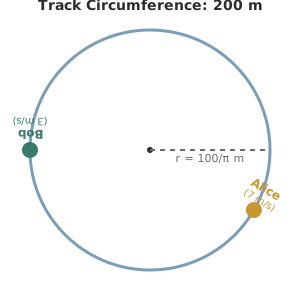
What You Will Learn
- How to calculate circumference when radius contains π
- Finding relative speed for objects moving in the same direction
- Understanding what "lapping" means in circular motion problems
- Converting between different measures of circular motion
- Setting up and solving multi-step motion problems
Solution: Method 1 — The Relative Speed Approach
This problem is all about understanding that "lapping" means gaining a full circumference worth of distance. Let's work through it systematically.
Step 1 — Calculate the track circumference
Using the formula C = 2πr with radius 100/π meters:
The π terms cancel out perfectly, giving us a clean circumference of 200 meters.
Step 2 — Find the relative speed
Since both runners move in the same direction, Alice gains ground on Bob at the difference of their speeds:
This means Alice gains 4 meters on Bob every second.
Step 3 — Calculate time for one lap
For Alice to lap Bob once, she must gain exactly one full circumference (200 m) on him:
Step 4 — Find time for three laps
Since lapping events happen at regular intervals:
Solution: Method 2 — The Position Tracking Method
Instead of thinking about relative speed, we can track each runner's position and find when Alice is exactly one, two, and three laps ahead.
Step 1 — Express positions as functions of time
After t seconds:
Bob's position: 3t meters around the track
Step 2 — Set up the lapping condition
Alice laps Bob when she has traveled exactly one more complete track length than Bob:
where n is the number of complete laps Alice is ahead.
Step 3 — Solve for each lap
Rearranging the equation:
4t = 200n
t = 50n
Step 4 — Find the specific times
Second lap (n = 2): t = 50 × 2 = 100 seconds
Third lap (n = 3): t = 50 × 3 = 150 seconds
Verification
Let's check our answer by calculating how far each runner has traveled after 150 seconds:
Bob's distance: 3 m/s × 150 s = 450 meters
Difference: 1,050 - 450 = 600 meters
Since the track is 200 meters around, a 600-meter difference means Alice is exactly 3 complete laps ahead of Bob. ✓
We can also verify the individual lapping times:
At 100s: Alice = 700m, Bob = 300m → Difference = 400m = 2 laps ✓
At 150s: Alice = 1050m, Bob = 450m → Difference = 600m = 3 laps ✓
Common Pitfalls
Mistake 1: Adding speeds instead of subtracting
This would be correct if the runners were moving toward each other, but they're moving in the same direction. When finding relative speed for same-direction motion, always subtract the slower speed from the faster one.
Mistake 2: Confusing radius and diameter in the circumference formula
The problem states the radius is 100/π meters, not the diameter. Using C = 2πr correctly gives us C = 2π × (100/π) = 200 meters.
Mistake 3: Thinking Alice needs to run 3 full laps
This calculates how long Alice takes to run 3 complete laps herself, but ignores that Bob is also moving. The question asks when Alice laps Bob 3 times, which depends on their relative motion.
Mistake 4: Not simplifying the π terms
While mathematically correct, this makes the calculation unnecessarily complex. Always simplify: 200π/π = 200 meters exactly.
The General Formula
For any circular track lapping problem where both objects move in the same direction:
where v₁ is the faster speed and v₂ is the slower speed.
This formula works because:
- The relative speed (v₁ - v₂) tells us how quickly the faster object gains ground
- Each lap requires gaining exactly one circumference worth of distance
- The lapping events occur at regular intervals
How to Spot This Problem Type
Watch for these key phrases that signal a relative motion problem:
- "laps" or "overtakes" — indicates one object gaining a full circuit on another
- "circular track" or "around a loop" — tells you it's circular motion
- "same direction" vs "opposite directions" — determines whether to add or subtract speeds
- "how long until..." — asking for time, not distance
This problem type also appears in disguised forms:
- Cars on a racetrack
- Cyclists on a velodrome
- Satellites orbiting at different speeds
- Clock hands (hour vs minute hand)
What If?
In 40 seconds, Alice gained exactly 200 meters (one lap) on Bob. So relative speed = 200 m ÷ 40 s = 5 m/s
Relative speed = Alice's speed - Bob's speed5 = 8 - Bob's speed
Bob's speed = 8 - 5 = 3 m/s
Check: After 40s, Alice travels 8 × 40 = 320 m, Bob travels 3 × 40 = 120 m. Difference is 320 - 120 = 200 m = 1 lap ✓
When moving in opposite directions, speeds add: 7 + 3 = 10 m/s
They meet when they've covered one track circumference together: 200 m ÷ 10 m/s = 20 seconds
5 × 20 = 100 seconds
After 100s: Alice travels 7 × 100 = 700 m, Bob travels 3 × 100 = 300 m in opposite direction. Combined distance: 700 + 300 = 1000 m = 5 × 200 m ✓
Alice must overcome Bob's 50 m head start PLUS gain a full 200 m lap: 50 + 200 = 250 meters
Same as before: 7 - 3 = 4 m/s
Time = 250 m ÷ 4 m/s = 62.5 seconds
After 62.5s: Alice travels 7 × 62.5 = 437.5 m, Bob travels 3 × 62.5 = 187.5 m but started 50 m ahead, so his total is 187.5 + 50 = 237.5 m. Difference: 437.5 - 237.5 = 200 m = 1 lap ✓
The square track has the same 200 m perimeter as the circular track. Track shape doesn't affect this calculation.
Relative speed = 7 - 3 = 4 m/s (unchanged)
Time = 2 × (200 m ÷ 4 m/s) = 2 × 50 = 100 seconds
After 100s: Alice travels 7 × 100 = 700 m, Bob travels 3 × 100 = 300 m. Difference: 700 - 300 = 400 m = 2 × 200 m = 2 laps ✓
Frequently Asked Questions
2026-09-05