




Solve Linear Inequalities: Movie Rewards Card Problem
What This Problem Teaches
- Translating "at least" language into mathematical inequalities with the ≥ symbol
- Setting up linear inequalities from real-world scenarios with initial values and rates
- Solving one-step and two-step inequalities using inverse operations
- Understanding why rounding up is necessary when dealing with discrete quantities like visits
- Verifying inequality solutions by testing boundary values
Picture This
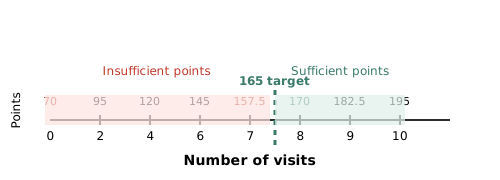
This number line shows how Fatoumata's points accumulate with each visit. Starting with 70 points, she adds 12.5 points per visit. The dashed line marks the 165-point target—she needs at least 8 visits to cross this threshold.
Solution: Method 1 — The Inequality Setup
Step 1 — Define the variable
Let n represent the number of visits Fatoumata makes to the movie theater.
Step 2 — Express her total points
Fatoumata's total points = Sign-up bonus + Points from visits
Step 3 — Write the inequality
She needs "at least 165 points," which means her total points must be greater than or equal to 165:
Step 4 — Solve for n
Subtract 70 from both sides:
12.5n ≥ 95
Divide both sides by 12.5:
n ≥ 7.6
Step 5 — Round appropriately
Since Fatoumata cannot make 7.6 visits (she can only make whole visits), and she needs at least 7.6 visits, she must round up to the next whole number: 8 visits.
Solution: Method 2 — Working Backwards from the Target
Step 1 — Calculate points needed from visits
Fatoumata needs 165 total points and already has 70 from signing up:
Step 2 — Find visits needed
Since each visit gives 12.5 points, the number of visits needed is:
Step 3 — Round to whole visits
Since she can't make a partial visit, she needs at least 8 full visits to accumulate enough points.
Step 4 — Verify the result
With 8 visits: 70 + 12.5(8) = 70 + 100 = 170 points ≥ 165 ✓
Verification
Let's check our answer by testing both 8 visits and 7 visits:
Testing n = 8 visits:
Since 170 ≥ 165, eight visits is sufficient. ✓
Testing n = 7 visits:
Since 157.5 < 165, seven visits is not enough. ✗
This confirms that 8 is indeed the minimum number of visits needed.
Watch Out For These
✗ Using the wrong inequality symbol
Writing 70 + 12.5n > 165 instead of 70 + 12.5n ≥ 165. The phrase "at least 165" includes exactly 165 points, so we need ≥, not just >. Using > would incorrectly require more than 165 points.
✗ Rounding down instead of up
Getting n ≥ 7.6 and concluding she needs 7 visits. Since 7 visits only gives 157.5 points (which is less than 165), she actually needs 8 visits. When the solution is not a whole number, always round up for "at least" problems involving discrete quantities.
✗ Forgetting the sign-up bonus
Setting up 12.5n ≥ 165 and ignoring the initial 70 points. This would give n ≥ 13.2, leading to the wrong answer of 14 visits. Always include all sources of points or quantities in the setup.
The Pattern Behind This
This problem follows the standard pattern for "minimum value" inequality problems:
General form: a + bx ≥ c
Solution: x ≥ (c - a)/b
In this case: a = 70 (sign-up bonus), b = 12.5 (points per visit), c = 165 (target), and x = n (visits).
Important: When the variable represents something that must be a whole number (visits, people, items), always round up if the calculated answer isn't already whole. The phrase "at least" means you need to meet or exceed the requirement.
If You See These Words...
Learn to recognize the language that signals an inequality setup:
- "At least" → use ≥ (greater than or equal to)
- "No more than" or "at most" → use ≤ (less than or equal to)
- "Minimum" or "lowest" → usually leads to ≥ with rounding up
- "Maximum" or "highest" → usually leads to ≤ with rounding down
- "Exceeds" or "more than" → use > (strict inequality)
Also watch for scenarios involving:
- Loyalty programs and reward points
- Saving money toward a goal
- Meeting grade requirements or quotas
- Qualifying for discounts or benefits
Where This Shows Up in Real Life
- Loyalty programs: Airlines, hotels, and retailers use point systems where you need minimum thresholds for rewards—exactly like Fatoumata's movie theater card.
- Savings goals: Determining how many months of regular deposits you need to reach a savings target for a car, vacation, or emergency fund.
- Academic planning: Calculating minimum test scores needed to achieve a target course grade, or credits needed to graduate on time.
What If?
With 45 sign-up points and 15 points per visit: 45 + 15n ≥ 165
Subtract 45: 15n ≥ 120
Divide by 15: n ≥ 8
With 8 visits: 45 + 15(8) = 45 + 120 = 165 points exactly. ✓
8 visits are needed.
Let s = sign-up bonus. Total points: s + 12.5(6) = 165
Points from 6 visits: 12.5 × 6 = 75 points
s + 75 = 165s = 165 - 75 = 90
90 points sign-up bonus would be needed.
Total points needed: 165 + 85 = 250 points
70 + 12.5n ≥ 250
12.5n ≥ 250 - 70 = 180n ≥ 180 ÷ 12.5 = 14.4
Since she needs at least 14.4 visits, round up to 15 visits.
15 visits: 70 + 12.5(15) = 70 + 187.5 = 257.5 ≥ 250 ✓
After 5 visits: 70 + 5(10) = 70 + 50 = 120 points
120 < 165, so she needs more than 5 visits.
Additional points needed: 165 - 120 = 45 points
Extra visits needed: 45 ÷ 15 = 3 visits
Total visits: 5 + 3 = 8 visits
8 visits: 70 + 5(10) + 3(15) = 70 + 50 + 45 = 165 ✓
Frequently Asked Questions
2026-06-09