




Solving a Ribbon Sales System of Equations
Visualizing the Problem
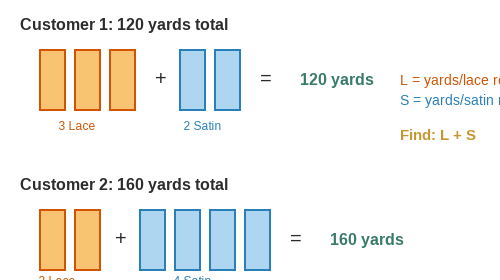
Let's map out what each customer bought to see the pattern clearly:
What This Problem Teaches
- Converting real-world scenarios into algebraic systems of equations
- Applying the elimination method to solve two-variable systems
- Recognizing when to manipulate equations to eliminate variables strategically
- Verifying solutions by substitution back into original constraints
- Understanding that some problems ask for combinations of variables, not individual values
Solution: Method 1 — The Elimination Approach
Step 1 — Define the variables
Let's call the number of yards on each type of ribbon roll:
S = yards per roll of satin ribbon
Step 2 — Write equations from the customer purchases
Customer 1 buys 3 lace rolls and 2 satin rolls for 120 yards total:
Customer 2 buys 2 lace rolls and 4 satin rolls for 160 yards total:
Step 3 — Use elimination to remove one variable
I'll eliminate S by making its coefficients opposites. The first equation has 2S and the second has 4S. If I multiply the first equation by 2, I'll get 4S in both equations:
6L + 4S = 240
Step 4 — Subtract to eliminate S
Now I subtract the second original equation from this new equation:
-(2L + 4S = 160)
________________
4L + 0S = 80
4L = 80
L = 20
Step 5 — Find S by substitution
Substituting L = 20 into the first original equation:
60 + 2S = 120
2S = 60
S = 30
Step 6 — Calculate the combined yardage
The question asks for one roll of each type combined:
Solution: Method 2 — Direct Linear Combination
Step 1 — Look for a shortcut to L + S
Instead of solving for L and S separately, let's see if we can manipulate our equations to directly find L + S. We have:
2L + 4S = 160
Step 2 — Find coefficients that give us equal L and S terms
We want to find constants that make the coefficients of L and S equal. If we multiply the first equation by 2 and the second by 1:
1(2L + 4S) = 1(160) → 2L + 4S = 160
Step 3 — Subtract to isolate terms
Subtracting the second from the first:
-(2L + 4S = 160)
________________
4L = 80
L = 20
Step 4 — Use substitution to find S
From the first original equation:
60 + 2S = 120
S = 30
Step 5 — Calculate the sum
Verification
Let's check our answer by substituting L = 20 and S = 30 back into both original equations:
Customer 2: 2L + 4S = 2(20) + 4(30) = 40 + 120 = 160 ✓
Both equations check out perfectly, confirming that lace rolls contain 20 yards each, satin rolls contain 30 yards each, and together they total 50 yards.
Common Pitfalls
How to Spot This Problem Type
Look for these telltale signs that signal a system of equations:
- "Different customers buy..." — Multiple scenarios with the same unknown quantities
- Two unknowns, two constraints — Each customer purchase gives you one equation
- "For a total of..." — The sum language that creates your equations
- "How much/many combined?" — Often asks for a sum rather than individual values
- Real-world context — Shopping, manufacturing, mixing — any scenario where quantities combine linearly
The Pattern Behind This
This problem follows the classic linear system pattern where two equations in two unknowns represent different constraints on the same situation:
a₁x + b₁y = c₁
a₂x + b₂y = c₂
In retail problems like this one, the pattern is:
- Variables: Individual item quantities/prices/measurements
- Coefficients: How many of each item in each transaction
- Constants: Total purchase amounts/measurements
- Question: Often asks for individual values or their combination
The elimination method works especially well when you can easily make coefficients match by simple multiplication, as we did by doubling the first equation to match the S coefficients.
Where This Shows Up in Real Life
Inventory management: Stores track mixed shipments to determine individual product quantities when only totals are known.
Recipe scaling: Professional kitchens use different ingredient combinations to reverse-engineer original amounts from multiple scaled recipes.
Manufacturing quality control: When products are bundled differently but total material usage is tracked, systems help identify per-unit material consumption.
What If?
Let L = yards per lace roll, S = yards per satin roll.
Customer 1: 4L + S = 110
Customer 2: L + 3S = 110
Multiply the second equation by 4: 4L + 12S = 440
Subtract the first equation: (4L + 12S) - (4L + S) = 440 - 110
This gives us: 11S = 330, so S = 30
Substitute into the first equation: 4L + 30 = 110
So 4L = 80 and L = 20
L + S = 20 + 30 = 50 yards
Check: 4(20) + 30 = 110 ✓ and 20 + 3(30) = 110 ✓
Answer: 50 yards combined
Let x = number of lace rolls, y = number of satin rolls
Total yards: 20x + 30y = 200
Total rolls: x + y = 5
From the second equation: x = 5 - y
Substitute: 20(5 - y) + 30y = 200
Expand: 100 - 20y + 30y = 200
100 + 10y = 200
10y = 100
y = 10
x = 5 - 10 = -5
This gives a negative answer, which is impossible.
No solution exists. You cannot make exactly 200 yards using exactly 5 rolls of these ribbon types.
Let L = lace, S = satin, V = velvet yards per roll
2L + S + V = 90 (Customer 1)
L + 2S + V = 100 (Customer 2)
L + S + 2V = 110 (Customer 3)
Subtract equation 1 from equation 2:
(L + 2S + V) - (2L + S + V) = 100 - 90
-L + S = 10, so S = L + 10
Multiply equation 1 by 2: 4L + 2S + 2V = 180
Subtract equation 3: (4L + 2S + 2V) - (L + S + 2V) = 180 - 110
3L + S = 70
Substitute S = L + 10 into 3L + S = 70:
3L + (L + 10) = 70
4L = 60, so L = 15
S = L + 10 = 15 + 10 = 25
From equation 1: 2(15) + 25 + V = 90
30 + 25 + V = 90, so V = 35
Answer: Lace = 15, Satin = 25, Velvet = 35 yards per roll
If L + S = 50 and L = 20, then S = 30 yards per roll
New customer: 5 lace + 3 satin = 5(20) + 3(30) = 100 + 90 = 190 yards
But the problem states 280 yards. Let's check if this is consistent:
280 ≠ 190, so there's an inconsistency in the given information.
If 5L + 3S = 280 and L = 20:
5(20) + 3S = 280
100 + 3S = 280
3S = 180, so S = 60 yards per roll
Using S = 60: 2(20) + 6(60) = 40 + 360 = 400 yards
The given information is inconsistent with our original problem. If the new customer really got 280 yards, then satin rolls must contain 60 yards each (not 30), and 2 lace + 6 satin would be 400 yards.
Frequently Asked Questions
2026-11-28