




Finding Shortest Distance with Pythagorean Theorem
What This Problem Teaches
- Recognizing when perpendicular movements form a right triangle
- Applying the Pythagorean theorem to find direct distances
- Simplifying square roots by factoring out perfect squares
- Understanding the difference between path distance and straight-line distance
- Converting between exact radical form and decimal approximations
Picture This
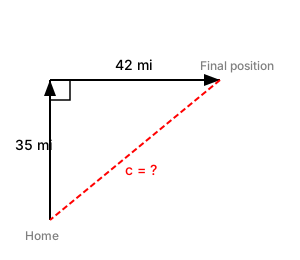
Mark's path creates a right triangle. The shortest distance home is the hypotenuse.
Solution: Method 1 — The Direct Pythagorean Approach
Step 1 — Identify the right triangle
Mark's path forms a perfect right triangle. He drives 35 miles North, then 42 miles West. Since North and West are perpendicular directions, these two segments are the legs of a right triangle, and the shortest distance home is the hypotenuse.
Step 2 — Set up the Pythagorean theorem
For any right triangle, the Pythagorean theorem states that c² = a² + b², where c is the hypotenuse and a and b are the legs.
Step 3 — Calculate the squares
Let's compute each term:
35² = 35 × 35 = 1,22542² = 42 × 42 = 1,764
Step 4 — Add and take the square root
Step 5 — Simplify the square root
To simplify √2,989, we need to factor it. Let's check if it has any perfect square factors:
2,989 ÷ 49 = 61(since 49 = 7²)- So
2,989 = 49 × 61 = 7² × 61
For a decimal approximation: √61 ≈ 7.81, so c ≈ 7 × 7.81 = 54.67 miles.
Solution: Method 2 — Recognition of the 7-Factor Pattern
Step 1 — Notice the common factor
Both legs are multiples of 7:
35 = 7 × 542 = 7 × 6
Step 2 — Factor out the 7
We can rewrite the Pythagorean theorem as:
Step 3 — Take the square root directly
This method is faster when you recognize that both legs share a common factor, allowing you to factor before calculating large squares.
Verification
Let's verify our answer by substituting back into the Pythagorean theorem:
We can also check reasonableness: Mark's total path distance is 35 + 42 = 77 miles. The straight-line distance should be shorter, and indeed 54.7 < 77. Additionally, the hypotenuse should be longer than either leg, and 54.7 > 42 > 35 ✓.
Common Pitfalls
Some students calculate
35 + 42 = 77 miles. This gives the total path distance, not the straight-line distance. The problem asks for the shortest distance, which requires the Pythagorean theorem.
Calculating
35² + 42² = 2,989 and stopping there. Remember that c² = 2,989 means c = √2,989, not c = 2,989.
Writing
√2,989 = √(49 × 61) = 49√61 instead of 7√61. Only perfect squares can be taken out of the radical as their square root: √49 = 7.
The Math Beneath the Surface
This problem demonstrates the fundamental principle that the shortest distance between two points is a straight line. When you have perpendicular movements (North-South and East-West), they form the legs of a right triangle, and the Pythagorean theorem gives you that straight-line distance.
The general formula for this type of problem is:
This same mathematical structure appears in:
- GPS navigation systems calculating "as the crow flies" distances
- Vector addition in physics (combining perpendicular forces)
- Distance formula in coordinate geometry:
d = √[(x₂-x₁)² + (y₂-y₁)²]
Beyond the Textbook
This calculation appears constantly in real-world navigation:
- Aviation: Pilots calculate direct flight paths when air traffic control allows deviation from standard routes
- Emergency services: Fire departments and ambulances use straight-line distances to estimate response times
- Delivery logistics: Companies like Amazon use these calculations to optimize drone delivery routes
How to Spot This Problem Type
Look for these key phrases and setups:
- "Due North," "due South," "due East," or "due West" — these signal perpendicular movements
- "Shortest distance" or "direct distance" — this asks for the hypotenuse, not the path length
- Any movement in two perpendicular directions followed by a question about returning to the starting point
- "As the crow flies" — another way of asking for straight-line distance
If you see a problem involving two perpendicular movements and a question about distance, you're likely looking at a Pythagorean theorem problem.
Try These Variations
We know the hypotenuse (65 miles) and one leg (35 miles). Using the Pythagorean theorem: 65² = 35² + w² where w is the westward distance.
4225 = 1225 + w²
w² = 4225 - 1225 = 3000
w = √3000 = √(100 × 30) = 10√30 ≈ 54.8 miles
√(35² + (10√30)²) = √(1225 + 3000) = √4225 = 65 ✓
Answer: Mark drove 10√30 ≈ 54.8 miles West.
Net North movement: 35 - 20 = 15 miles North
Net West movement: 42 miles West
The net displacement forms a right triangle with legs of 15 and 42 miles.
c² = 15² + 42² = 225 + 1764 = 1989
1989 = 9 × 221 = 9 × 13 × 17c = √1989 = 3√221 ≈ 44.6 miles
(3√221)² = 9 × 221 = 1989 = 15² + 42² ✓
Answer: 3√221 ≈ 44.6 miles
Sarah's path forms a right triangle with legs of 24 miles (East) and 32 miles (North).
Both distances are multiples of 8: 24 = 8 × 3 and 32 = 8 × 4. This suggests a 3-4-5 triangle scaled by 8.
c² = 24² + 32² = 576 + 1024 = 1600
c = √1600 = 40 miles
Indeed, this is a 3-4-5 triangle scaled by 8: 8 × 5 = 40 ✓
Answer: 40 miles
North leg: 35 ÷ 50 = 0.7 hours
West leg: 42 ÷ 60 = 0.7 hours
Total: 0.7 + 0.7 = 1.4 hours
From the original problem: d = 7√61 ≈ 54.67 miles
Time = 54.67 ÷ 55 ≈ 0.994 hours
Time saved = 1.4 - 0.994 = 0.406 hours
0.406 × 60 ≈ 24.4 minutes
Answer: Mark saves approximately 24.4 minutes
Frequently Asked Questions
2026-07-28