




Comparing Simple and Compound Interest
What You Will Learn
- How to set up and solve equations where simple and compound interest produce equal returns
- The relationship between simple interest rates and compound interest rates for equivalent outcomes
- Why simple interest requires a higher rate than compound interest to achieve the same final amount
- Practical applications of interest rate comparisons in financial planning
- Working backwards from equal outcomes to find unknown parameters
Solution: Method 1 — Calculate and Equate
Step 1 — Calculate Colin's compound interest amount
Since Colin's investment details are completely known, we can find his final amount using the compound interest formula:
A = 16000(1 + 0.03)^2
A = 16000(1.03)^2
A = 16000(1.0609)
A = $16,974.40
Step 2 — Set up Sam's simple interest equation
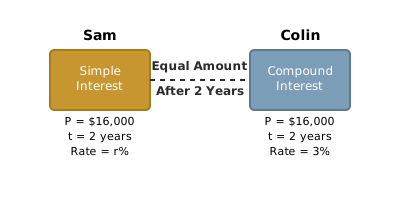
For simple interest, the formula is A = P(1 + rt). Since Sam must have the same final amount as Colin:
Note that we use r as the decimal form of the percentage (so r% = r/100 in decimal form, but we'll solve for the percentage directly).
Step 3 — Solve for r
Divide both sides by 16000:
1 + 2r = 1.06090
2r = 0.06090
r = 0.03045
Step 4 — Convert to percentage
Since the problem asks for r%, we convert:
Solution: Method 2 — Interest Earned Comparison
Step 1 — Find Colin's total interest earned
Instead of working with final amounts, we can compare the interest earned by each person:
Colin's interest earned = $16,974.40 - $16,000 = $974.40
Step 2 — Set up Sam's interest equation
For simple interest, Interest = Prt. Since Sam earns the same total interest:
Step 3 — Equate the interest amounts
Setting Sam's interest equal to Colin's:
r = 974.40 ÷ 320
r = 3.045%
Verification
Let's check our answer by calculating both final amounts:
= 16000(1 + 0.0609)
= 16000(1.0609)
= $16,974.40 ✓
Colin's amount = 16000(1.03)^2
= 16000(1.0609)
= $16,974.40 ✓
Both amounts are equal, confirming our answer is correct.
Does This Seem Reasonable?
Our answer makes intuitive sense. Colin's compound interest rate is 3%, and we found Sam needs 3.045% simple interest to match it. This small difference tells us something important:
Key Insight: Simple interest requires a slightly higher rate than compound interest to achieve the same return over a given period. This happens because compound interest earns "interest on interest" while simple interest only earns on the principal.
The difference is small here (0.045%) because we're only looking at 2 years. Over longer periods, the gap would be much larger.
Common Pitfalls
✗ Using the wrong formula for compound interest:
A = P(1 + rt) = 16000(1 + 0.03 × 2) = $16,960
Why it's wrong: This is actually the simple interest formula! Compound interest requires the exponent: A = P(1 + r)^t.
✗ Forgetting to convert between percentage and decimal:
Setting up: 16000(1 + 2r) = 16974.40 and solving to get r = 0.03045, then reporting "r = 0.03045%"
Why it's wrong: If you use r as a decimal in the formula, then r = 0.03045 means the percentage is 3.045%, not 0.03045%.
✗ Mixing up who gets which type of interest:
Calculating 16000(1 + 0.03 × 2) for Sam and 16000(1 + r)^2 for Colin
Why it's wrong: The problem clearly states Sam gets simple interest (r%) and Colin gets compound interest (3%). Double-check which person gets which type.
The Underlying Pattern
This problem illustrates a fundamental relationship in finance:
P(1 + r_simple × t) = P(1 + r_compound)^t
Solving for the simple rate:
r_simple = [(1 + r_compound)^t - 1] ÷ t
In our problem: r_simple = [(1.03)² - 1] ÷ 2 = [1.0609 - 1] ÷ 2 = 0.03045 = 3.045%
This formula works for any time period and shows why simple interest rates must be higher: they need to "catch up" to the compounding effect by earning more per year on the principal alone.
Real Applications
Investment comparison: When choosing between a simple interest bond and a compound interest savings account, this calculation helps determine equivalent rates.
Loan analysis: Some loans quote "simple" interest while others compound. Understanding the equivalent rates helps borrowers make informed decisions.
Financial planning: This type of calculation appears in retirement planning when comparing different types of accounts with varying compounding schedules.
Four "What-If?" Problems
Colin: A = 16000(1.03)² = 16000(1.0609) = $16,974.40
Sam: 20000(1 + 2r) = 16974.40
1 + 2r = 16974.40 ÷ 20000 = 0.848722r = -0.15128r = -0.07564 = -7.564%
This is impossible! A negative interest rate would mean Sam loses money. When Sam invests more principal ($20,000 vs $16,000), no positive simple interest rate can make his final amount equal Colin's smaller final amount.
Sam's amount = Colin's amount16000(1 + 0.04t) = 16000(1.03)^t
Divide by 16000: 1 + 0.04t = (1.03)^t
At t = 0: 1 = 1 ✓ (both start equal)
At t = 10: 1.4 ≈ 1.344 (simple > compound)
At t = 20: 1.8 ≈ 1.806 (very close!)
This requires logarithms to solve exactly, but the answer is approximately 20 years. After this point, simple interest (higher rate) overtakes compound interest permanently.
Formula: A = P(1 + r/n)^(nt) where n = 12A = 16000(1 + 0.03/12)^(12×2)A = 16000(1.0025)^24 = 16000(1.0617) = $16,987.84
16000(1 + 2r) = 16987.84
1 + 2r = 16987.84 ÷ 16000 = 1.06172r = 0.0617r = 0.03085 = 3.085%
Sam: 16000(1 + 0.03085 × 2) = $16,987.20
Answer: r = 3.085% (slightly higher due to monthly compounding effect)
A = 16000(1 + 0.032 × 2) = 16000(1.064) = $17,024
16000(1 + c)² = 17024
(1 + c)² = 17024 ÷ 16000 = 1.0641 + c = √1.064 = 1.0315c = 0.0315 = 3.15%
Colin: 16000(1.0315)² = 16000(1.064) = $17,024 ✓
Answer: c = 3.15%
Frequently Asked Questions
2026-08-02