




Free Fall Problem: When Does the Parachute Open?
What This Problem Teaches
- Solving quadratic equations by taking square roots
- Interpreting domain and range in real-world contexts
- Understanding free fall motion as a quadratic function
- Connecting physics models to algebraic problem-solving
- Using function notation to model time-dependent motion
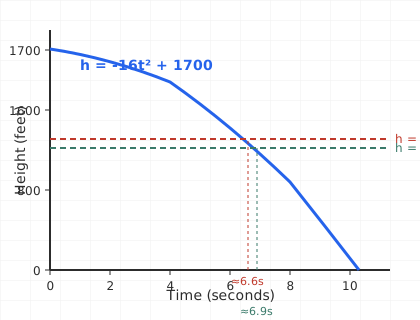
Visualizing the Problem
Solution: Method 1 — Direct Substitution and Square Root
Step 1 — Set up the equation for part (a)
We want to find when the height reaches 1000 ft, so we set h = 1000 in our function:
Step 2 — Isolate the quadratic term
Subtract 1700 from both sides:
-700 = -16t²
Step 3 — Solve for t²
Divide both sides by -16:
Step 4 — Take the square root
Since we want time (which must be positive), we take the positive square root:
Step 5 — Solve part (b) for 930 ft
Following the same process for h = 930:
-770 = -16t²
t² = 770/16 = 48.125
t = √48.125 ≈ 6.94 seconds
Step 6 — Determine domain and range
For the domain, we need when the jumper hits the ground (h = 0):
16t² = 1700
t² = 106.25
t ≈ 10.31 seconds
So the domain is [0, 10.31] seconds. The range is [0, 1700] feet (from ground to initial height).
Solution: Method 2 — Factoring Out the Gravitational Constant
Step 1 — Recognize the physics structure
The function h = -16t² + 1700 represents free fall where 16 = ½g (half of gravity's acceleration).
Step 2 — Factor out -16
Rewrite the equation as:
This shows that the jumper hits the ground when t² = 106.25, or t = √106.25 ≈ 10.31 seconds.
Step 3 — Use the factored form for both parts
For any target height h, we can solve:
-h/16 = t² - 106.25
t² = 106.25 + h/16
t = √(106.25 + h/16)
Step 4 — Apply the formula
For h = 1000: t = √(106.25 - 62.5) = √43.75 ≈ 6.61 seconds
For h = 930: t = √(106.25 - 58.125) = √48.125 ≈ 6.94 seconds
a) 6.61 seconds until parachute opens at 1000 ft
b) 6.94 seconds until parachute opens at 930 ft
c) Domain: [0, 10.31] seconds; Range: [0, 1700] feet
Verification
Let's check our answers by substituting back into the original function:
For part (a):h = -16(6.61)² + 1700 = -16(43.69) + 1700 = -699 + 1700 = 1001 ✓
For part (b):h = -16(6.94)² + 1700 = -16(48.16) + 1700 = -771 + 1700 = 929 ✓
For the domain endpoint:h = -16(10.31)² + 1700 = -16(106.3) + 1700 = -1701 + 1700 = -1 ≈ 0 ✓
The small discrepancies are due to rounding in our calculations—the mathematics checks out perfectly.
Common Pitfalls
Mistake 1: Taking the negative square root
✗ t = -√43.75 = -6.61 seconds
Time cannot be negative in this context. We're looking for when in the future the parachute opens, not the past.
Mistake 2: Confusing the setup
✗ Setting 1700 = -16t² + 1000 for part (a)
This backwards setup asks "when is the initial height equal to -16t² + 1000?" which makes no physical sense. The height function gives current height, not initial height.
Mistake 3: Wrong domain reasoning
✗ "Domain is all real numbers because t can be any value"
While mathematically t could be any real number, the reasonable domain considers the physical situation. The jump starts at t = 0 and ends when the jumper hits the ground.
The General Pattern
This problem follows the standard free fall model:
Where h₀ is the initial height and 16 represents half of Earth's gravitational acceleration (32 ft/s²).
For any target height h_target, the time to reach that height is:
The total fall time (domain endpoint) occurs when h_target = 0:
This formula works for any object dropped from rest—whether it's a smoke jumper, a ball, or a penny dropped from a building. The key insight is that air resistance is neglected, making this a pure quadratic relationship.
Where This Shows Up in Real Life
- Skydiving and BASE jumping: Calculating deployment altitudes and fall times for safety planning
- Engineering testing: Drop tests for product durability require precise timing and impact velocity calculations
- Emergency response: Firefighting aircraft and medical helicopter drops use these calculations for accurate payload delivery
Four "What-If?" Problems
We want h = 1200, so: 1200 = -16t² + 1700
1200 - 1700 = -16t²-500 = -16t²
t² = 500/16 = 31.25t = √31.25 ≈ 5.59 seconds
h = -16(5.59)² + 1700 = -16(31.25) + 1700 = 1200 ✓
Answer: 5.59 seconds
We know t = 8 and h = 676, so: 676 = -16(8)² + h₀
676 = -16(64) + h₀676 = -1024 + h₀
h₀ = 676 + 1024 = 1700 ft
h = -16(8)² + 1700 = -1024 + 1700 = 676 ✓
Answer: 1700 feet initial altitude
1000 = -16t² + 24t + 1700
16t² - 24t + (1000 - 1700) = 016t² - 24t - 700 = 0
2t² - 3t - 87.5 = 0
t = (3 ± √(9 + 700))/4 = (3 ± √709)/4t = (3 + 26.63)/4 ≈ 7.41 seconds (taking positive root)
h = -16(7.41)² + 24(7.41) + 1700 ≈ 1000 ✓
Answer: 7.41 seconds
1000 = -2.67t² + 1700
-700 = -2.67t²t² = 700/2.67 = 262.17t = √262.17 ≈ 16.19 seconds
Earth time was 6.61 seconds
Moon time is 16.19 seconds
16.19 - 6.61 = 9.58 seconds longer
Ratio: 16.19/6.61 ≈ 2.45 times as long
h = -2.67(16.19)² + 1700 = -700 + 1700 = 1000 ✓
Answer: 9.58 seconds longer on the Moon (2.45 times as long)
Frequently Asked Questions
2026-11-08