




Student-Teacher Ratio: System of Equations with Two Conditions
What This Problem Teaches
- Converting ratio relationships into algebraic expressions
- Setting up equations when quantities change but their relationship is constrained
- Solving rational equations by cross-multiplication
- Understanding that ratios give proportional relationships, not absolute values
- Verifying solutions by checking both the original and modified scenarios
Visualizing the Situation
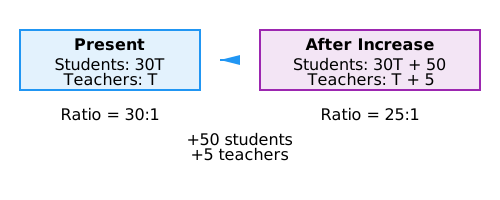
This diagram shows how the quantities change while maintaining specific ratio relationships in both scenarios.
Solution: Method 1 — Variable Substitution with Ratios
Step 1 — Define the variable
Let T represent the present number of teachers.
Step 2 — Express current students using the ratio
Since the current ratio is 30 to 1, for every 1 teacher there are 30 students. With T teachers, there are 30T students currently.
Step 3 — Set up the equation for the new scenario
After the increases:
- Students:
30T + 50 - Teachers:
T + 5 - New ratio: 25 to 1
Step 4 — Cross multiply and solve
Cross multiplying gives us:
Step 5 — Isolate the variable
Subtract 25T from both sides:
Solution: Method 2 — System of Equations Approach
Step 1 — Define two variables
Let S = current number of students and T = current number of teachers.
Step 2 — Write the first equation from the current ratio
The current ratio is 30:1, so:
Step 3 — Write the second equation from the new ratio
After the increases, the ratio is 25:1:
Step 4 — Substitute and solve
Substitute S = 30T into the second equation:
Step 5 — Find the number of students
Using S = 30T:
Verification
Check the current ratio
With 15 teachers and 30 × 15 = 450 students:
Check the ratio after increases
After adding 50 students and 5 teachers:
- Students:
450 + 50 = 500 - Teachers:
15 + 5 = 20
Both conditions are satisfied, confirming our answer.
Common Pitfalls
Some students let
T = 30 (thinking the ratio means there are 30 teachers), or let S = 30 (confusing students with the ratio number). Remember: the ratio 30:1 means 30 students per teacher, not 30 total of anything.
Writing
(30T + 50)/(T + 5) = 30/25 instead of 25/1. The new ratio is 25 to 1, meaning 25 students per teacher, not a comparison between the old and new ratios.
Writing
30T + 50 = 25T + 5 instead of 30T + 50 = 25T + 125. When cross multiplying with 25/1, you must multiply the entire expression (T + 5) by 25.
The Underlying Pattern
This problem follows the general structure for changing ratios:
a:b to c:d after adding quantities Δx and Δy, and you know one original quantity in terms of a variable, set up:
The key insight is that ratios constrain the relationship between quantities, not their absolute values. A 30:1 ratio could represent 30 students and 1 teacher, or 300 students and 10 teachers, or any multiple. The additional constraint (how the ratio changes when specific amounts are added) pins down the exact values.
This type of problem appears frequently in mixture problems, population dynamics, and any scenario where proportional relationships change due to external additions or removals.
Where This Shows Up in Real Life
- Staffing analysis — HR departments use similar calculations to maintain optimal staff ratios when hiring
- Recipe scaling — Adjusting ingredient ratios when adding specific amounts to achieve a target taste balance
- Investment portfolios — Rebalancing asset ratios after adding new investments to maintain desired risk profiles
Four "What-If?" Problems
From the original problem, we found there are currently 15 teachers.
With a 30:1 ratio and 15 teachers: Students = 30 × 15 = 450
After increases: 450 + 50 = 500 students, 15 + 5 = 20 teachers
New ratio: 500/20 = 25/1 ✓
The present number of students is 450.
Let T = present number of teachers. Then present students = 30T
(30T + 60)/(T + 4) = 28/1
30T + 60 = 28(T + 4)
30T + 60 = 28T + 112
2T = 52
T = 26
Current: 780/26 = 30/1 ✓
After: (780+60)/(26+4) = 840/30 = 28/1 ✓
The present number of teachers is 26.
Let School C have S students and T teachers.
Total students: 450 + 240 + S = 690 + S
Total teachers: 15 + 12 + T = 27 + T
(690 + S)/(27 + T) = 24/1
690 + S = 24(27 + T) = 648 + 24T
S = 24T - 42
School C's ratio: S/T = (24T - 42)/T = 24 - 42/T
For whole numbers, if T = 6, then S = 102
School C's ratio: 102/6 = 17:1
School C needs a ratio of 17:1 (example: 102 students, 6 teachers).
Students remain: 450
Let x = number of teachers to hire
New number of teachers: 15 + x
450/(15 + x) = 22/1
450 = 22(15 + x)
450 = 330 + 22x
120 = 22x
x = 120/22 = 60/11 ≈ 5.45
Since we need whole teachers, hire 6 teachers.
Check: 450/21 ≈ 21.43:1 (slightly better than target)
With 5 teachers: 450/20 = 22.5:1 (slightly worse than target)
They must hire 6 teachers to achieve approximately the target ratio.
Frequently Asked Questions
2026-10-20